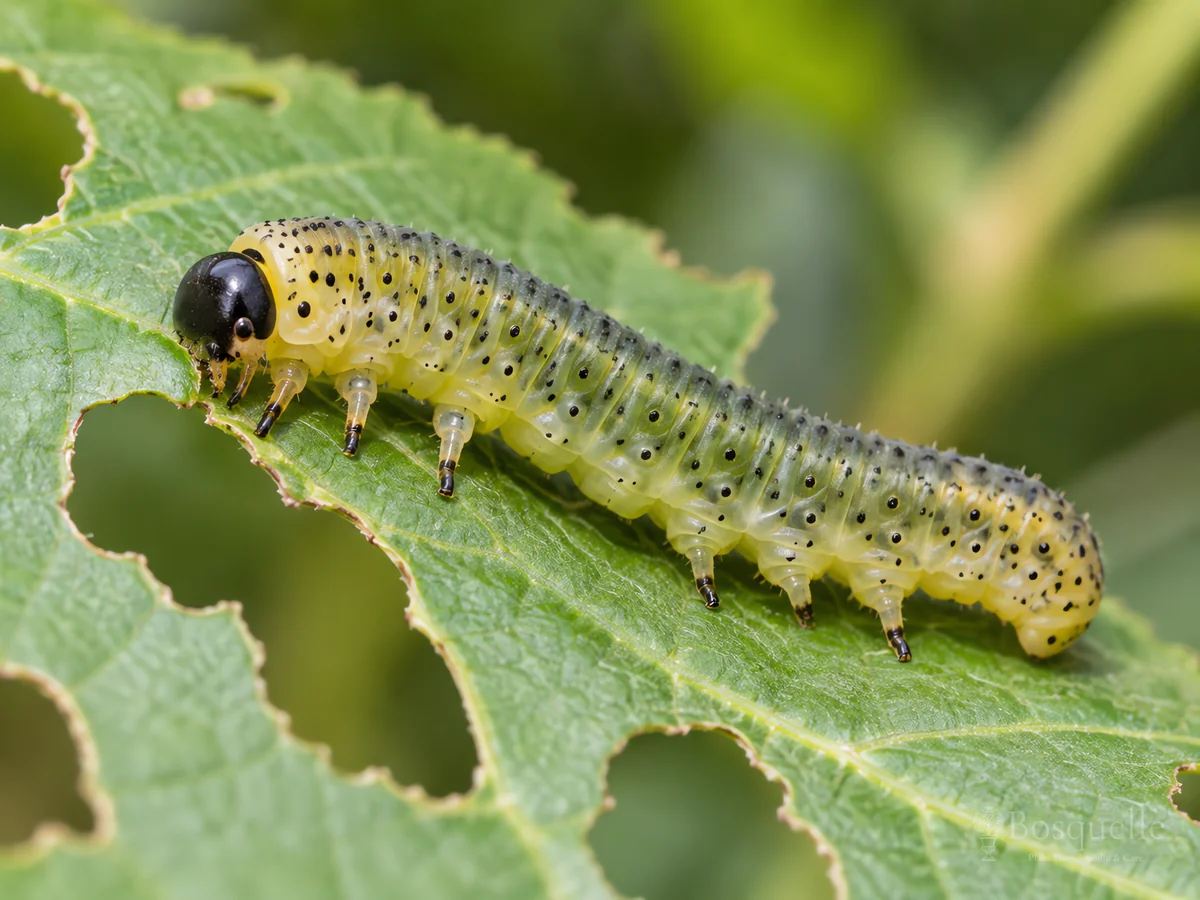
Pick the group of worms into a bucket of soapy water, or knock them off with a hard hose stream, because they do not climb back onto the plant. Count the fleshy extra legs behind the three true pairs: six or more means this is a sawfly, related to bees and wasps, so a Bt spray made for moth caterpillars will not kill them. Insecticidal soap or horticultural oil can finish young larvae if the spray actually wets the insect, and on a rose that means the underside of the leaf.
People still say saw fly, then sawfly. The adult is a stout, thick-waisted wasp, usually under half an inch, and it does not sting. The female saws a slit in a leaf or needle and lays eggs there. The larva is the one you find: smooth, often in a group, often rearing into an S when you bump the branch. Each kind stays on its own plant. Rose slugs stay on roses. Pine sawflies stay on pine. A healthy mature tree can wear the chew. A young pine that is going bare cannot wait.
Pick them into soapy water; skip Bt
Knock the cluster into soapy water, crush them on the leaf, or hit them with a hard hose stream, because small larvae cannot climb back. Most sawflies feed in a group, so one chewed branch is often the whole outbreak on that plant. On a rose, flip the leaf first, because roseslugs scrape the underside and leave a windowpane that looks empty from above. On pine, the gray-green worms sit in a cluster on last year's needles, so wipe that cluster into the bucket before you reach for a bottle.
Bt, the Bacillus product sold for moth and butterfly caterpillars, does not kill this insect. Sawflies belong with bees and wasps, not moths. If a caterpillar spray sat on a chewed rose and nothing died, count the extra legs before you buy a second bottle. The same miss shows up on pine, dogwood, and birch whenever the worms rear into an S in a group.
Labeled insecticidal soap or horticultural oil can finish young larvae, about half grown or smaller, because the spray has to hit the body. Soap does little once they are large, so those you pick. Repeat if live worms are still on the plant, since dried soap does not keep working. Skip kitchen dish liquid on the foliage. It can burn the leaf and has no plant label. Spinosad is a later option while they are still feeding, and not on open bloom, because it can hurt bees for hours after it dries. Skip the brand aisle. Read a label that names sawfly larvae on that plant.
- Confirm. Count the fleshy extra legs. Six or more, often an S-curve in a group, means sawfly. A silk tent in a crotch is a moth, so that insect takes a different bottle.
- Pick them into soapy water, or crush them, or hose them off. They do not climb back. On a rose, flip the leaf and hit the underside.
- Soap or oil only while they are still small, and only where the spray wets the insect. Large larvae shrug that off, so pick those. Repeat if live worms remain.
- Wait on a healthy mature tree if feeding is already done. Treat a young pine, or a small rose that is going bare, while the larvae are still small.
How do I get rid of sawfly larvae?
Pick them into soapy water, crush them, or knock them off with a hard hose stream. They do not climb back. Soap or horticultural oil only while they are still small, and the spray has to wet the insect. Skip Bt. A healthy mature tree can wear the chew.
Does Bt kill sawflies?
No. Bt is made for moth and butterfly caterpillars. Sawflies are related to bees and wasps. Count the extra legs. Six or more means this insect, and that bottle will not finish it.
A healthy tree can wear the chew; a young pine cannot wait
A healthy, well-established deciduous tree or shrub usually lives through one season of this feeding. The chewed leaves do not green up again, so the plant looks rough until they drop, and then new growth covers it. If the worms are already about half grown or larger, they have done most of the eating. A spray then does not rewind the holes. Birds can have what is left.
Young pines, newly planted shrubs, and a small rose that is going bare are a different judgment. Some pine sawflies eat only last year's needles and leave the new flush, so the tree usually lives, even when it looks stripped. Others eat new and old needles and can kill a small pine if they take the whole crown. European pine sawfly on mugo and Scots pine is the common old-needle kind. Redheaded pine sawfly on a young jack or red pine is the one that can finish a small tree. Pick those clusters while they are still small. A rose with windowpane leaves still blooms. Heavy skeletonizing can cut the next flush of flowers, but it does not kill an otherwise healthy bush.
You often find the damage after the larvae have already dropped to the soil to pupate. A spray then misses them. Lightly raking the soil under a plant that was stripped this year exposes some cocoons to birds and weather. It is not a finish by itself. Check the same plant next spring while the larvae are still small, because that is when pick and soap still work.
Will sawflies kill my tree?
A healthy mature deciduous tree usually lives. Young pines, newly planted shrubs, and a small plant that is stripped can be stunted or killed. Pick those clusters while the larvae are still small. Chewed leaves do not green up again.
Will rose slugs kill my roses?
An otherwise healthy rose usually lives. The leaves look lacy and brown, and a heavy year can cut the next flush of flowers. Pick or soap the undersides while the larvae are small. The old leaves stay ugly until they drop.
Should I spray after the worms have dropped?
No. If the larvae have already left to pupate in the soil, a spray on empty leaves misses them. Rake lightly under the plant if you want, then watch next spring while they are still small.
Six extra legs and an S-curve means sawfly, not a caterpillar
Count the fleshy extra legs on the abdomen, skip the last pair at the tail, and you have the insect: six or more is a sawfly, five or fewer is a moth or butterfly caterpillar. Both kinds have three pairs of true legs just behind the head. The adult is easy to miss, because it looks like a small wasp with a broad waist, not a pinched one, and it does not sting. Sawfly larvae are usually smooth, under an inch when full grown, and many rear together into an S when you bump the branch. Slug-like kinds on rose and pear have tiny extra legs that are easy to miss, so use the plant and the scrape, not a fuzzy caterpillar guess.
| Where you see it | What it is | Try this |
|---|---|---|
| Group of smooth worms; six extra legs; they rear into an S | Sawfly | Pick into soapy water; skip Bt |
| Windowpane or lace on a rose underside; slimy green worm | Roseslug, a sawfly | Flip the leaf; pick or soap the underside |
| Gray-green cluster on last year's pine needles | Pine sawfly | Wipe the cluster into soapy water |
| White powdery worms on dogwood; then yellow and black | Dogwood sawfly | See dogwood sawfly — same pick, that shrub |
| Olive-green slimy film on pear or cherry | Pear sawfly | See pear sawfly — not a true slug |
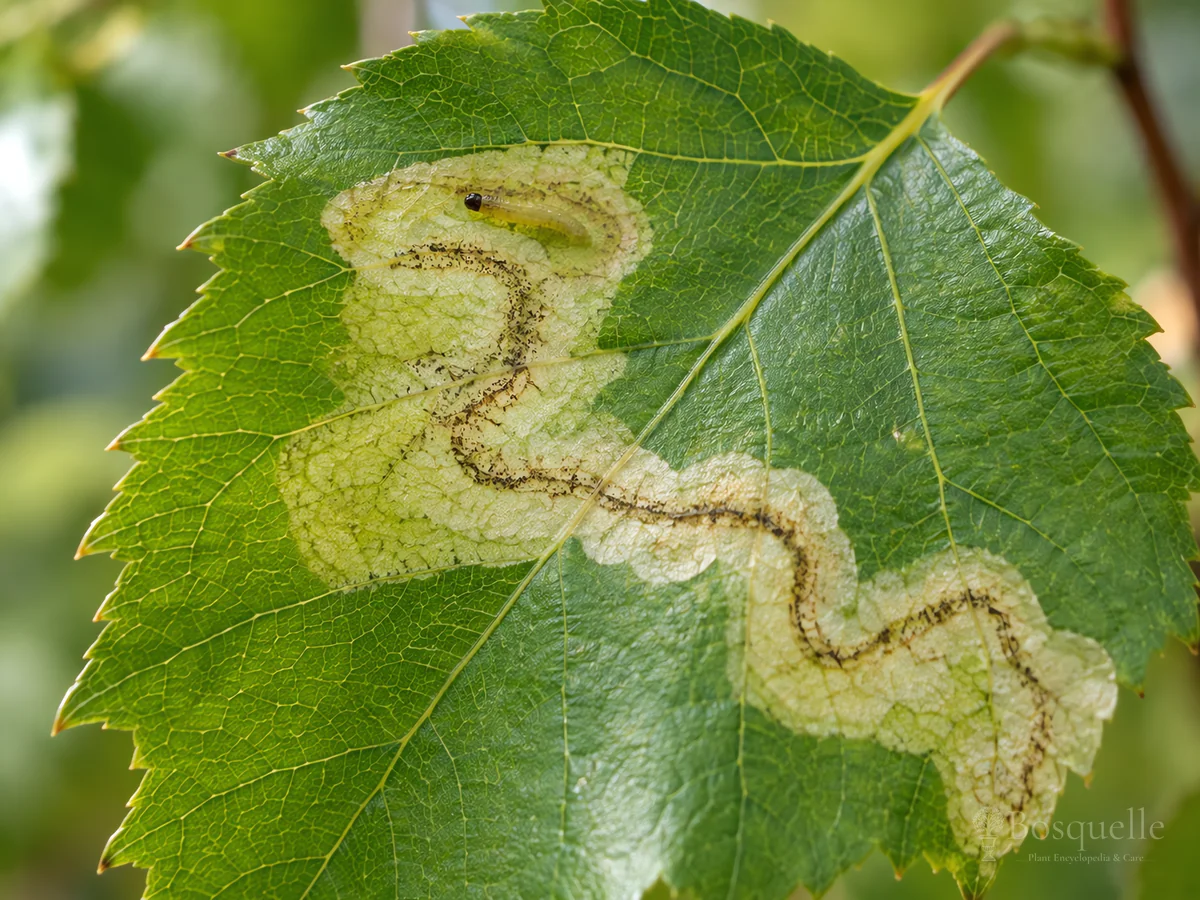
| Brown blotch inside a birch leaf in spring | Birch leafminer, a sawfly | See birch leafminer — not this pick |
| Silk tent in a crotch, or a hairy caterpillar with five extra legs or fewer | Moth caterpillar | See tent caterpillar — Bt can work on that insect |
| No legs, slime on the surface, hides by day | True slug | See slug — not this sawfly |
What do sawfly larvae look like?
They look like smooth caterpillars, usually under an inch, often in a group. Many rear into an S when you bump the branch. Count the fleshy extra legs: six or more. The adult is a small thick-waisted wasp that does not sting.
Windowpane on a rose is this insect; a silk tent is not
A slimy green worm scraping the underside of a rose leaf is a roseslug. That is a sawfly, not a true slug, because it has legs. A true slug has none, leaves slime, and hides by day. See slug if you have slime and no legs. Do not run a beer trap as the finish on a roseslug. The rose still takes the same pick, hose, and underside soap as the rest of this insect.
An olive-green slimy film on pear, cherry, or hawthorn is pear sawfly, also called pear slug. See pear sawfly. White powdery worms on dogwood, then yellow and black, are dogwood sawfly. A group of yellow-green worms with black heads on a birch leaf edge is dusky birch sawfly. Those are the same pick-and-skip-Bt job on a named plant. Do not copy a second calendar from those pages onto a rose.
A brown blotch between the skins of a birch leaf in spring is birch leafminer. That insect is also a sawfly, but it lives inside the leaf, so this pick misses it. See birch leafminer. A silk tent in a crotch, a hairy caterpillar, or a looper with five extra legs or fewer is a moth. Bt can work on that insect. See tent caterpillar, gypsy moth, or fall cankerworm. Do not paste their Bt spray onto a sawfly group.
Are rose slugs the same as slugs?
No. A roseslug is a sawfly larva. It has legs and scrapes a windowpane on the underside of a rose leaf. A true slug has no legs and leaves slime. See slug if you have slime and no legs. The rose still takes pick, hose, and underside soap.
Are pear slugs the same insect?
Pear slug is another sawfly, with a slimy olive film on pear and cherry. Same extra-leg count, same skip-Bt rule. See pear sawfly for that fruit-tree job. Do not treat it as a true slug.
Is a brown blotch on birch this insect?
A blotch between the skins of a birch leaf is birch leafminer, still a sawfly, but it lives inside the leaf. This pick misses it. See birch leafminer. A group on the leaf edge is dusky birch sawfly.
Related reading
- Dogwood sawfly — white powder, then yellow-and-black larvae on dogwood, not a moth.
- Dusky birch sawfly — yellow-green group on a birch leaf edge, rearing into an S.
- Pear sawfly — slimy olive film on pear and cherry, not a true slug.
- Birch leafminer — blotch inside a birch leaf, a sawfly you cannot pick off the surface.
- Slug — no legs, slime on the surface, not a roseslug.
- Tent caterpillar — silk tent and a true caterpillar; Bt can work on that insect.
- How to grow roses — site and water for a bush that takes roseslug on the underside.
FAQ
Do sawflies sting people or pets?
The adult looks like a small wasp, but it does not sting. The larva eats leaves and needles, not people. Handle them with gloves if the plant itself can irritate skin, such as some dogwoods.
Does dish soap kill sawfly larvae?
A labeled insecticidal soap can kill young larvae on contact. Kitchen dish liquid can burn the leaf and has no plant label. Use the labeled soap, and wet the insect. Large larvae shrug soap off, so pick those.
Does neem oil get rid of sawflies?
A labeled oil or neem has to wet the larva, same as horticultural oil. It is slower than picking a cluster you can reach. Skip it on open bloom if bees are working that plant.
Related pests



Related diseases




Updated: Reviewed by Bosquelle Editors