
Pick the cluster off the leaf edge and drop it in soapy water. Those yellow-green bodies with black heads rear into an S when you touch the leaf. Count the extra fleshy legs. Six or more means this is a sawfly, so a Bt spray will not work. A healthy birch can wear a chewed branch.
Dusky birch sawfly is a native sawfly, Croesus latitarsus. Lists also call it Nematus latitarsus. Some gardeners say river birch sawfly. The adult is a black, wasp-like insect about half an inch long, and it does not sting. The larva does the chewing. It feeds in a group along the edge of a birch leaf, often on river birch or gray birch, and leaves the midrib when it is young.
- Pick the cluster into soapy water, or prune that leaf.
- Count the extra legs before you buy Bt.
- Skip a spray once the larvae are about an inch long.
Pick the cluster off the leaf edge and drop it in soapy water
They feed in a clump of about ten to twenty. One pass on that leaf finishes that group. Pluck them into a pail of soapy water, crush them on the leaf, or prune the chewed leaf and destroy it. A hard water spray will knock them off if you can reach the branch. On a small birch you can see the whole job. On a tall river birch, the clusters you can reach are the ones worth picking.
If you cannot reach them, you often found them late. They are already large, the branch is already stripped, and they will drop into the soil soon to pupate. Killing them then does not put the missing leaves back. Watch that tree again in May and in mid-summer for the next hatch, and pick while the larvae are still small.
How do I get rid of dusky birch sawfly?
Pick the cluster off the leaf edge and drop it in soapy water, or prune that leaf. Skip a spray once the larvae are about an inch long. Bt will not work.
They rear into an S; six extra legs means sawfly, not a caterpillar
Touch the leaf. The larvae swing their rear ends away from the edge together and make an S. That is the confirm. Young larvae start dark gray. As they grow they turn greenish-gray, then yellow-green, with a shiny black head and black blotches on the sides. They reach about an inch. They chew from the edge inward. Young ones leave the midrib and the main side veins. Older larvae eat the whole leaf and move on, often leaving a stub of midrib.
Count the fleshy extra legs behind the three true pairs near the head. This insect has six. A moth or butterfly caterpillar has five or fewer, and those extra legs have tiny hooks. These do not, so they cling less tightly and can rear up. The adult is easy to miss. It lives about a week, drinks nectar, and cuts eggs into the leaf. Two generations are common: larvae from May into early July, then again from mid-summer into September. They overwinter in the soil under the tree, not in the leaf.
| Where you see it | What it is | Try this |
|---|---|---|
| Group of yellow-green worms with black heads on a birch leaf edge; they rear into an S | Dusky birch sawfly | Pick into soapy water, or prune that leaf |
| Larvae already about an inch; branch already stripped | Feeding is finished | Skip the spray; water a small tree |
| Brown blotch inside the leaf; flat larva and black specks between the skins | Birch leafminer | See that pest — do not pinch a mine here |
| Lace on the underside in late summer; tiny pale caterpillar, not a group on the edge | Birch skeletonizer | A moth, not this sawfly |
| Silk tent in a fork, or a looper dropping on a thread | Tent caterpillar or fall cankerworm | See those pests — Bt can work on those moths |
| Dieback from the top down; D-shaped holes in the bark | Bronze birch borer | See that pest — do not spray leaves for wood |
What does dusky birch sawfly look like?
Yellow-green larvae with shiny black heads and black blotches, about an inch when full grown. They feed in a group on the birch leaf edge and rear into an S when you touch them.
A brown blotch inside the leaf is a different insect
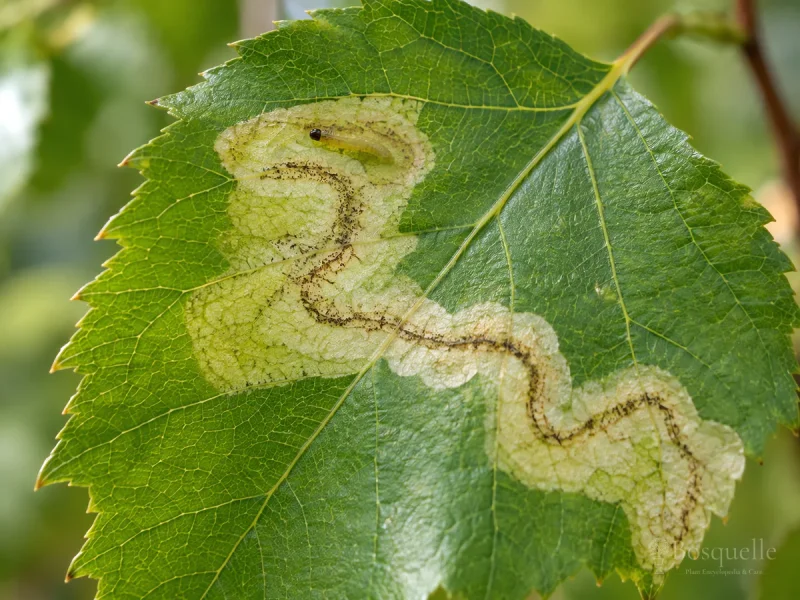
Birch leafminer is another sawfly, but it lives between the two skins of the leaf. Hold a brown blotch to the light. A flat, yellowish, legless larva and black specks means that insect, not this edge-chewer. See birch leafminer. Do not run its pinch-the-mine method on a cluster sitting on the margin.
A tiny pale caterpillar that chews the underside and leaves a lace of veins is a birch skeletonizer, a moth. Raking brown leaves can help that moth. This sawfly pupates in the soil, so raking does not finish it. A looper that drops on a silk thread is fall cankerworm, a true caterpillar. A silk tent in a branch fork is tent caterpillar. Bt can work on those moths. It will not work here. White-powder larvae on dogwood are dogwood sawfly. Raised ribs or white fluff on a river birch leaf are aphids, not a chew. Top-down dieback with D-shaped holes is bronze birch borer.
A yellowish larva with a reddish-yellow head on birch is a different sawfly. If it still feeds in a group on the leaf edge, pick that cluster the same way. Do not open a second spray plan for the head color.
Is this birch leafminer?
Not if the insects sit on the leaf edge and rear into an S. Birch leafminer is a flat larva between the skins. Hold a blotch to the light. See birch leafminer for that mine.
A healthy birch can wear a chewed branch
They strip whole patches because they feed together, so one river birch limb can look cleaned overnight. The rest of the crown often still has leaves. Whole-canopy defoliation is rare. A healthy, watered birch is treated for looks, not because this insect is about to kill it. Death from this sawfly alone is rare. A young seedling with few leaves is the tree that can be hurt in one pass.
Numbers swing from year to year. A heavy week this July does not mean the same tree will be covered next June. The second generation is often the louder one. If you catch the first group in May or June and pick it, you cut what would have dropped into the soil. Water a small birch that lost a lot of leaf. Mulch the root zone. Keep the mower off the bark. Dieback from the top is a different insect.
Do dusky birch sawflies kill the tree?
Almost never on a healthy, watered birch. They can strip a branch, and a small seedling can lose most of its leaves. Death from this insect alone is rare.
Skip a spray once they are an inch long
Horticultural oil and insecticidal soap only kill larvae they wet. They work on young larvae, about half grown or smaller, and only with thorough coverage on the cluster. Repeat if a new group hatches. You do not need to spray the whole crown if the insects sit on two branches. Once larvae are about an inch long, they stop feeding and drop to the soil. A bottle then is late. Skip the brand aisle. Read a label that names sawfly larvae on ornamental trees. A soil drench is not the plan for a cluster you can pick off a leaf.
Fail if the plan is a driveway fog on inch-long larvae after the branch is already bare. A kitchen dish-soap mix sprayed over a tall river birch is not the method. Use a labeled insecticidal soap if you still mean to spray young larvae you can actually cover.
Does insecticidal soap kill them?
On young larvae, if you wet the cluster. Soap does not finish inch-long larvae that have already stopped feeding. Pick those. A kitchen dish-soap fog on a tall tree is not the method.
Bt will not work on this insect
Bacillus thuringiensis kurstaki, the Bt sold for caterpillars, has to be eaten by a moth or butterfly larva. Dusky birch sawfly is a sawfly, related to bees and wasps. No Bt strain kills it. Count the extra legs before you buy that bottle. If you counted five or fewer, and the insect dropped on a silk thread or sat in a silk tent, you have a moth, not this sawfly. See that pest. Do not copy its Bt calendar onto this cluster.
Oil or soap on young larvae is the contact option if picking cannot reach them. Spinosad and other labeled products sit on the shelf for larger larvae you still mean to treat. They are not the first move on a group you can pick.
Does Bt kill dusky birch sawfly?
No. Bt kurstaki kills moth and butterfly caterpillars. This insect is a sawfly. Count the extra legs. Six or more means skip that bottle.
Confirm the cluster, then pick or wait
- Touch the leaf. An S-shaped group of yellow-green larvae with black heads on a birch leaf edge confirms this sawfly. Six extra fleshy legs, not five or fewer.
- If the brown is a blotch inside the leaf, stop. See birch leafminer. Do not pick a mine as if it were this insect.
- If you can reach them, pick the cluster into soapy water, crush them, or prune that leaf and destroy it.
- If they are already about an inch long and the branch is stripped, skip the spray. Water a small tree. Watch for the next hatch in May and again in mid-summer.
- If you still want a labeled product, use oil or insecticidal soap only on young larvae you can wet. Do not use Bt. Do not spray a tree you cannot cover.
- Leave a healthy birch alone once the group is gone. A chewed branch is looks. Top-down dieback is bronze birch borer.
Related reading
- Birch leafminer — a blotch inside the leaf, not a group chewing the edge.
- Bronze birch borer — top-down dieback and D-shaped holes, not a chewed leaf.
- Dogwood sawfly — white powder larvae on dogwood, not on birch.
- Fall cankerworm — a looper that drops on silk; a true caterpillar, so Bt can work there.
FAQ
Do dusky birch sawflies sting?
No. The adult is a stingless wasp. The larva chews birch leaves. It does not live in houseplant mix.
Will they come back next year?
Not as a rule. Numbers swing widely from year to year. A heavy week this summer does not lock in the same damage next June. Watch the new leaves anyway.
Should I rake fallen birch leaves?
This sawfly pupates in the soil, not in the leaf. Raking does not finish it. Picking the cluster while it is still on the leaf does. Raking can help some moths and leaf spots. It does not finish this insect.
Does river birch get dusky birch sawfly?
Yes. River birch and gray birch are the usual landscape trees. Paper, yellow, and other birches can be chewed too. Named trees in the yard are fine to check. Do not treat the name as a spray calendar.
Related pests





Related diseases



Updated: Reviewed by Bosquelle Editors