Scrape every tan, velvety egg mass into soapy water. Leave the bucket two days. Eggs you dump on the ground still hatch.
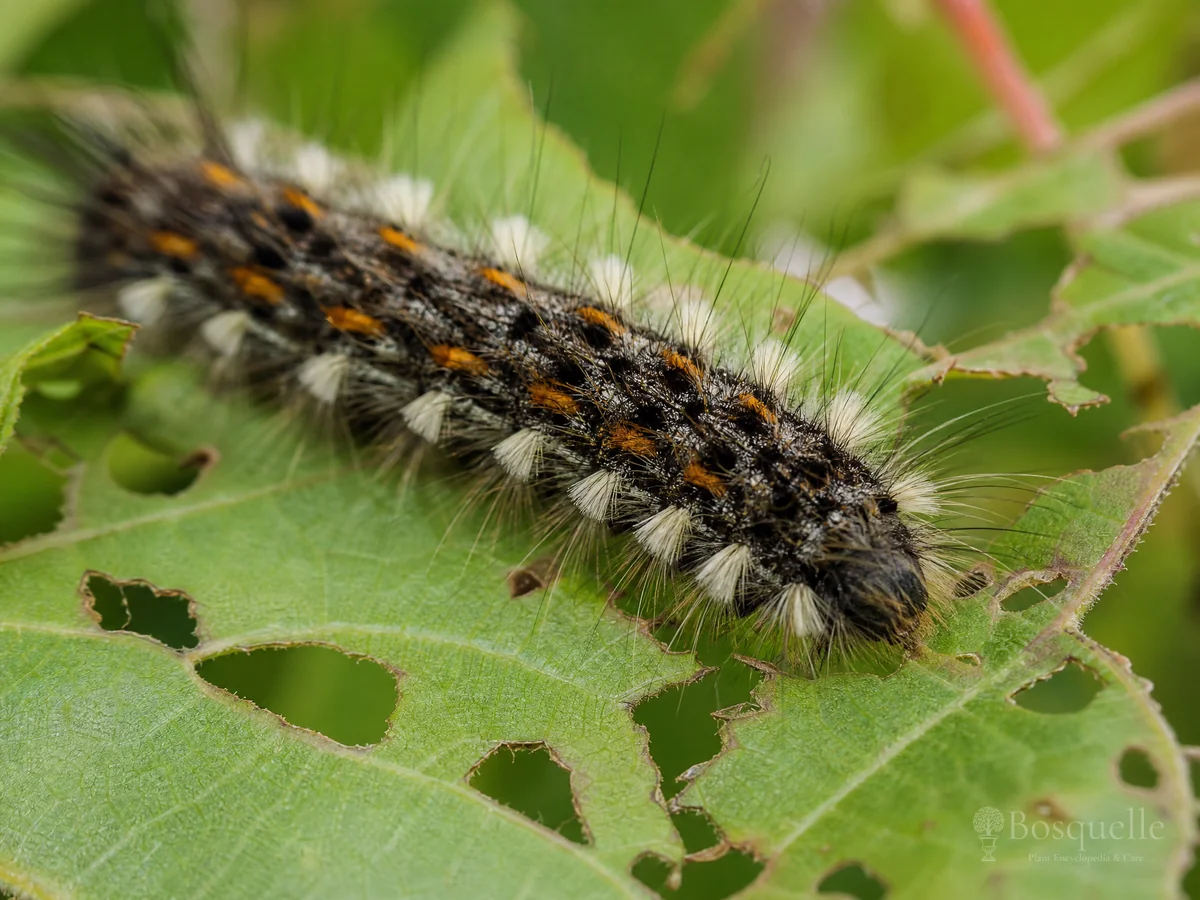
Spongy moth is an invasive moth, Lymantria dispar. People still call it gypsy moth. Then the real name. The larva is hairy, with five pairs of blue bumps and then six pairs of red. It does not spin a silk tent. In June, wrap a burlap skirt at chest height and empty it every afternoon. Bt only while those caterpillars are still small. A healthy oak usually leafs out after one June of feeding.
- Scrape masses into soap. Do not scrape them onto the mulch.
- Five blue spots, then six red. No tent in a fork.
- A spray after the oak is already veins-only is too late.
Scrape the egg masses into soapy water
The mass looks like a scrap of dirty sponge stuck to bark, siding, lawn chairs, wheel wells, or a woodpile. It is tan or buff, about an inch to an inch and a half, and felted with hair from the female. One mass can hold hundreds of eggs, sometimes near a thousand. Slide a putty knife or paint scraper under it. Catch it. Drop it in soapy water. Leave it two days, then trash it.
Eggs left on the soil still hatch. Stepping on a mass does not finish it. Wear gloves. The felt can rash bare skin. A labeled horticultural oil can soak a mass you cannot reach with the knife. Motor oil is leftover. It injures the tree. Old, faded, soft masses already hatched. Scrape the firm new ones from fall through the week before oak leaf-out.
Fail if the finish is a scrape onto the ground and a hope that frost will do the rest.
When should I scrape spongy moth egg masses?
From the time the females lay them in midsummer until hatch at oak leaf-out. Fall and winter are the easy window. A mass scraped onto the ground still hatches.
Wrap a burlap skirt and empty it every afternoon
Once the caterpillars are about an inch long, they walk down the trunk in the heat of the day to hide, then climb back at night to feed. Cut a strip of burlap twelve to eighteen inches wide and long enough to go around the trunk at chest height. Tie twine around the middle. Fold the top half down so it hangs as a skirt. That pocket is where they rest.
Check it every afternoon. Wear gloves, or knock them with a stick, into a bucket of soapy water. Leave them two days. Pupae and the pale, flightless females hide under the same flap in July. They go in the same bucket. Take the cloth down in August so it does not girdle the bark, and scrape any new masses that were laid under it.
In April and May, while larvae are still tiny, a sticky wrap can catch crawlers that ballooned onto the trunk. Put batting in the furrows, then a wrap, then sticky compound on the wrap. Never smear glue on the bark. It stains and injures the tree, and they walk around the dry patches. Switch to the burlap skirt when they are large enough to hide. Empty the skirt. Glue on the bark is leftover.
Should I glue sticky compound on the bark?
No. Put batting in the furrows, then a wrap, then the sticky layer on the wrap. Glue on bark injures the tree. In June, the burlap skirt is the band that matters.
When do I take the burlap down?
In August, after pupae and females have been emptied. Cut the wrap off. Scrape any new masses under it. Do not leave cloth or sticky compound on the trunk over winter.
A healthy oak usually leafs out after one June
The canopy can look winter-bare in June while the maple next door is still green. A healthy hardwood that went into spring with a full crown usually pushes a second set of leaves later in summer. That flush spends reserves. One year is looks and a weaker tree, not an automatic take-down. Wait until the next spring before you decide the oak is dead.
Two heavy years in a row, or one year on a newly planted oak in drought, is the year to treat. Pine and hemlock mixed under oak can die after one heavy feeding, because those needles do not come back the same season. Water through dry weeks. Do not pile fertilizer on a skeletonized canopy as the first move. Wait on a strong oak that still has green interior wood and only one June of this feeding.
Will gypsy moths kill my oak?
A healthy mature oak usually leafs out again after one June. Two heavy years, or one year on a young tree in drought, is the real risk. Pine and hemlock under oak can die after one heavy feeding. Water. Do not take the oak down for one June of veins.
Five blue spots, then six red, and no silk tent
The confirm on a grown caterpillar is the row of bumps, not the hair. Five pairs of blue behind the head, then six pairs of red. The body is dark and bristly, up to about two and a half inches. Newly hatched larvae are tiny and black. The spots show after they molt. Tap is leftover. They do not drop on a silk thread the way a looping cankerworm does. They crawl the trunk and the leaves. There is no communal tent.
The female moth is white with wavy brown marks and cannot fly. The male is smaller and brown, with feathery antennae. The egg mass is velvety. A smooth gray mass without that felt is not this moth.
| Where you see it | What it is | Try this |
|---|---|---|
| Hairy larva, five blue then six red bumps, no silk nest | Spongy moth | Scrape masses; burlap in June; Bt while small |
| White stripe, dense silk in a branch fork, spring | Tent caterpillar leftover | See tent caterpillar — not this scrape |
| Loose web wrapping branch tips in late summer | Fall webworm leftover | See fall webworm — not this scrape |
| Hairless looping worm that drops on silk when you tap | Fall cankerworm leftover | See fall cankerworm — not this scrape |
| Keyhole marks down the back, no tent, spring hardwoods | Forest tent leftover | Not this moth — no communal tent here either |
| Smooth gray egg mass, not velvety | Spotted lanternfly leftover | See spotted lanternfly — not this felt |
| Frass rain and chewed oak, no insect in sight | Feeding leftover | Look on the trunk at midday; check for tan masses |
What do spongy moth caterpillars look like?
Hairy, dark, up to about two and a half inches. Five pairs of blue bumps, then six pairs of red. No silk tent. Newly hatched larvae are tiny and black. The spots show after they molt.
A fork tent is tent caterpillar; a tip web is fall webworm
Eastern tent caterpillars spin a dense nest in the V of a branch in spring, then leave the tent to feed. They have a pale stripe down the back. See tent caterpillar. Do not run their stick-pull here.
Fall webworms wrap the tips of deciduous branches in a loose web in late summer, after this moth has already pupated. Many hairy caterpillars sit inside. See fall webworm. The web is a communal nest, not a hiding skirt you tie on the trunk.
Fall cankerworm is a hairless looping inchworm. Tap a chewed leaf and it drops on silk. See fall cankerworm. Do not run that moth's after-leaf-drop sticky band here. Forest tent caterpillars feed in groups on oak and aspen and do not build a tent. Color will not split every hairy worm. The five-then-six row still belongs to spongy moth. A smooth egg mass is spotted lanternfly, not this felt.
Are gypsy moths the same as tent caterpillars?
No. Tent caterpillars live in a communal silk tent in a branch fork in spring and have a pale stripe. Spongy moth larvae have the blue-then-red row and do not build a tent. See tent caterpillar.
Do spongy moths make a web?
No. A dense nest in a fork is tent caterpillar. A dirty web on the tips in August is fall webworm. This moth hides under a burlap skirt you tie on. It does not spin that nest.
Bt only while the caterpillars are still small
Bacillus thuringiensis (Bt, the kurstaki strain) has to be eaten. Spray when larvae are still under about half an inch, better under an inch, and leaves are out enough to hold the spray. That is usually May, while most of the leaf is still there. Once the canopy is veins-only, a bottle will not rewind the flush. Large larvae take a spray poorly, and a late fog can irritate them so they drop on people even more.
Hatch is staggered, so one pass is often not enough. Follow the label in your hand. Coverage on a tall oak is the missing step, not a brand. Broad leftover sprays that kill wasps can leave you with more caterpillars next year, not fewer. Skip the carton of male moth lure. It tells you males are flying. It does not protect this tree.
Does Bt kill spongy moths?
It kills young ones that eat treated leaves. Use it while larvae are still under about half an inch, after leaves have expanded. It will not rebuild a canopy that is already veins-only.
Confirm the spots, then scrape, band, wait, or spray young
- Confirm this moth. Five pairs of blue bumps, then six pairs of red. No silk tent. Tan velvety masses on bark or outdoor gear.
- Scrape every firm mass into soapy water. Leave it two days. Never onto the ground. Gloves on.
- If this is one June on a healthy mature oak, wait for the second flush. Water through dry weather. Do not take the tree down in June.
- Band in June. Burlap skirt at chest height. Empty it every afternoon. Sticky compound goes on a wrap in April, never on the bark.
- Bt only while the caterpillars are still small, if the tree is young, already stressed, a pine or hemlock under oak, or this is a second heavy year. Fail if the finish is a fog after the oak is already skeletonized.
How do I get rid of gypsy moths?
Scrape every tan egg mass into soapy water and leave it two days. In June, wrap a burlap skirt and empty it every afternoon. On a healthy oak after one June of feeding, wait for the second flush, or spray Bt while the caterpillars are still small. A fog on a skeletonized oak is too late.
Related reading
- Tent caterpillar — dense silk in a branch fork in spring, pale stripe, not a blue-then-red row.
- Fall webworm — loose web on deciduous tips in late summer, many caterpillars inside.
- Fall cankerworm — hairless looping inchworm that drops on silk; band after leaf drop, not a June burlap skirt.
- Spotted lanternfly — smooth egg mass, not this velvety felt.
- How to grow oak — the tree these larvae hit first in a June outbreak.
FAQ
Do gypsy moth caterpillars bite people?
No. They eat leaves. The hairs can cause a red, stinging rash, sometimes like poison ivy. Wear gloves. Wash clothes that touched them separately. That drop of frass is not a sting.
Do pheromone traps get rid of spongy moths?
No. The carton catches male moths so agencies can count them. Females still lay eggs. Hang it if you want to know they are flying. Scrape the masses if you want fewer caterpillars next May.
Can I move firewood with egg masses on it?
No. Buy and burn firewood where you burn it. Check trailers, furniture, and wheel wells before you drive. The mass is how this moth hitchhikes.
Is spongy moth the same insect as gypsy moth?
Yes. Same moth, Lymantria dispar. The common name changed. Scrape, band, and spray the same way.
Will dish soap kill spongy moths on the oak?
A kitchen mix sprayed into the canopy is leftover. Soapy water is for soaking scraped egg masses and the caterpillars you knock out of the burlap. It is not a substitute for Bt on small larvae.
Can the female moth fly?
The female of this moth in eastern yards cannot. She crawls, then lays the velvety mass. Unusual flying females are a different, quarantined complex. Report those. Do not wait on a carton.
Related pests





Related diseases




Updated: Reviewed by Bosquelle Editors