
Grow night-blooming jasmine in full sun or part shade, in moist soil that drains, and water it through the first season so the roots settle. Night-blooming jessamine is the same shrub. Cestrum is the Latin. This is not true jasmine.
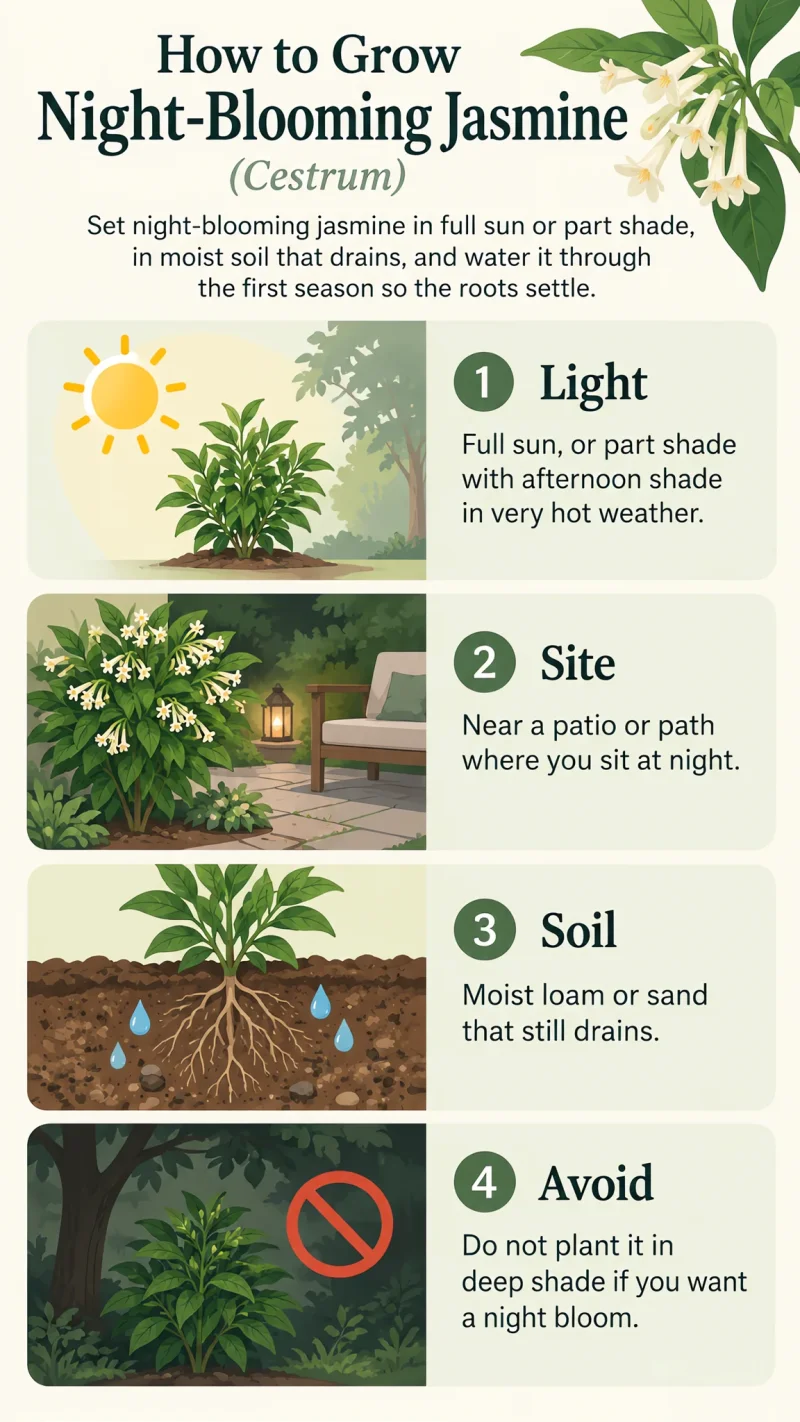
Give it full sun or part shade, and moist soil that drains
| Factor | Recommended | Avoid |
|---|---|---|
| Light | Full sun, or part shade with afternoon shade in very hot weather | Do not plant it in deep shade if you want a night bloom |
| Soil | Moist loam or sand that still drains | Do not leave the roots in a wet pocket |
| Water | Water regularly through the first growing season | Do not let a new plant dry out for days, and do not leave the pot standing in water |
| Site | Near a patio or path where you sit at night | Do not set it under a bedroom window if the night scent bothers you |
night-blooming jasmine is a woody nightshade shrub, about 3 to 13 feet tall, with glossy leaves and clusters of small creamy tubes that open after dark. The day flowers look plain. The night scent is the garden job. Give it full sun or part shade, and keep the soil moist without standing water. Deep shade is the usual reason the night bloom stays thin. A soggy pocket around the roots is the usual cause of rot. [1]
- Choose full sun, or part shade with afternoon shade where summers run very hot. Deep shade is the usual reason the tubes stay closed and the night scent never shows.
- Set it in moist loam or sand that still drains. Compost in the bed is fine if water does not stand around the roots.
- Water through the first growing season so the soil stays evenly moist. Let the surface dry slightly, then water again. Empty the saucer so the pot is not sitting in water.
Set a shrub in the ground after frost on Planting Night-Blooming Jasmine. Start another shrub from a summer stem on How to Propagate Night-Blooming Jasmine.
Does night-blooming jasmine need full sun?
Full sun or part shade. Afternoon shade helps in very hot weather. Deep shade is the usual reason it does not bloom at night.
How often should I water night-blooming jasmine?
Water regularly through the first growing season. Water when the surface has just begun to dry. Do not leave the roots in standing water.
Why isn't it blooming at night?
The tubes open after dark. If you get leaves and no scent, the plant is usually in too much shade, or it is still settling in its first season. Move it into brighter light.
Grow it in a pot and bring it in before frost
Night-blooming jasmine also grows in a large pot on a patio. Use a container with a drainage hole, fill it with a potting mix that drains, and water freely while it is in growth. It is not winter hardy where frost hits, so bring the pot indoors before a freeze. Give it a bright window, keep the mix just moist while it rests, and expect the night scent to fill a small room. [2] [3]
- Choose a large pot with a drainage hole. Empty the saucer after you water so the roots do not sit wet.
- Fill it with a potting mix that drains. A loam-based mix is fine if water runs through instead of pooling. [4]
- Set the pot in full sun or bright part shade outdoors. Water freely through summer. Afternoon shade helps if the leaves scorch in very hot weather.
- Bring the pot indoors before frost. Give it a bright window. Keep the mix just moist while growth slows. Do not feed it until new growth starts in spring. The night scent can be strong indoors, so a spare room is better than a small bedroom.
Can I grow night-blooming jasmine in a pot?
Yes. Use a large pot with a drainage hole, and bring it indoors before frost. Water freely in summer, and keep the mix just moist while it rests.
Prune after bloom to keep it in bounds
This shrub grows fast, so a light prune after a bloom flush keeps it from turning into a lanky screen. You do not have to prune it for it to flower. If you need to cut it hard, do that in late winter before new growth starts, because flowers form on the new wood.
- After a bloom flush, snip spent clusters and cut lanky stems back to a set of leaves if you want a denser shrub.
- If you need to reduce height, wait until late winter, then cut the tallest stems before new growth starts. Do not shear it in midsummer if you want the next night flush.
- After a freeze kills the top, wait for new growth, then cut the dead wood. Do not pull the plant because the top looks brown in late winter.
When do I prune night-blooming jasmine?
After a bloom flush, to keep it in bounds. For a harder size cut, wait until late winter before new growth starts.
Not true jasmine — and not a night-blooming cactus
Night-blooming jasmine is Cestrum, a nightshade shrub whose small tubes open after dark. True jasmine is Jasminum, usually a twining vine or a different shrub — see How to Grow Jasmine. Star jasmine is Trachelospermum, a fragrant climber for a trellis — see How to Grow Star Jasmine. Cape jasmine is Gardenia — see How to Grow Gardenia.
Night-blooming cereus, also sold as queen of the night, is a cactus — see How to Grow Orchid Cactus and How to Grow Dragon Fruit. Lady of the night on an orchid tag is usually Brassavola — see How to Grow Brassavola. Carolina jessamine is Gelsemium. Orange jessamine is Murraya. If the tag is not Cestrum, you do not have this plant.
Is night-blooming jasmine a true jasmine?
No. Night-blooming jasmine is Cestrum, a nightshade shrub. True jasmine is Jasminum. Star jasmine is Trachelospermum. Night-blooming cereus is a cactus.
Set night-blooming jasmine in full sun or part shade, in moist soil that drains, and water it through the first season so the roots settle.
FAQ
Is night-blooming jasmine poisonous to dogs?
Yes. All parts are toxic if eaten, especially the berries. Keep dogs, cats, horses, and children from chewing the plant. This is not a treatment guide; call a veterinarian if an animal eats it.
Is day-blooming jessamine the same plant?
No. Day-blooming jessamine is usually Cestrum diurnum, a related shrub that opens in daylight. Orange and purple cestrums are other species. Read the tag for Cestrum nocturnum if you want the night scent.
Is lady of the night the same shrub?
Not usually. Lady of the night is often the orchid Brassavola, or a cactus in search results. Night-blooming jasmine is Cestrum. Read the Latin on the tag.
Related guides


Recommended plants

References
- [1] NC State Extension -
https://plants.ces.ncsu.edu/plants/cestrum/ - [2] Royal Horticultural Society -
https://www.rhs.org.uk/plants/3457/cestrum-nocturnum/details - [3] University of Arkansas Extension -
https://www.uaex.uada.edu/yard-garden/in-the-garden/reference-desk/tropicals/jasmine.aspx - [4] Hayloft Plants -
https://hayloft.co.uk/how-to-grow-cestrum
This note is part of Cestrum Guides.
More first-season notes by plant are gathered in How to Grow Guides.
Updated: Reviewed by Bosquelle Editors