
Grow orchid cactus in bright shade with a mix that stays lightly moist, then give it a cooler, drier winter so flower buds can form. Shops also say Epiphyllum.

Give it bright shade, mix that stays lightly moist, and a cool winter rest
| Factor | Recommended | Avoid |
|---|---|---|
| Light | Bright filtered light, or morning sun. About 50 to 75 percent shade outdoors | Midday summer sun on the flattened stems, or a dark corner with no buds |
| Water | Soak the mix, then wait until the top begins to dry. Keep it lightly moist in spring and summer | A desert cactus dry-out, or a saucer of standing water |
| Mix and pot | A fast-draining mix that still holds some moisture, in a hanging basket or a snug pot | Heavy garden soil, or an oversized pot that stays wet |
| Winter rest | Cool nights around 50 to 57°F, less water, and no fertilizer. Keep lights off after sundown | A warm wet living room all winter, or lamps on after dark |
| Feed | A balanced fertilizer at half strength in active growth, then a low-nitrogen bloom formula in late autumn and again in late winter | High-nitrogen feed, or feeding in deep winter |
| Humidity and air | A pebble tray with water below the pot base, and air moving around the stems | The pot sitting in the water, or wet stems overnight in still air |
This is a forest epiphyte, not a desert cactus. Give it bright indirect light and a mix that drains, then soak thoroughly and let the top dry before you water again in the growing season. [1]
Seventy-five percent shade is the usual outdoor target; early morning sun is fine. Keep roots slightly moist, never soggy and never bone-dry. Skip high-nitrogen fertilizer. Plants bloom sooner in a small pot that the roots have filled. [2]
In winter, move the plant to a cooler room around 52 to 57°F and keep the mix only just damp. When buds show, return it to its warmer bright spot and resume ordinary watering. [3]
Indoors, do not turn lamps on after sundown during that rest or the next bloom cycle can stall. Soft black tissue at the soil line means the mix stayed wet too long.
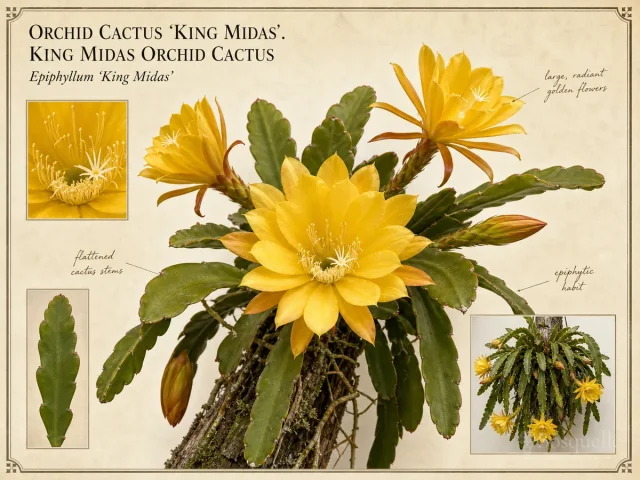
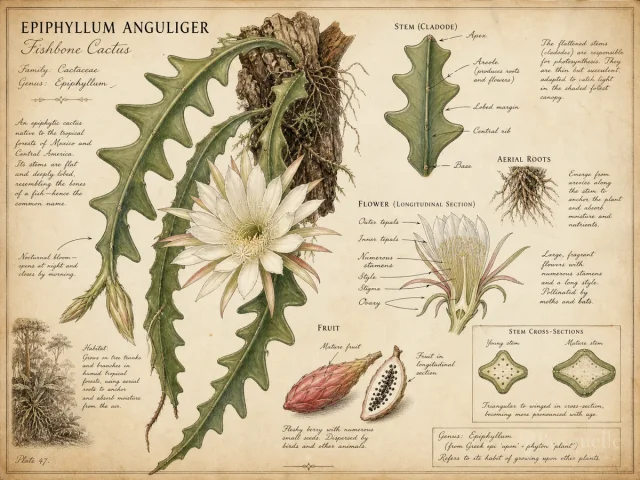
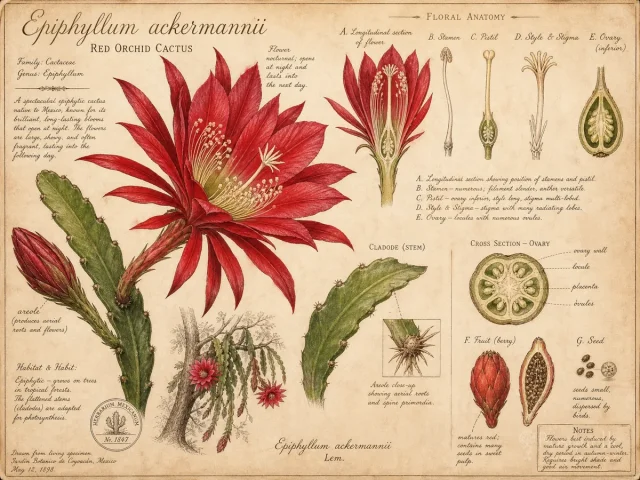
Epiphyllum ‘King Midas’ is a hybrid grown for showy color in hanging bright shade. E. anguliger is the zigzag fishbone look on the same moist forest mix. E. ackermannii carries vivid blooms on trailing stems. All four catalog faces share this light, water, and rest — not a second watering calendar.
How often should an Orchid Cactus be watered?
In spring and summer, water when the top of the mix begins to dry. Keep it lightly moist, never soggy. Water less in the cool winter rest.
How do I get my Orchid Cactus to flower?
Give bright filtered light in the growing season, then a cooler, drier winter with lights off after sundown. Keep the plant slightly snug in its pot.
Is Orchid Cactus hard to grow?
The hard part is treating it as a forest plant. Bright shade and a mix that stays lightly moist are the shared rule. It fails first if you dry it out like a desert cactus or leave it in a wet saucer.
How do I care for an Orchid Cactus indoors?
Bright filtered light, water when the top begins to dry, and a cooler rest in winter. Stand the pot above a humidity tray; do not leave it sitting in water.
Hang it outdoors in bright shade after frost
Orchid cactus is an epiphyte in a pot, not a bed plant. After frost risk passes, hang it in bright shade so midday sun does not scorch the stems, then bring it in before cold nights.
- Choose bright shade — under a tree or a shade cloth, never full midday sun on a hot wall.
- Hang the pot off the ground so snails cannot reach the stems, and water when the top of the mix begins to dry.
- Keep air moving around the trailing stems so wet nights do not leave permanent spots.
- Bring the pot indoors before nights drop near 50°F, then start the cool winter rest.
Can I put my Orchid Cactus outside?
Yes, in bright shade after frost risk passes. Hang it off the ground, and bring it in before cold nights.
Repot only after bloom, into a snug pot
Flowering is better when roots have filled the pot, so recut only after bloom and only one size up. [4]
- Wait until the last flowers drop. Do not lift a plant in bloom.
- Choose a pot only one size up, with drainage holes.
- Ease the root ball out. Shake off loose mix. Do not shred every root.
- Set the plant at the old soil line in fresh mix. Water lightly after about a week, then return to the ordinary schedule.
Not a Christmas cactus, a desert cactus, or the grafted moon cactus
A Christmas cactus (Schlumbergera) has shorter, jointed pads and flowers on a short-day winter calendar. Orchid cactus has long flattened stems and giant flowers after a cool rest — not the holiday-cactus schedule. A desert cactus wants a hard dry-down; this plant does not. The grafted moon cactus sold as a neon knob on a green stock is a Gymnocalycium, not the zigzag fishbone on this page. Night-blooming cereus on a tag is often a Selenicereus; E. oxypetalum is one queen-of-the-night face in this genus, not every cereus. Dutchman's pipe as a garden vine is Aristolochia, not this cactus.
How do I tell if my cactus is a Christmas cactus?
Christmas cactus pads are short and jointed and bloom in winter on short days. Orchid cactus stems are long and flattened, and the flowers are much larger after a cool rest.
King Midas for color, fishbone for zigzag stems, Dutchman's pipe for night bloom
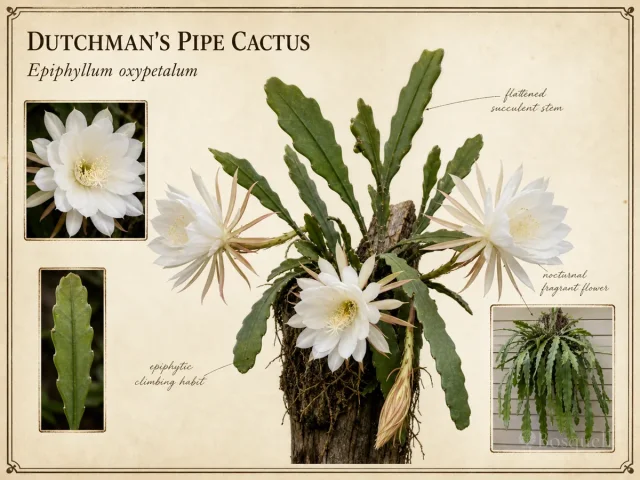
Shopping splits by flower color and stem shape more than by a second watering rule. Epiphyllum ‘King Midas’ is the hybrid color face. E. anguliger is the zigzag fishbone stem. E. ackermannii is the red orchid-cactus bloom. E. oxypetalum is the night-fragrant white Dutchman's pipe cactus. Disocactus on a fishbone or red tag is the same moist forest care, not a second genus to buy.
What is fishbone cactus?
Usually Epiphyllum anguliger — zigzag stems, same bright shade and lightly moist mix as other orchid cacti. It is not the grafted moon cactus.
How often does an Orchid Cactus bloom?
Hybrids often flower in spring or summer once they have had a cool winter rest and filled a snug pot. Night bloomers such as Dutchman's pipe cactus open for a short night show.
If buds fail after a warm, bright winter, cool the nights and keep lamps off after sundown before you change fertilizer.
FAQ
How long does an orchid cactus live?
A well-grown plant can last for many years if you keep the mix draining and refresh it after bloom when the pot is packed. Trailing stems get long; shorten one after bloom if you need to.
Can orchid cactus grow in garden soil?
No. It is an epiphyte. Use a fast-draining potting mix in a hanging basket or a snug pot, not garden soil.
Does orchid cactus make edible fruit indoors?
The fruits are edible in principle, but indoor plants rarely set them. Grow it for the flowers.
Is Dutchman's pipe the vine or the cactus?
On this page it is Epiphyllum oxypetalum, a night-blooming cactus. The garden vine Dutchman's pipe is Aristolochia, a different plant.
Related guides

Recommended plants
References
- [1] NC State Extension Gardener -
https://plants.ces.ncsu.edu/plants/epiphyllum-oxypetalum/ - [2] Epiphyllum Society of America -
https://epiphyllums.org/culture - [3] Royal Horticultural Society -
https://www.rhs.org.uk/plants/epiphyllum/growing-guide - [4] UC Master Gardeners of San Luis Obispo County -
https://ucanr.edu/blog/uc-master-gardeners-diggin-it-slo/article/orchid-cactus
This note is part of Epiphyllum Guides.
More first-season notes by plant are gathered in How to Grow Guides.
Updated: Reviewed by Bosquelle Editors