
Grow star jasmine in sun on a trellis the stems can twine. Shops also say confederate jasmine. If the tag says true jasmine or English ivy, that is a different plant.
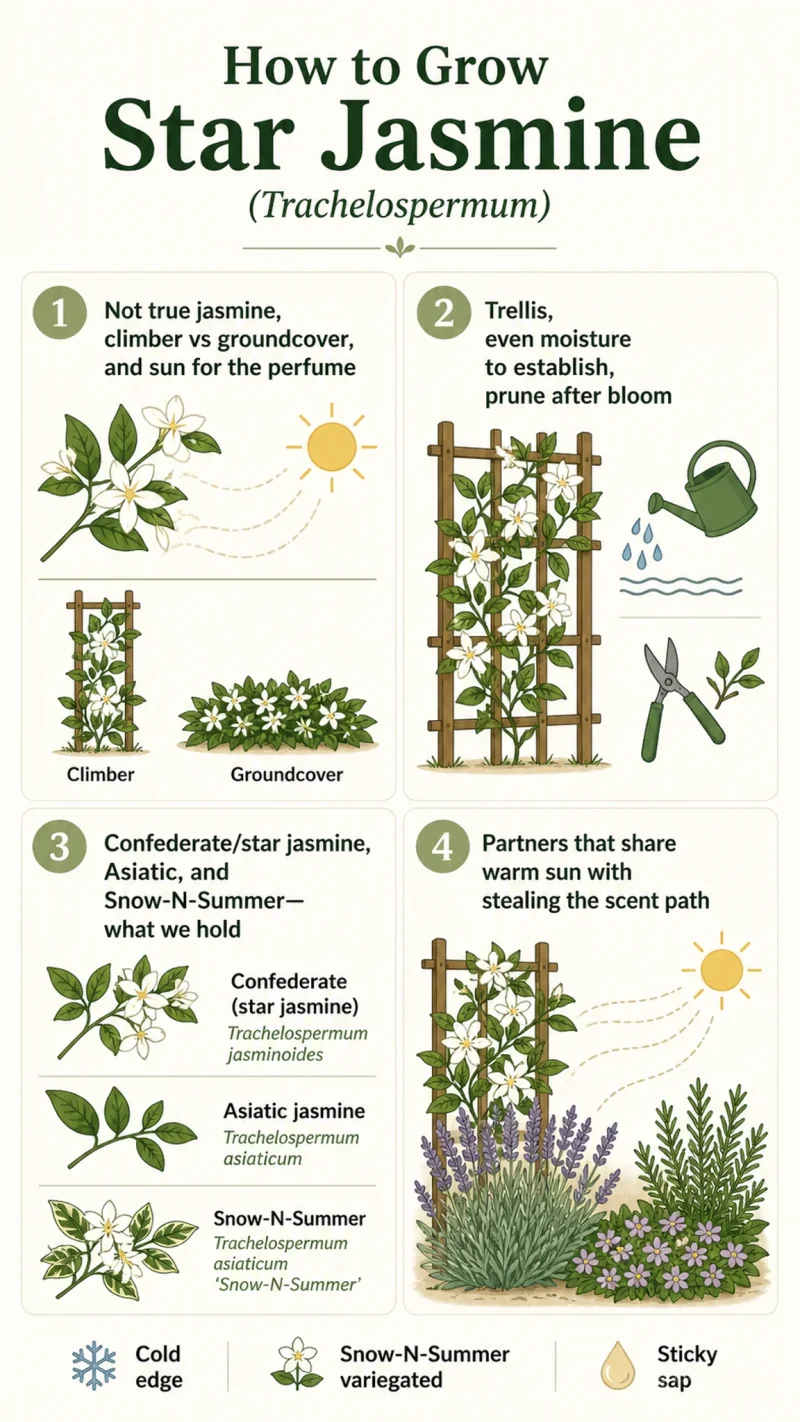
Give it sun, a trellis to twine, and water the first season
| Factor | Recommended | Avoid |
|---|---|---|
| Light | Full sun to light shade so the vine flowers | Deep shade with thin growth and few blooms |
| Support | Trellis, wires, arbor, or a fence the stems can twine through | Bare masonry with nothing to wrap; expecting it to glue itself to brick |
| Soil | Fertile ground that drains after rain | A soggy, heavy hole that stays wet |
| Water | Regular water the first season; then deep water in long dry spells | Planting in heat and letting a new vine bake dry |
| Winter | A sheltered wall, or a pot you can move before a hard freeze | An exposed, windy corner on the cold edge with no plan |
Star jasmine climbs by twining. Give it wires or trellis at the start. It will not stick to bare brick the way ivy does. [1] [2] Sun makes the perfume. Light shade is fine; deep shade leaves you with foliage and little flower. Water through the first season. Established plants take short dry spells better than a wet crown. Bronze leaves in a cold snap are common and usually recover in spring.
- Choose a warm, sheltered wall or fence in sun or light shade, near seating if you want the scent.
- Install trellis or horizontal wires before you plant. Leave a little air between the wall and the support.
- Use ground that drains. Skip a low wet pocket.
- Water regularly until the vine is established, then water deeply when the top inch stays dry through a drought.
Does star jasmine need a trellis?
Yes if you want a climber. Stems twine and need wires, trellis, or a fence. They will not glue themselves to bare masonry.
Can star jasmine grow in shade?
It survives shade, but flowers best in sun or bright part sun. Deep shade thins growth and cuts bloom.
Why won’t my star jasmine bloom?
Usually too much shade, a plant that is still settling in, or an Asiatic groundcover type that flowers less showily than the fragrant climber.
Grow it in a pot you can move in winter
Open ground against a sheltered wall is the default in a mild garden. On the cold edge, a large pot with drainage holes and a trellis insert lets you roll the plant into a bright garage or sunroom before a hard freeze. Empty the saucer after rain. Water the pot more often than in-ground vines in summer, and much less in winter.
Can I grow star jasmine in a pot?
Yes. Use a large container with drain holes and a trellis. Moving the pot is the usual winter plan where freezes are hard.
Plant at pot depth after the support is in
Plant in spring after the last frost, or in fall with enough weeks left for roots before a freeze. Set the top of the root ball at or slightly above the surrounding soil. Put the trellis in first so you are not stabbing stakes through new roots. [3]
- Confirm Trachelospermum — a twining evergreen, not true jasmine and not English ivy.
- Install the arbor, wires, or trellis. A climber is usually one vine per structure.
- Water the nursery pot, then slide the root ball out. Loosen circling roots.
- Dig a hole as deep as the pot and two to three times as wide. Set the crown at or slightly above grade.
- Backfill with the soil you dug, water to settle, and mulch the root zone without piling bark against the stems.
- Tie a few young leaders onto the support. Water through the first season.
For an Asiatic groundcover mat, clear weeds first and space plants about 18 inches apart so the carpet can fill in. Do not treat that mat as a lawn you walk on.
When should I plant star jasmine?
Spring after frost, or fall with about four weeks before a freeze. Summer planting works only if you can water.
How far apart should I plant it?
One climber per trellis is enough. For an Asiatic mat, about 18 inches between plants. Do not pack vines into a wet huddle.
Start a cutting if you want another vine
Semi-ripe stem cuttings root in a gritty, moist mix in summer. Take a piece with a node, strip the lower leaves, and keep the mix barely moist out of hot midday sun. Wear gloves — cut stems leak milky sap. Named kinds stay true from cuttings. Seed is rarely useful.
- Cut a 4- to 6-inch semi-ripe shoot just below a node.
- Strip the lower leaves. Dip the cut end in rooting hormone if you have it.
- Stick the node into moist mix that drains. Keep it shaded and barely moist until roots hold, then pot it on.
Prune after bloom, and wipe the sap
After the main flower flush, shorten long shoots and thin crossed stems so the vine stays on the support. Cut to a leafy side shoot, not into bare old wood and expect a flush from nothing. Wear gloves and wipe tools — the sap is milky and sticky. An Asiatic mat can be sheared in spring to hold the edge. Do not wait until the vine has filled gutters and windows.
- Wait until the main bloom fades.
- Thin crowded stems and shorten wayward leaders back to a leafy side shoot.
- Tie remaining shoots onto the trellis. Wipe sap off blades and gloves.
When should I prune star jasmine?
After the main flower flush. That keeps next season’s flowering wood. Dead or damaged stems can come off anytime.
Not true jasmine, Carolina jessamine, or English ivy
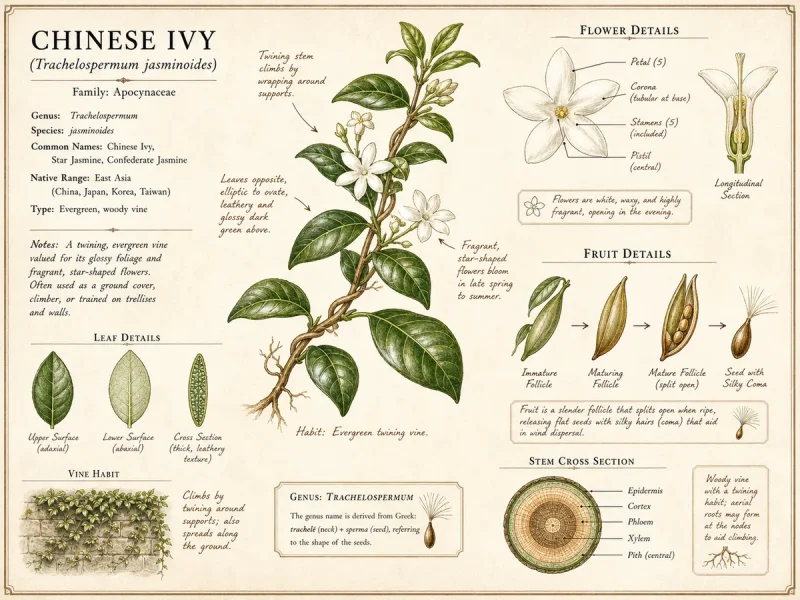
Star jasmine is Trachelospermum in the dogbane family, not Jasminum. True jasmine is a different genus with its own care. Downy jasmine (Jasminum multiflorum) is also sold as star jasmine in some shops — check the Latin name.
Carolina jessamine is Gelsemium, a yellow-flowered vine that is toxic if eaten. Do not copy that plant’s care or assume the same risk. English ivy is Hedera, often evergreen with adhesive roots — a different genus. Chinese ivy on a Trachelospermum tag is still this climber, not English ivy.
Is star jasmine a true jasmine?
No. It is Trachelospermum. True jasmine is Jasminum. Carolina jessamine is Gelsemium. English ivy is Hedera.
Confederate climber, Asiatic mat, or Snow-N-Summer
Sun, drain, and a support for anything you want to climb are shared. Habit is the choice. Do not treat extra shop names as a different plant.
- Fragrant climber — T. jasminoides is confederate or star jasmine, the showy white pinwheels on twining stems. Give it a trellis.
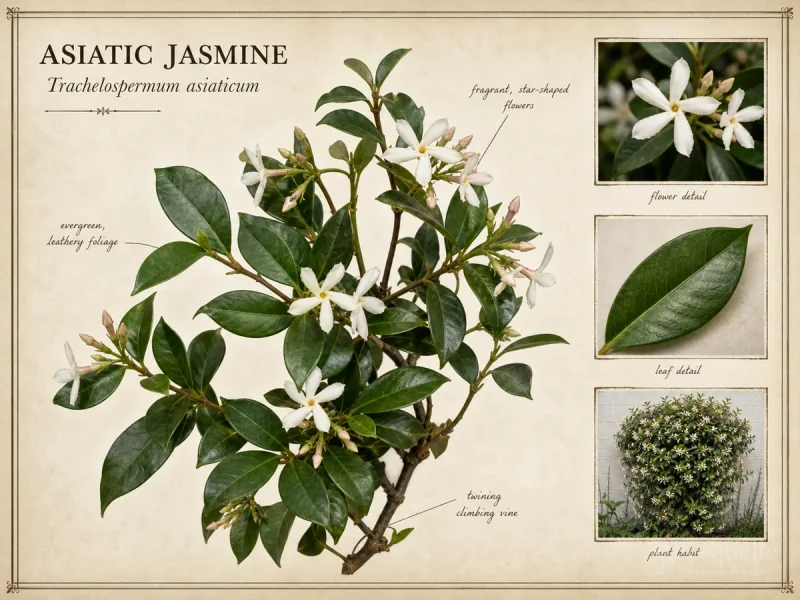
- Evergreen mat — T. asiaticum is Asiatic jasmine: smaller, darker leaves, smaller cream flowers, and a tougher groundcover in sun or even dense shade. [4] Flower show is secondary to the carpet.
- Variegated mat — T. asiaticum ‘Snow-N-Summer’ is a variegated Asiatic selection. Pink-to-cream new growth ages toward green-and-white. It is still a mat, not a different watering method.
Is star jasmine the same as confederate jasmine?
Usually yes — both names point to Trachelospermum jasminoides. Asiatic jasmine is a related plant used more as groundcover.
Asiatic jasmine vs star jasmine — what’s the difference?
Star or confederate jasmine is the showier fragrant climber. Asiatic jasmine has smaller leaves and flowers and is the tougher groundcover.
What is Snow-N-Summer jasmine?
A variegated Trachelospermum asiaticum selection used as an ornamental groundcover mat. Care matches other Asiatic mats.
Give it sun and a trellis, plant at pot depth after the support is in, prune after bloom, and read the tag so you did not buy true jasmine.
FAQ
Are extra shop names extra plants?
Madison, Minima, and similar tags are still this genus. This page covers the three catalog plants. Extra names are not a different watering method.
Is downy jasmine the same plant?
No. Downy jasmine is Jasminum multiflorum, sometimes sold as star jasmine. Confirm Trachelospermum on the tag.
Is star jasmine poisonous?
Do not eat it. Cut stems leak milky sap that can irritate skin, so wear gloves when you prune. Carolina jessamine is a different, highly toxic yellow vine.
Can I grow named kinds from seed?
Buy a plant if you want a named climber or Snow-N-Summer to come true. Cuttings are the usual way to copy a vine you already like. Seed is rarely useful.
What can I plant nearby?
Neighbors should share sun and drain without smothering the trellis face. Skip thirsty shade plants and vines that will fight for the same wires.
Do deer eat it?
Deer often skip it, but that is not a reason to skip the trellis or first-season water. Site still decides whether the vine flowers.
Recommended plants

References
- [1] NC State Extension Gardener -
https://plants.ces.ncsu.edu/plants/trachelospermum-jasminoides/ - [2] Clemson HGIC -
https://hgic.clemson.edu/factsheet/jasmine/ - [3] Almanac -
https://www.almanac.com/plant/star-jasmine - [4] UF/IFAS Gardening Solutions -
https://gardeningsolutions.ifas.ufl.edu/plants/ornamentals/asiatic-jasmine/
More first-season notes by plant are gathered in How to Grow Guides.
Updated: Reviewed by Bosquelle Editors