
Grow dragon fruit in full sun with mix that drains, and water when the top of the mix is almost dry. Dragon fruit is Selenicereus undatus — a climbing cactus, also sold as Hylocereus, not a Christmas cactus.

Give it full sun, mix that drains, and water when the top is dry
| Factor | Recommended | Avoid |
|---|---|---|
| Sun | Full sun outdoors for fruit; bright light on a patio pot | Do not keep a fruiting plant in a dim room that never sees direct sun |
| Soil | Loam or cactus mix that drains | Do not leave it in a soggy pot or a bed that stays wet after rain |
| Water | Water when the mix is almost dry in spring and summer; water from flower through harvest | Do not keep the mix wet, and do not let it stay bone-dry all winter |
| Drought | Established plants take a dry spell once the mix drains | Do not skip water while flowers and fruit are on the stems |
dragon fruit is a climbing cactus, not a desert globe. Give it full sun and mix that drains, then water when the mix is almost dry. Cut back in winter, but do not leave the roots bone-dry for weeks. [1] Once flowers open, keep the mix from drying out until you pick, because a long dry spell then cuts the crop. [2] Choose the kind — fruit on a post, hanging zigzag stems, or a night-bloom plant — on Types of Selenicereus. A fruit crop on a post is a landscape plant-out on Planting Dragon Fruit.
Does dragon fruit need full sun?
Yes, for fruit outdoors. A hanging zigzag plant takes bright light with some afternoon shade. A dim room will not crop.
How often should I water dragon fruit?
Water when the top of the mix is almost dry in the growing season. Water less in winter, but do not let the pot stay bone-dry for weeks.
Is dragon fruit drought tolerant?
Established plants take a dry spell once the mix drains. Water through flower and fruit, because a dry stretch then cuts the crop.
Not a Christmas cactus — and not orchid cactus or Arizona queen of the night
Dragon fruit is Selenicereus. A Christmas cactus is Schlumbergera, with flattened holiday pads that bloom in short days. An orchid cactus is Epiphyllum. Arizona queen of the night is Peniocereus greggii, a desert plant with a tuber, not a fruiting post. [3] [4]
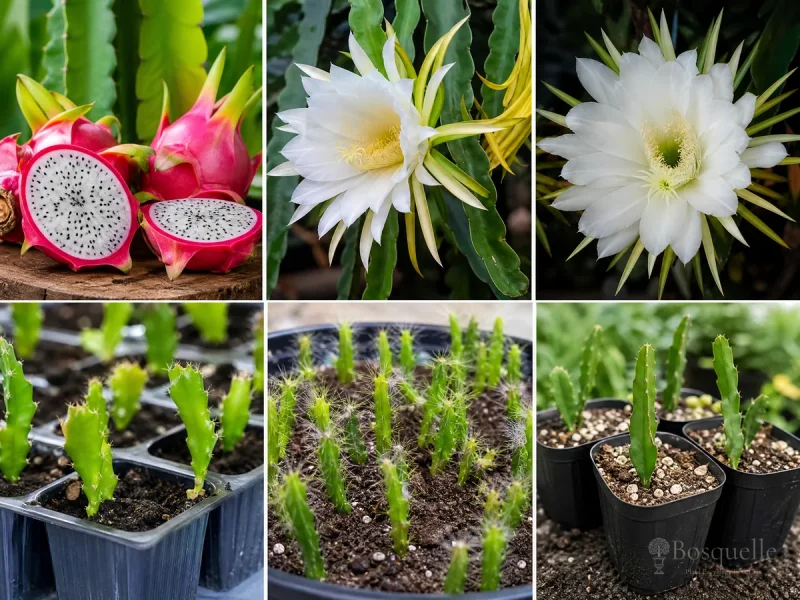
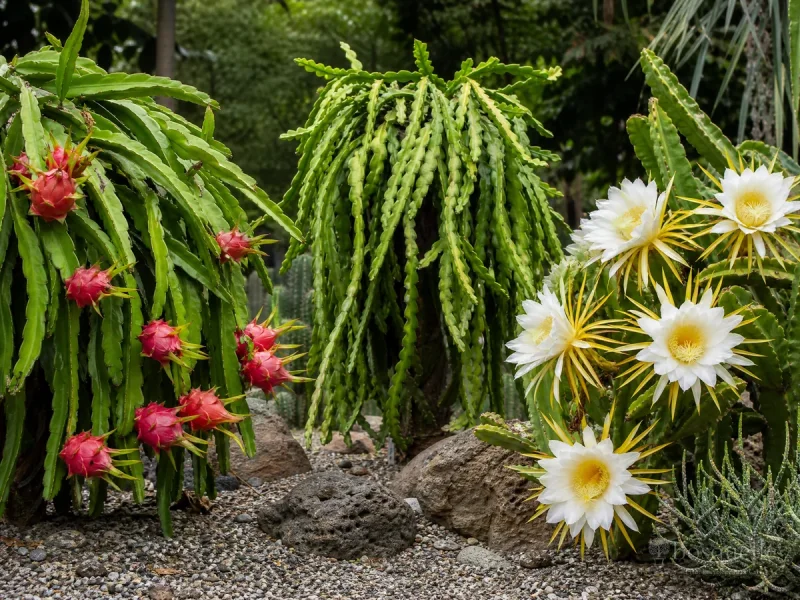
- Dragon fruit (Selenicereus undatus) — three-winged climbing stems, night flowers, and an edible berry with scale-like skin. dragon fruit is the grocery fruit.
- Christmas cactus (Schlumbergera) — flattened, jointed pads and winter bloom. See How to Grow Christmas Cactus.
- Orchid cactus (Epiphyllum) — flat, leaf-like stems. Its fishbone kind is not fishbone cactus. See How to Grow Orchid Cactus.
- Arizona queen of the night — thin gray stems from a tuber. Night-blooming cereus on a tag can mean any of these plants, so read the Latin name.
Nopal and tuna on a grocery list are prickly pear (Opuntia), not this climber. See How to Grow Prickly Pear.
Is dragon fruit a Christmas cactus?
No. Dragon fruit is Selenicereus, a climbing cactus with three-winged stems. Christmas cactus is Schlumbergera, with flattened holiday pads.
Is night-blooming cereus the same plant?
Sometimes the tag means dragon fruit, and sometimes it means orchid cactus, queen of the night, or Arizona queen of the night. Check the Latin name before you buy.
Keep the mix almost dry between waterings, and check the tag so you did not buy a holiday cactus by mistake.
FAQ
Do I need to hand-pollinate?
Some kinds set fruit on their own. Others need a second kind, or a brush on the open night flower. If flowers drop with no fruit, plant two kinds or move pollen at night.
Is tuna or nopal the same plant?
No. Those names are for prickly pear. Dragon fruit is a climbing cactus with three-winged stems, not a pad cactus.
What is the white fluff on the stems?
That is often mealybug. Wipe it off with a cloth as soon as you see it, and keep air moving around the stems.
Related guides



Recommended plants


References
- [1] NC State Extension Gardener Plant Toolbox -
https://plants.ces.ncsu.edu/plants/selenicereus-undatus/ - [2] University of Florida IFAS Extension -
https://ask.ifas.ufl.edu/publication/HS303 - [3] University of Arkansas Division of Agriculture -
https://www.uaex.uada.edu/yard-garden/resource-library/plant-week/night-blooming-cereus-10-01-10.aspx - [4] Clemson Cooperative Extension HGIC -
https://hgic.clemson.edu/factsheet/indoor-cacti/
This note is part of Selenicereus Guides.
More first-season notes by plant are gathered in How to Grow Guides.
Updated: Reviewed by Bosquelle Editors