
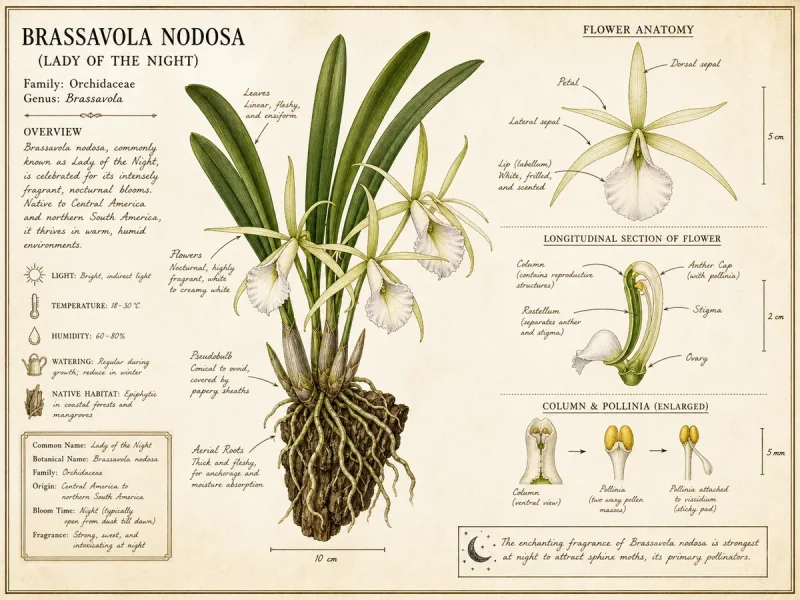
Grow Brassavola in bright light, in coarse bark that dries between waterings. Brassavola here is Brassavola nodosa, the lady of the night orchid — not night-blooming jasmine, and not a moth orchid.

Give it bright light, and let the bark dry between waterings
| Factor | Recommended | Avoid |
|---|---|---|
| Light | A bright east or shaded-south window; some morning sun is fine if air moves | Do not keep it in a dim room if you want flowers |
| Water | Water thoroughly, then wait until the bark is almost dry; water more often in heat | Do not leave the pot sitting in water, and do not use ice cubes |
| Mix | Medium to large orchid bark in a pot just large enough for the roots | Do not pack garden soil around the roots |
| Air | Moving air and, if you can, humidity around 50 percent | Do not wrap the roots in a wet, closed bag |
| Winter rest | When new growth stops, keep it drier for at least two weeks | Do not keep the bark wet all winter if you want bloom |
Give lady of the night orchid a bright seat and bark that dries between waterings. A dim, wet pot is the primary reason it grows leaves and skips flowers. Days around 65 to 80°F with a cooler night suit it; it may not flower if you keep it below about 55°F. [1] The flowers open white to pale green and smell strongest after dusk. A plant that is happy often blooms more than once a year.
How much light does Brassavola need?
A bright east or shaded-south window. Leaves that stay very dark green usually mean the plant needs more light before it will bloom.
How often should I water it?
Water until it runs out, then wait until the bark is almost dry. In heat you water more often. Do not leave a saucer of water under the pot.
Pot it in coarse bark, or mount it if you can water every day
Most houseplants stay in a snug pot of medium to large orchid bark. The pot only needs room for the roots plus about two years of growth. A mount on cork or tree-fern works if the room stays humid and you can soak the roots at least once a day in summer. [2] If you cannot water that often, keep it in bark.
- Choose a pot with holes, just large enough for the roots. Do not size up into a deep, wet pot.
- Fill with medium to large orchid bark, cork nuggets, or tree-fern fiber. Leave the base of the stems at the surface.
- Water until it drains, then wait until the bark is almost dry before you water again.
- Repot when new roots start, or as soon as the flowers fade, if the bark has collapsed or the rhizome has walked over the rim.
In frost-free south Florida, tie it to a tree
Where frost never reaches the yard, you can clean the mix off the roots and tie the plant to a hardwood tree or a palm. Skip smooth, flaky bark. Use a horizontal limb with some afternoon shade, or the north or east face of a trunk.
- Soak the pot, then ease the plant out and gently pick bark off the roots.
- Hold the base of the stem against the bark so new root tips touch the wood. [3]
- Tie it tight with sisal or a zip tie at the stem base. Water daily for about a month, until the roots grab.
Should I mount it or keep it in a pot?
Keep it in bark unless you can water a mount every day in summer. A snug pot is the easier houseplant method.
When do I repot?
When new roots start, or right after the flowers fade, if the bark has gone soft or the plant has walked over the rim. Stay in a snug pot.
Give it a two-week dry rest when growth slows
When the plant is not making new leaves, keep the bark drier for at least two weeks so the growth can harden and set flower buds. You still mist or water lightly if the leaf starts to shrivel. Resume regular water when new growth starts. [4]
- Watch for a pause in new leaves, often in the cooler months.
- Stop fertilizer. Water much less — a light soak every two or three weeks is enough in most rooms, or a morning mist if the air is dry.
- Keep the bright window. Do not move it into a dim room for the rest.
- When a new growth starts, return to watering when the bark is almost dry.
Why won't it bloom?
It usually needs more light, or a two-week dry rest after the growth hardens. Keeping it below about 55°F also stops flowers.
Not night-blooming jasmine — and not a moth orchid or queen-of-the-night cactus
Night-blooming jasmine is Cestrum, a soil shrub with small tubular flowers. Shops also call that shrub lady of the night. Brassavola is an orchid with one fleshy, almost pencil-thick leaf per growth. Do not plant this orchid in garden soil as if it were that shrub.
A moth orchid is Phalaenopsis. It wants less light and a mix that stays a little moister. See How to Grow Phalaenopsis if the leaves are wide and flat and the shop tag says moth orchid.
Queen of the night and lady of the night cactus are flattened orchid cacti, not this plant — see How to Grow Orchid Cactus and How to Grow Dragon Fruit if the stems are flat pads. True jasmine is Jasminum — see How to Grow Jasmine if the plant is a twining shrub, not an orchid.
Is this night-blooming jasmine?
No. Night-blooming jasmine is Cestrum, a shrub in soil. Lady of the night orchid is Brassavola, with pencil-thick leaves and aerial roots.
Is this a moth orchid?
No. A moth orchid has wide, flat leaves and wants less light. Brassavola wants a bright window and bark that dries.
Set the next plant in a bright window, in snug bark that dries between waterings, give a two-week dry rest when growth slows, and do not buy night-blooming jasmine as this orchid.
FAQ
Do I cut the spike when the flowers fade?
Yes. Cut the dry stalk off at the base once the flowers are spent. A new spike comes from the next growth, not from the old stalk.
Can I divide a large clump?
Wait until the plant has several leafy growths with healthy roots, then split it when you repot. Each piece needs roots of its own. Seed is flask work, not a windowsill start.
Can I grow it from seed?
Home seed is not practical. Nurseries raise Brassavola in flask. Buy a started plant.
Is lady of the night toxic to pets?
Night-blooming jasmine (Cestrum) is a poisonous shrub if eaten. This orchid is not that shrub. Keep pets from chewing houseplants either way.
Is this the orchid from Red Dead Redemption?
The game uses the same common name. The plant here is Brassavola nodosa, a real night-scented orchid you can grow in a bright window.
Do I need to feed it?
A weak orchid fertilizer after you water, while it is making new leaves, is enough. Skip feed during the dry rest, and flush the bark with plain water now and then so salts do not build up.
Do you hold Brassavola cucullata or Rhyncholaelia?
The plant here is Brassavola nodosa. Other Brassavola names in shops, and the old Brassavola digbyana, still want bright light and bark that dries. They are not extra cards on this site.
Can it stay outdoors all winter?
Only where frost never reaches the pot or the tree. Everywhere else, grow it as a houseplant you can bring in before nights drop near 55°F.
Recommended plants
References
- [1] University of Wisconsin Horticulture -
https://hort.extension.wisc.edu/articles/lady-of-the-night-orchid-brassavola-nodosa/ - [2] American Orchid Society -
https://www.aos.org/explore/brassavola - [3] Fairchild Tropical Botanic Garden -
https://fairchildgarden.org/wp-content/uploads/2024/03/Brassavola-Nadosa-Care-Sheet.pdf - [4] Orchid Species Culture -
https://www.orchidculture.com/COD/FREE/FS231.html
More first-season notes by plant are gathered in How to Grow Guides.
Updated: Reviewed by Bosquelle Editors