
Grow grass pink in wet sand and peat, in full sun or part sun. Grass pink is Calopogon. It is a bog orchid, not a garden pink.
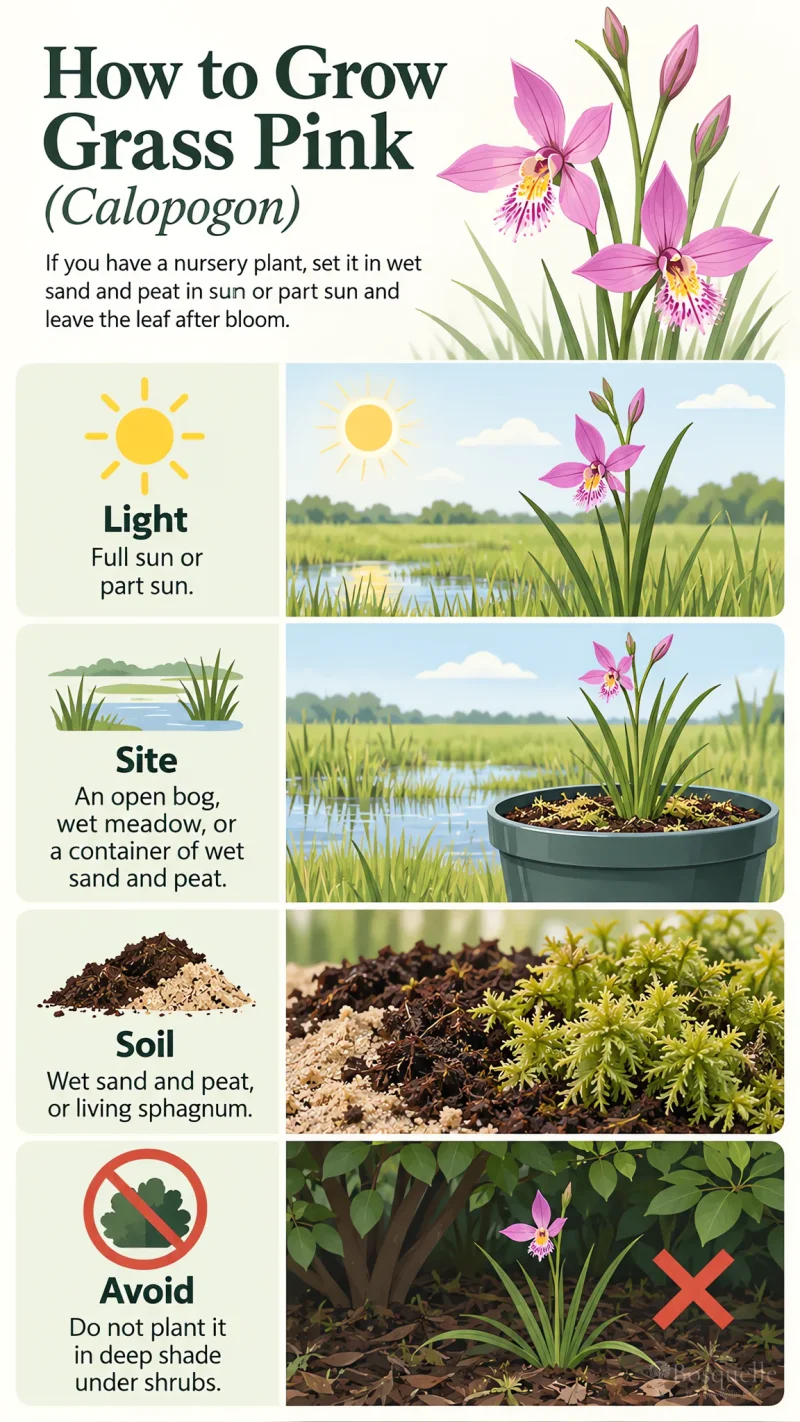
Keep it in wet sand and peat, in full sun or part sun
| Factor | Recommended | Avoid |
|---|---|---|
| Light | Full sun or part sun | Do not plant it in deep shade under shrubs |
| Soil | Wet sand and peat, or living sphagnum | Do not use ordinary potting mix or a dry border |
| Water | Keep the peat wet | Do not let the corm sit dry, and do not sink the plant underwater |
| Site | An open bog, wet meadow, or a container of wet sand and peat | Do not collect a wild plant |
| Source | A nursery-raised plant from a specialist grower | Do not dig it from a wild bog |
grass pink is a corm orchid. One grass-like leaf stands at the base while a spike of pink flowers opens, with the showy lip on top and a yellow beard. Give it wet sand and peat, or living sphagnum, in an open site. Ordinary garden soil that dries out is the wrong home. [1] It wants full sun in moist meadows, bogs, and savannas. Keep that peat wet, and do not let shrubs close over the plant. [2]
How much sun does grass pink need?
Full sun or part sun. Deep shade under shrubs is a poor site.
How wet should the peat stay?
Keep the peat wet. Do not let the corm sit dry, and do not sink the plant underwater like a pond lily.
Set a nursery corm in wet peat — do not dig a wild plant
Specialist nurseries sell nursery-grown plants. A plant lifted from a wild bog can wipe out a local stand, and it rarely takes. If you have a nursery corm, set it in wet sand and peat or living sphagnum, with the bud just under the surface, then leave it. [3]
- Buy a nursery-raised plant. Do not dig a wild plant, even if the bog is on your land and the flowers are showy.
- Set the corm in wet sand and peat or living sphagnum, with the bud just under the surface.
- Water so the peat stays wet after planting. A tall pot that sits in a shallow tray of rainwater works if you have no bog. Do not sink the plant underwater.
- Leave the plant in that wet spot. A later move rarely works.
Can I transplant one from a wild bog?
No. Digging it can wipe out a local stand, and a wild plant rarely takes. Leave it in the bog.
Can I grow it in a pot?
Yes, in a tall outdoor pot of wet sand and peat that stays wet. Do not use ordinary mix on a windowsill.
Leave the grass-like leaf until it yellows
The leaf is already there at bloom. After the pink spike fades, leave that leaf until it yellows, so the corm can store food for next year. Leave the corm in the wet peat through winter. This is a hardy bog perennial, not a bulb you lift and store dry.
- After the pink flowers fade, leave the stalk and the leaf in place.
- Do not cut the leaf while it is still green.
- Leave the corm in wet peat through winter. Do not store it dry.
When does the leaf show?
At bloom. One grass-like leaf stands at the base while the flowers open.
Do I cut it back for winter?
No. Leave the leaf until it yellows, and leave the corm in wet peat. Do not lift and store it dry.
Not garden pinks — and not muhly grass or dragon's mouth
Garden pinks are Dianthus, a border plant with pairs of leaves and a dryish, gritty bed. See How to Grow Dianthus if that is the plant on the tag. Grass pink is a bog orchid.
Pink muhly is a grass — see How to Grow Pink Muhly Grass if the tag says muhly. Bearded pink is this orchid, not bearded iris — see How to Grow Irises if you bought a rhizome iris.
Dragon's mouth is Arethusa. It grows in the same wet sphagnum, but the stalk is nearly leafless at bloom and the lip sits at the bottom. See How to Grow Dragon's Mouth if that is the plant. Rose pogonia has a stem leaf at flowering and the lip at the bottom, with no yellow brush on top. [4]
Swamp pink on a U.S. conservation list is usually Helonias, an evergreen rosette with a cone of many small pink flowers, not this orchid. Lady's slipper is Cypripedium, with a pouch — see How to Grow Lady's Slipper if you bought a slipper orchid. A moth orchid is Phalaenopsis — see How to Grow Phalaenopsis if that is the houseplant. Bog orchid on many tags is a fringed orchid — see How to Grow Fringed Orchid if that is the plant.
Is this the same as a garden pink?
No. Garden pinks are Dianthus. Grass pink is a bog orchid with the lip on top.
Is this the same as swamp pink?
Usually no. Swamp pink on a conservation list is Helonias, an evergreen rosette. Grass pink is a corm orchid.
If you have a nursery plant, set it in wet sand and peat in sun or part sun and leave the leaf after bloom. If you found a wild plant, leave it in the bog.
FAQ
Can I grow it from seed?
The dust-like seed is usually raised in a flask. Do not collect seed from wild plants. Buy a nursery plant.
Is it a houseplant?
No. Grow it outdoors in wet sand and peat. A windowsill pot of ordinary mix will dry out or rot.
Are there other kinds of grass pink?
Other Calopogon species grow in the wild in the South. The plant shops sell as grass pink is tuberous grass pink. Those others are not extra kinds of this orchid.
Will it come back every year?
In a wet acid bog or a wet sand-and-peat bed it can. Leave the corm in wet peat and do not expect a dry border perennial.
Recommended plants

References
- [1] NC State Extension -
https://plants.ces.ncsu.edu/plants/calopogon-tuberosus-var-tuberosus/ - [2] North American Orchid Conservation Center -
https://goorchids.northamericanorchidcenter.org/species/calopogon/tuberosus/ - [3] University of Wisconsin–Madison Botany -
https://archive.botany.wisc.edu/orchids.botany.wisc.edu/Calopogon.html - [4] Native Plant Trust -
https://gobotany.nativeplanttrust.org/species/calopogon/tuberosus/
More first-season notes by plant are gathered in How to Grow Guides.
Updated: Reviewed by Bosquelle Editors