
Grow eastern hemlock in moist, acidic soil that drains, with afternoon shade where summers run hot. Eastern hemlock is Tsuga canadensis, also sold as Canadian hemlock.
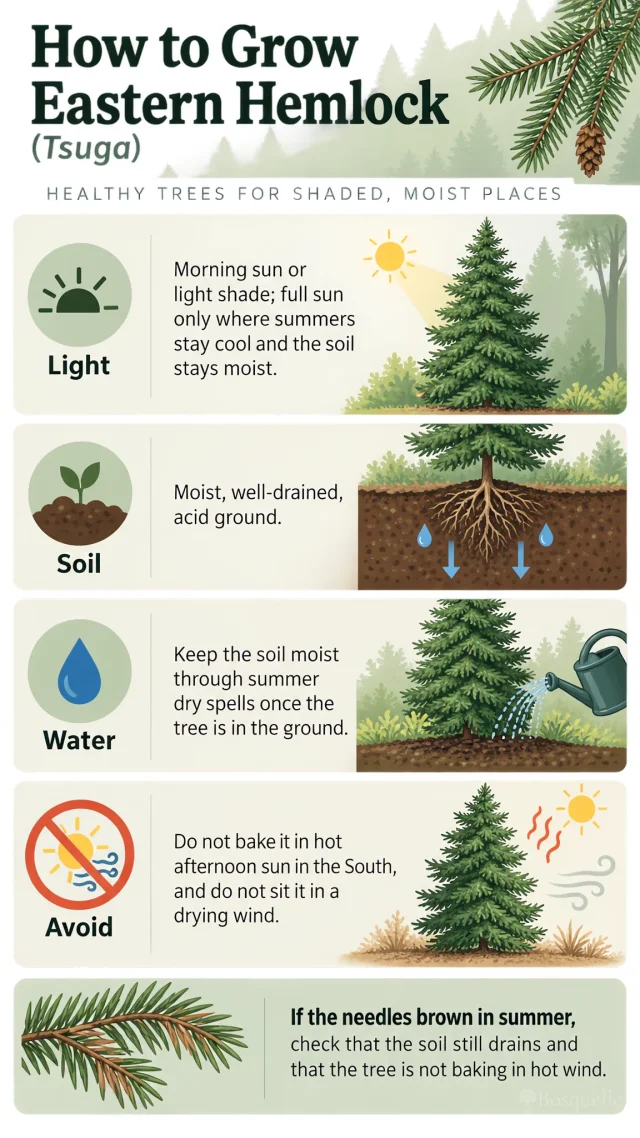
Give it moist acid soil, cool summers, and shade from hot afternoon sun
| Factor | Recommended | Avoid |
|---|---|---|
| Light | Morning sun or light shade; full sun only where summers stay cool and the soil stays moist | Do not bake it in hot afternoon sun in the South, and do not sit it in a drying wind |
| Soil | Moist, well-drained, acid ground | Do not plant it in dry alkaline soil, and do not sit the roots in standing water |
| Water | Keep the soil moist through summer dry spells once the tree is in the ground | Do not treat it as drought-proof, and do not flood heavy clay |
| Size | About 40 to 70 feet tall and 25 to 35 feet wide in a landscape | Do not park a species tree against the house or under utility wires |
eastern hemlock is a large eastern evergreen with flat needles and small hanging cones. Give it moist, acidic soil that drains, and keep it out of hot, dry wind. [1] It takes shade better than most needled evergreens, and it fails in heat, drought, and a tight urban street. [2] The same acid, moist, well-drained ground works from full sun into shade. [3] A small nursery tree still needs regular water after you set it — that job is on Planting Eastern Hemlock.
How do you grow eastern hemlock?
Give it moist, acidic soil that drains, cool summers, and afternoon shade where the heat builds. Keep it out of drought and drying wind.
How big does an eastern hemlock get?
A landscape tree is about 40 to 70 feet tall and 25 to 35 feet wide. Leave that room so the lower branches can stay on the tree.
Keep the soil moist through dry spells, and skip waterlogged clay
Once the tree is established, water deeply when the top of the soil dries in a summer dry spell, then let the extra water drain away. The tree is not drought-tolerant, so a hot bank with no soak will brown the needles. Heavy clay that holds a puddle brings root rot, so raise the bed or pick a slope that sheds water. Do not water on a calendar if rain already soaked the root zone. A screen of several trees wants the same moist, drained ground, not a wet ditch.
How often do I water eastern hemlock?
Water when the surface dries in a summer dry spell, and soak to the depth of the roots. Do not leave a puddle on clay.
Not poison hemlock — and not yew, spruce, or pine
Eastern hemlock is a woody evergreen with needles and small hanging cones. Poison hemlock is a tall herb with purple-blotched hollow stems and white umbrella flowers. If the plant dies to the ground in winter and has no needles, you do not have this tree.
Ground-hemlock is a yew, Taxus canadensis: a low spreading shrub with fleshy red arils, not hanging woody cones. If the tag says yew, read How to Grow Yew.
Spruce is Picea: the needles are square and roll between your fingers, and they sit on woody pegs. If the needles roll and the twigs feel rough after they drop, read How to Grow Spruce.
Pine is Pinus: the needles come in bundles of two, three, or five. If the needles are bundled, read How to Grow Pine.
True fir is Abies: the cones stand up and fall apart on the tree. Douglas-fir is Pseudotsuga, with hanging cones that show three-pointed bracts. If the tag says fir, start at How to Grow Fir or How to Grow Douglas Fir.
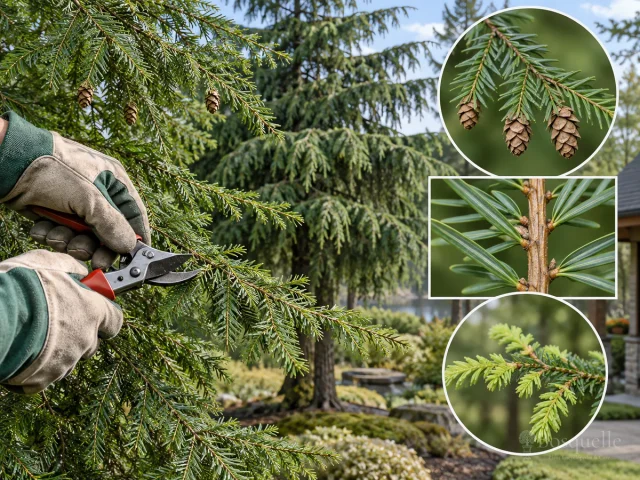
The sure field marks on this tree are short, flat, blunt needles with two pale stripes underneath, and small hanging cones. The needles do not roll, and they do not come in bundles. [4]
How do I tell eastern hemlock from poison hemlock?
Look for wood, needles, and small hanging cones. Poison hemlock is a herb with purple-blotched hollow stems and white umbrella flowers. It is not this tree.
If the needles brown in summer, check that the soil still drains and that the tree is not baking in hot wind.
FAQ
Is there more than one kind of eastern hemlock?
This shop holds one species, Tsuga canadensis. Weeping, dwarf, and Sargentii names are still this species and want the same moist, acid, drained ground.
Can I grow eastern hemlock in a pot?
A nursery pot is how a young tree is sold, not a houseplant. Plant it in the ground. A 40-foot tree will not stay in a patio pot. A dwarf named form can live in a large outdoor container that drains, then it still needs the same moist, cool site.
Will deer eat eastern hemlock?
The tree is moderately deer-resistant. Hungry deer still browse the foliage in a hard winter, so protect a young plant if browse pressure is high.
Is eastern hemlock poisonous?
This evergreen tree is not the poison hemlock of ditches. The tree is listed as non-toxic for cats, dogs, and horses. Do not brew the needles as a tea crop.
What pests hit eastern hemlock?
Hemlock woolly adelgid is the pest that kills stands. Watch for white wool on the undersides of twigs. For the insect itself, read Adelgids. Loopers that mat needles are on Hemlock looper.
Does eastern hemlock need winter protection?
An established tree stays in the ground as an evergreen. Shelter it from a strong winter wind so the needles do not burn. Do not lift it like a tender pot plant.
Related guides
Recommended plants

References
- [1] NC State Extension -
https://plants.ces.ncsu.edu/plants/tsuga-canadensis/ - [2] The Morton Arboretum -
https://mortonarb.org/plant-and-protect/trees-and-plants/eastern-hemlock/ - [3] Penn State Extension -
https://extension.psu.edu/the-state-tree-of-pennsylvania-eastern-hemlock - [4] Michigan Department of Natural Resources -
https://www.michigan.gov/invasives/-/media/Project/Websites/invasives/Documents/ID/Disease/hemlock_tree_ID_brochure.pdf
This note is part of Tsuga Guides.
More first-season notes by plant are gathered in How to Grow Guides.
Updated: Reviewed by Bosquelle Editors