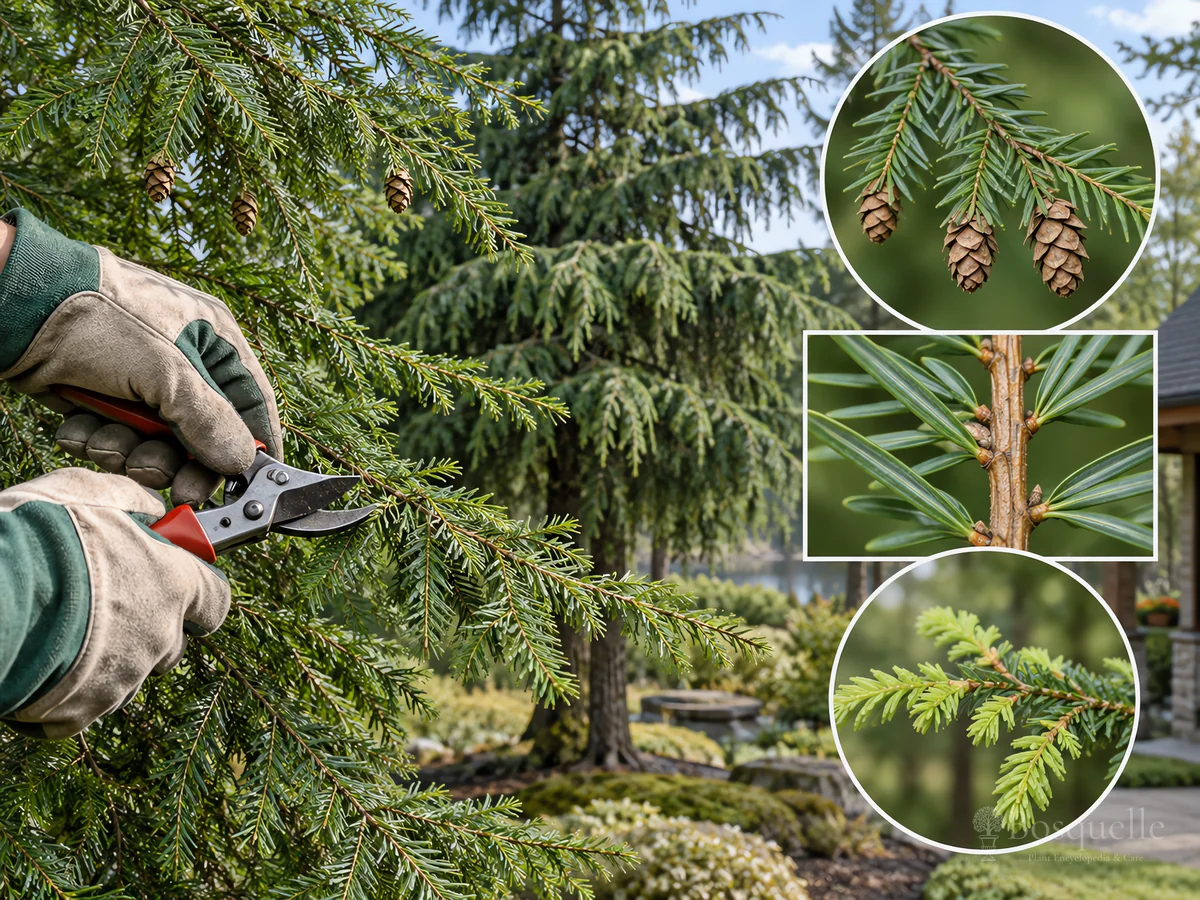
Prune eastern hemlock in late winter. Shear a hedge so the base is wider than the top, and do not cut into wood that has no needles.

Shear a hedge in late winter, wider at the base than the top
| Factor | Recommended | Avoid |
|---|---|---|
| When | Late winter, just before spring growth; a second light trim in late spring if the hedge is vigorous | Do not prune in summer or fall, except to take broken wood |
| Shape | A wedge, with the base wider than the top so light reaches the lower branches | Do not cut a flat top with vertical sides that shade out the skirt |
| Where | Green wood that still has needles | Do not cut into the needleless interior |
| How much | A light shear on a hedge; little or none on a specimen that already has a good outline | Do not shear every month, and do not top the leader on a landscape tree |
eastern hemlock takes a hedge shear better than most needled evergreens, and it still looks best if you stop once the outline is even. [1] Trim in late winter, keep the base wider than the top, and use shears only for the surface. Thin a few inner stems with loppers so light reaches the interior. [2]
- Wait until late winter, just before the flush. Take a second light pass in late spring only if the hedge jumped.
- Stand back and mark a wedge: the bottom of the hedge should be wider than the top on both sides.
- Shear the surface in short bites, back to green needles. Do not reach into bare wood to chase a line.
- Thin a few crowded inner stems with loppers so light reaches the lower branches.
- Stop. Frequent shearing packs the outer needles and enlarges the bare core.
When should I prune eastern hemlock?
Late winter, just before new growth starts. A vigorous hedge can take a second light trim in late spring. Remove broken wood any time.
How to prune a landscape eastern hemlock
A specimen wants almost no shear. Keep one leader, cut only where green needles remain, and leave the lower branches unless a limb blocks a walk or a roof. [3] Needles will not sprout from bare interior wood. If you cut into it, the hole stays. [4]
- Wait until late winter or early spring, before the strong flush.
- Find the last green needles on the stem you want to shorten. Do not go behind that into bare wood.
- Cut back to a side bud or a side branch that still has needles. Take a large limb at the branch collar with a three-cut method so the bark does not tear.
- Leave the central leader. If it is broken, pick one upright shoot to replace it and remove rivals.
- Leave the lowest healthy branches. Take a lower limb only if it blocks a walk or a roof, and cut it back to the trunk.
- Stop. If the tree already fills the lot, replace it rather than topping into the core.
Will eastern hemlock grow back from bare wood?
No. New needles will not grow from branches left with no needles. Cut only where foliage remains, or replace the plant.
If you already cut into bare wood or topped the leader, leave the tree and do not cut again this year.
FAQ
Can I top an eastern hemlock to hold the height?
No. Cutting the leader makes weak multiple tops that split in wind and snow. Choose a smaller named form, or a different tree, next time.
What if I already cut a hole in old wood?
That gap will not needle out. Nearby green growth may hide it over years. A large wound is a reason to replace the plant.
Can I prune after August?
Do not make late-summer or fall shape cuts. Soft new growth will not harden before frost. Take broken wood any time.
Related guides


Recommended plants
References
- [1] NC State Extension -
https://plants.ces.ncsu.edu/plants/tsuga-canadensis/ - [2] Save Georgia's Hemlocks -
https://www.savegeorgiashemlocks.org/Downloads/Resources_page/Other_SGH_Instructions_&_Reference_Materials/SGH_Pruning_Hemlocks_2-8-23.pdf - [3] The Morton Arboretum -
https://mortonarb.org/plant-and-protect/tree-plant-care/plant-care-resources/how-to-prune-evergreen-trees-and-shrubs/ - [4] Colorado State University Extension -
https://extension.colostate.edu/resource/pruning-evergreens/
This note is part of Tsuga Guides.
More pruning timing notes by plant live in Pruning Guides.
Updated: Reviewed by Bosquelle Editors