
Grow blue cohosh in deciduous shade, in moist woodland soil with leaf litter. Blue cohosh is Caulophyllum. It is not black cohosh.
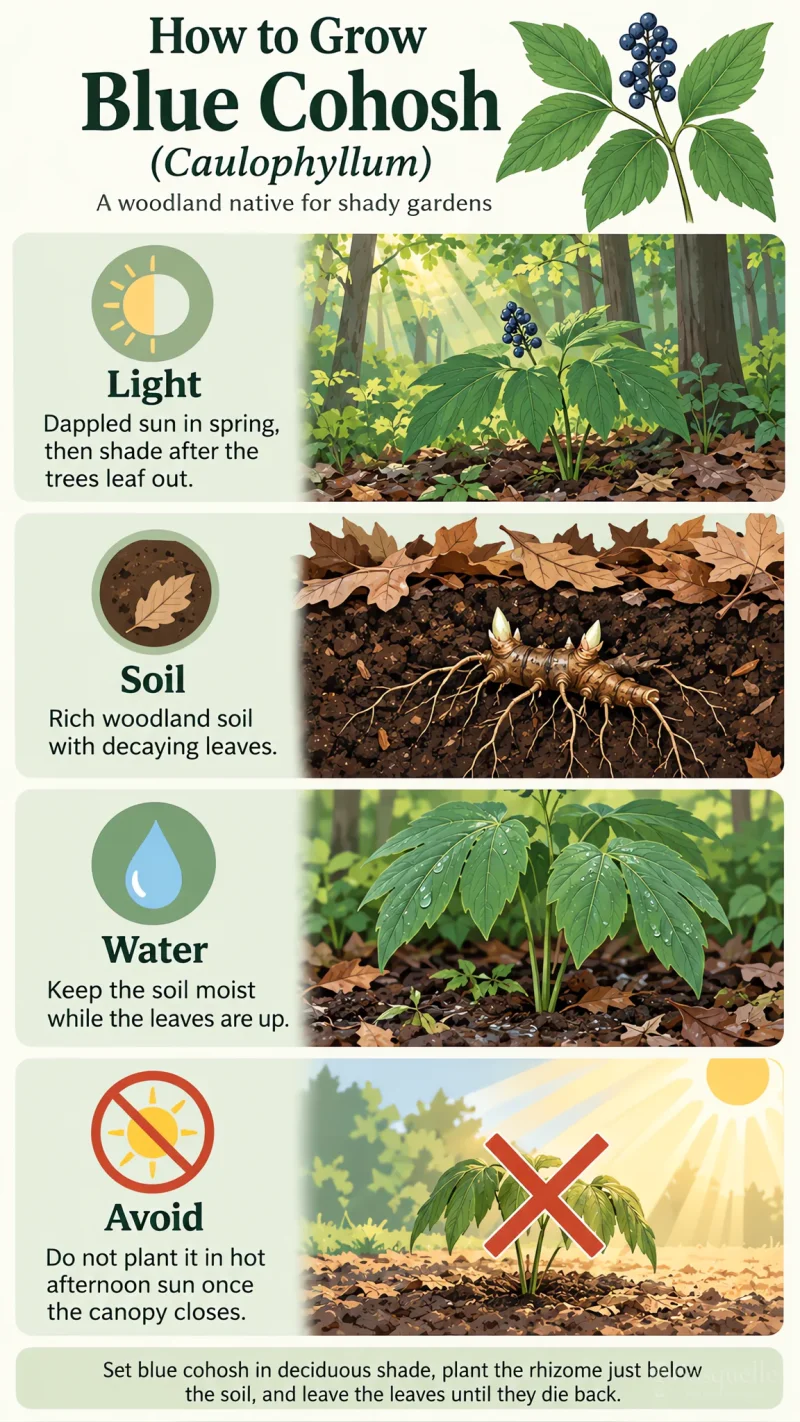
Keep it in deciduous shade, in moist woodland soil with leaf litter
| Factor | Recommended | Avoid |
|---|---|---|
| Light | Dappled sun in spring, then shade after the trees leaf out | Do not plant it in hot afternoon sun once the canopy closes |
| Water | Keep the soil moist while the leaves are up | Do not let the woodland bed dry out, and do not leave standing water around the rhizomes |
| Soil | Rich woodland soil with decaying leaves | Do not strip the leaf litter every fall |
| Seeds | Leave the blue seeds for birds | Do not eat the blue seeds or the roots |
| Winter | Leave a cover of mixed tree leaves | Do not bury the crown under a heavy bark mulch |
Blue cohosh wants moist, well-drained woodland soil under trees that lose their leaves. It blooms in spring before the leaves fully expand, then the blue seeds show through summer. [1] Give it dappled light in April, then shade once the canopy closes. [2] blue cohosh is a slow woodland perennial with lacy compound leaves and a knotty rhizome. It is not a houseplant and not a tea crop.
Where is the best place to plant blue cohosh?
Set it under deciduous trees, in moist soil with leaf litter. Oak or maple woods that stay damp through summer are the right kind of shade.
Does blue cohosh need shade?
Yes. Give it dappled sun in early spring, then shade once the trees leaf out. Open afternoon sun after the canopy closes dries the bed too fast.
Can you eat blue cohosh berries?
No. The bright blue seeds look like small grapes, but they are toxic if eaten. Leave them for birds. Do not make tea or take the roots as medicine.
Plant the rhizome just below the soil, with the buds barely covered
Plant a nursery rhizome in fall or early spring, while the plant is still dormant or just coming up. Lay the knotty piece horizontal, just below the mineral soil, with the buds barely covered. Then add a couple of inches of rotted leaves. Do not pile bark mulch on the crown. Once a clump is happy, leave it in place. Moving an old patch sets it back for years.
- Choose a moist woodland bed under deciduous trees. Loosen the soil and keep decaying leaves on top.
- Set the rhizome horizontal, just below the soil surface, with the buds facing up and barely covered.
- Spread the roots out, firm the soil, and water once so it settles.
- Cover with about two inches of leaf litter, not a heavy bark mulch.
- Keep the soil moist through the first summer. Do not till the bed, and do not dig an established clump for sport.
How do I plant blue cohosh?
Set a knotty rhizome just below the soil, buds barely covered, in moist woodland soil with leaf litter. Plant in fall or early spring, and leave established clumps alone.
Divide only after bloom, or while the plant is dormant
Most gardeners buy a nursery plant rather than lift an old clump. If you must divide, wait until just after the flowers fade, or wait until the plant is underground in fall. Cut a plump piece with several buds, and replant it at once so it does not dry. Stem cuttings do not make a new plant.
- Wait until after bloom, or until the leaves have died back.
- Lift a knotty piece with several buds. Do not tear the clump into dry fragments.
- Replant at once at the same shallow depth, and water so the soil settles.
Can I grow blue cohosh from cuttings?
No. Start a new plant from a plump rhizome piece with several buds, not from a stem cutting. Divide only after bloom, or while the plant is dormant.
Sow fresh seed if you want seedlings
Seed loses its ability to sprout if it dries. Collect the blue seeds in late summer, nick the hard coat, and sow them at once on a moist, shaded bed. Seedlings often take two years to appear, and they are slow to flower. [3] A nursery rhizome still gives you a plant sooner than a seed packet.
- Collect seeds when they have turned bright blue, usually late summer. Do not eat them.
- Nick the hard coat, and sow at once on moist, shaded soil. Do not store a dry packet over winter if you can help it.
- Mark the bed and wait. Many seedlings do not show until the second spring.
How to grow blue cohosh from seed?
Sow fresh seed in fall on a moist, shaded bed, and nick the hard coat. Stored dry seed often fails, and seedlings may take two years to appear.
Let the leaves die back, and leave a winter cover of leaves
Do not cut the leaves while they are green. They feed the rhizome for next spring. When they yellow in fall, leave them until they disappear. A cover of mixed tree leaves through winter keeps the rhizome from heaving. [4] Do not pile a heavy bark mulch on the bed. The rhizome sits just under the surface.
- Leave the foliage in place until it yellows and dies back on its own.
- Keep a layer of mixed tree leaves on the bed through winter and into spring.
- Do not till, rake hard, or pull weeds by the roots through the dormant patch.
- Mark the patch if you will divide later, because there is little to see in winter.
Do I cut blue cohosh back?
No. Leave the leaves until they yellow and die back. Cutting them while they are green starves the rhizome.
Does blue cohosh come back after the leaves die?
Yes. The plant rests underground through winter. New shoots come up the next spring from the same rhizome.
Not black cohosh — and not meadow rue
Black cohosh is Actaea, a taller woodland plant with white bottlebrush flowers later in the season — see How to Grow Bugbane. Blue cohosh has lacy compound leaves, small yellow-green or bronze flowers in spring, and bright blue seeds. Do not swap the two names on a tea or capsule label.
Meadow rue is Thalictrum. The leaflets look similar, which is why the species name is thalictroides, but meadow rue does not make blue seeds — see How to Grow Meadow Rue. Rue anemone is Thalictrum thalictroides, a smaller spring woodland flower — see How to Grow Rue Anemone.
Early blue cohosh, sometimes called giant blue cohosh, is a different species with larger purple flowers that open before the leaves expand. It is not this shop card. Trillium, wild ginger, and Solomon's seal share the same woods; they are not this plant — see How to Grow Trillium, How to Grow Wild Ginger, and How to Grow Solomon's Seal.
Is blue cohosh the same as black cohosh?
No. Black cohosh is Actaea, with tall white bottlebrush flowers. Blue cohosh is Caulophyllum, with lacy leaves and blue seeds. They are not the same plant and not the same tea.
Is this meadow rue?
No. The leaflets look alike, but meadow rue is Thalictrum and does not make bright blue seeds. Blue cohosh is Caulophyllum.
Where is the best place to plant black cohosh?
Black cohosh is Actaea. Site that plant from How to Grow Bugbane. Blue cohosh is the lacy woodland plant with blue seeds.
Set blue cohosh in deciduous shade, plant the rhizome just below the soil, and leave the leaves until they die back.
FAQ
Can I grow blue cohosh in a pot?
A pot works only as a short stop for a nursery rhizome. Blue cohosh is a woodland perennial. Set it in the ground under deciduous trees.
Is there more than one blue cohosh?
This shop card is Caulophyllum thalictroides. Early blue cohosh, also called giant blue cohosh, is a different species. Black cohosh is Actaea, not this plant.
Is blue cohosh a native woodland plant?
Yes. It is a native of eastern deciduous woods. Grow it as a shade wildflower, not as a crop.
Recommended plants

References
- [1] NC State Extension -
https://plants.ces.ncsu.edu/plants/caulophyllum-thalictroides/ - [2] Illinois Wildflowers -
https://www.illinoiswildflowers.info/woodland/plants/blue_cohosh.html - [3] Iowa State University woodland understory restoration -
https://understory.nrem.iastate.edu/species/caulophyllum-thalictroides - [4] Lady Bird Johnson Wildflower Center -
https://www.wildflower.org/plants/result.php?id_plant=CATH2
More first-season notes by plant are gathered in How to Grow Guides.
Updated: Reviewed by Bosquelle Editors