
Solomon’s seal fails fastest in a hot, dry west exposure or when you plant it as if it were false Solomon’s seal (Maianthemum) with a different habit story.

P. humile, P. multiflorum, P. biflorum, and cream-edged P. odoratum ‘Variegatum’ want cool shade, humus-rich soil that stays evenly moist while they establish, and shallow horizontal rhizomes left mostly alone.
Once knitted under trees they can handle drier shade — year one still needs water. Match dappled light and cool roots before you blame the kind.
Cool shade and a quiet rhizome run come first
| Site you give it | What you get | What fails |
|---|---|---|
| Dappled shade or morning sun, moist humus, room for rhizomes to creep | Arching stems, spring bells, calm foliage into autumn yellow | Almost nothing — this is the plant’s job |
| Hot west wall or reflected pavement heat | Scorched leaf edges; thin stressed clumps | Elegant understory structure |
| Compacted bare clay with no mulch under thirsty trees | Short stems; drought wilt every July | Steady colony knit |
| Deep planting like a peony eye | Slow or rotting crowns | Reliable spring emerge |
Solomon’s seal is a woodland rhizome plant. Dig where leaf litter, tree shade, or a north-facing fence keeps soil cool through summer. If the site fries hostas and ferns by August, it will fry Polygonatum too. Rhizomes travel horizontally just under the mulch line — give them a quiet run without constant foot traffic.
The common name comes from the round scar left on the rhizome when last year’s stem detaches after frost. Berries are ornamental and poisonous if eaten — grow this as shade foliage, not forage.
False Solomon’s seal (Maianthemum) is a different genus with its own care page. Confirm Polygonatum when you want the classic arching cane and dangling axillary bells.
Plant Solomon's seal with the rhizome decided
- Confirm Polygonatum — Solomon’s seal with arching stems and bells under the leaves, not false Solomon’s seal (Maianthemum).
- Choose dappled shade or morning sun with cool, humus-rich soil — woodland edge, north fence, or under deciduous canopy.
- Loosen the top spit and work in leaf mould or composted bark so rhizomes can creep sideways.
- Lay rhizomes horizontally, buds up, covered by only a few centimetres of soil — never deep like a peony.
- Water to settle and keep evenly moist through the first one to two summers, especially under thirsty trees.
- Mulch with leaf litter or shredded bark to keep roots cool; mark the clump so spring digging does not spear the crown.
Divide in early spring as shoots emerge, or early autumn once foliage softens. Lift with a wide fork, cut pieces that each carry at least one strong bud, and replant immediately. Do not yank stems upward — that snaps the crown from the rhizome. Midsummer division in heat is a sulk invitation.
Common failure modes: full-sun planting; deep planting; drought year one with no mulch; cutting foliage hard in midsummer; confusing Maianthemum labels at the nursery.
Dwarf, arching, and variegated kinds
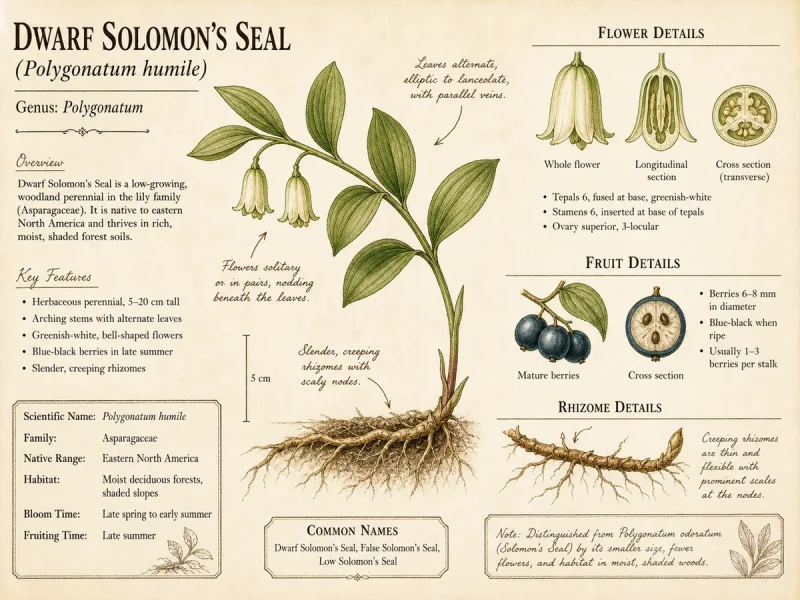
- Dwarf lane — P. humile for ankle- to shin-high front edges and narrow shade paths (same cool moist contract).
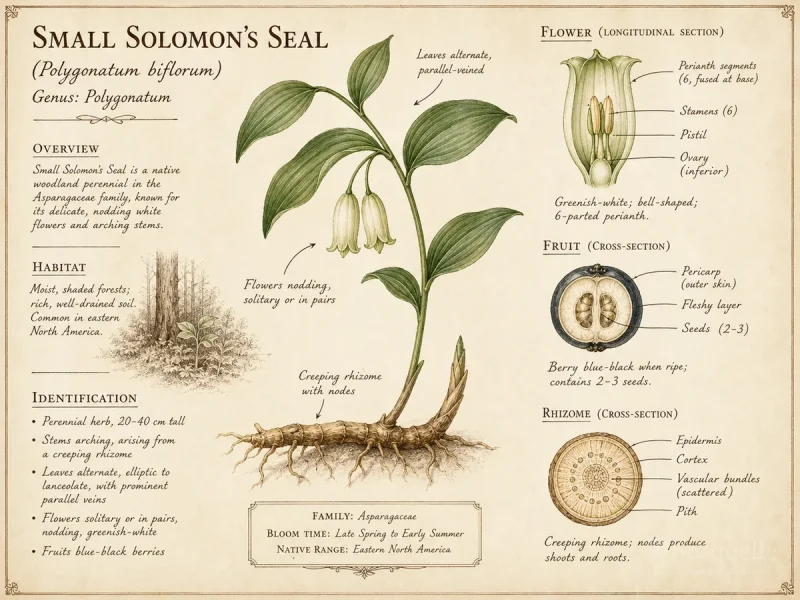
- Classic arching lane — P. multiflorum for the Eurasian arching habit many gardeners mean by the common name; P. biflorum for taller native woodland structure in good soil.
- Variegated lane — P. odoratum ‘Variegatum’ for cream margins that brighten dark shade — not a sun-tolerant upgrade.
Browse rule: pick height and foliage first; keep shade and moisture. Swapping humile for multiflorum will not rescue a hot dry bed, and variegation does not buy afternoon sun.
Season timeline — bells, then foliage architecture
| Season | What Solomon's seal is doing | Your job |
|---|---|---|
| Early spring | Shoots emerge; bells follow on arching stems | Weed gently; divide only if moving clumps |
| Late spring | Flowers hang under leaves; pollinators visit | Keep soil evenly moist; slug-watch soft tips |
| Summer | Foliage carries the show; rhizomes thicken | Water drought under trees; do not shear green stems |
| Autumn | Leaves yellow; blue-black berries may hang | Let foliage die back; refresh mulch; mark the clump |
| Winter | Dormant rhizomes under mulch | Avoid deep digging through the marked patch |
Year-one stems often look thinner than catalog photos. Judge success by whether the clump returns thicker the next spring, not by matching a mature woodland picture in month three.
When pots beat open ground
- Temporary holding while a woodland bed is prepared.
- A deep, cool patio tub you can water without cooking the root ball.
- You need to move plants before a hardscape change.
Open woodland ground still wins for long-term colonies. Shallow pots that overheat fail the cool-root contract faster than any cultivar swap.
Partners that share cool shade
- Fern texture beside P. multiflorum or P. biflorum in moist humus.
- Spring bulb flash that finishes before the canopy closes, without digging the rhizome zone every year.
- Bright foliage ribbon — P. odoratum ‘Variegatum’ with epimedium or light-rooted shade geraniums that leave travel room.
Skip aggressive mat-forming groundcovers that smother rhizomes, and skip thirsty sun shrubs that force a desert watering schedule on the whole bed.
Myths that waste a Solomon's seal planting
Myth: it wants full sun like a border perennial. False — cool shade is the growth engine.
Myth: variegated kinds take more light. False — cream margins bleach and burn in hot sun.
Myth: it is the same plant as false Solomon's seal. False — Maianthemum is a different genus.
Myth: dry shade means no water ever, from day one. False — establish with moisture first; drought tolerance comes later.
What usually decides Solomon's seal success
Cool shade, moist humus while rhizomes knit, and shallow planting outperform a prettier tag in a hot dry pocket every time. Photograph spring bells and again the following spring after shoots thicken — flowers prove the site; denser stems prove the rhizomes settled. When in doubt, add mulch and shade before you add fertiliser.
FAQ
Does Solomon's seal need full shade?
Dappled shade or morning sun with afternoon relief is ideal. Deep dark shade slows growth; hot full sun scorches leaves and stresses rhizomes.
How deep should I plant Solomon's seal rhizomes?
Shallow. Lay rhizomes horizontally with buds up and cover with only a few centimetres of soil, then mulch lightly.
When can I divide Solomon's seal?
Early spring as shoots emerge, or early autumn. Lift with a wide fork, keep buds on each piece, and replant immediately.
Why are my Solomon's seal leaves scorched?
Usually too much sun or dry heat at the root. Move to cooler shade, mulch, and water during drought under trees.
Can Solomon's seal grow in dry shade?
Once established, many plantings tolerate dry shade near tree roots if you mulch and water the first seasons.
Will variegated Solomon's seal take more sun?
No. Cream margins bleach and burn in hot light. Keep P. odoratum 'Variegatum' in bright shade with cool roots.
Is Solomon's seal poisonous?
Berries and other parts are poisonous if eaten. Grow it as a shade foliage plant — not a forage crop.
Is Solomon's seal the same as false Solomon's seal?
No. False Solomon's seal is Maianthemum — a different genus. Confirm Polygonatum for classic arching stems with bells under the leaves.
Is Polygonatum humile just a short multiflorum?
It is a dwarf species for front-of-border shade. Care is the same cool moist contract — dwarf does not mean drought alpine.
Do deer eat Solomon's seal?
Often less than hostas, but pressure varies. Do not use deer resistance as an excuse to plant in baking sun.
Should I cut Solomon's seal back after flowering?
No. Leave foliage to feed the rhizome until it yellows naturally in autumn.
What soil suits Solomon's seal best?
Humus-rich, evenly moist soil that never bakes hard. Leaf mould and composted bark beat bare clay.
Can I grow Solomon's seal in a container?
Possible short-term in a deep, cool pot that never overheats, but woodland ground is kinder for long-term rhizomes.
How fast does Solomon's seal spread?
Steadily sideways once happy — not a runaway mint, but give room and divide when crowded.
What partners work beside Solomon's seal?
Shade ferns, epimediums, spring bulbs, and light-rooted woodland companions that share moisture without constant digging.
What fails Solomon's seal fastest?
Hot dry sun, deep planting, and year-one drought under trees with no mulch.
Recommended plants


More first-season notes by plant are gathered in How to Grow Guides.
Updated: Reviewed by Bosquelle Editors