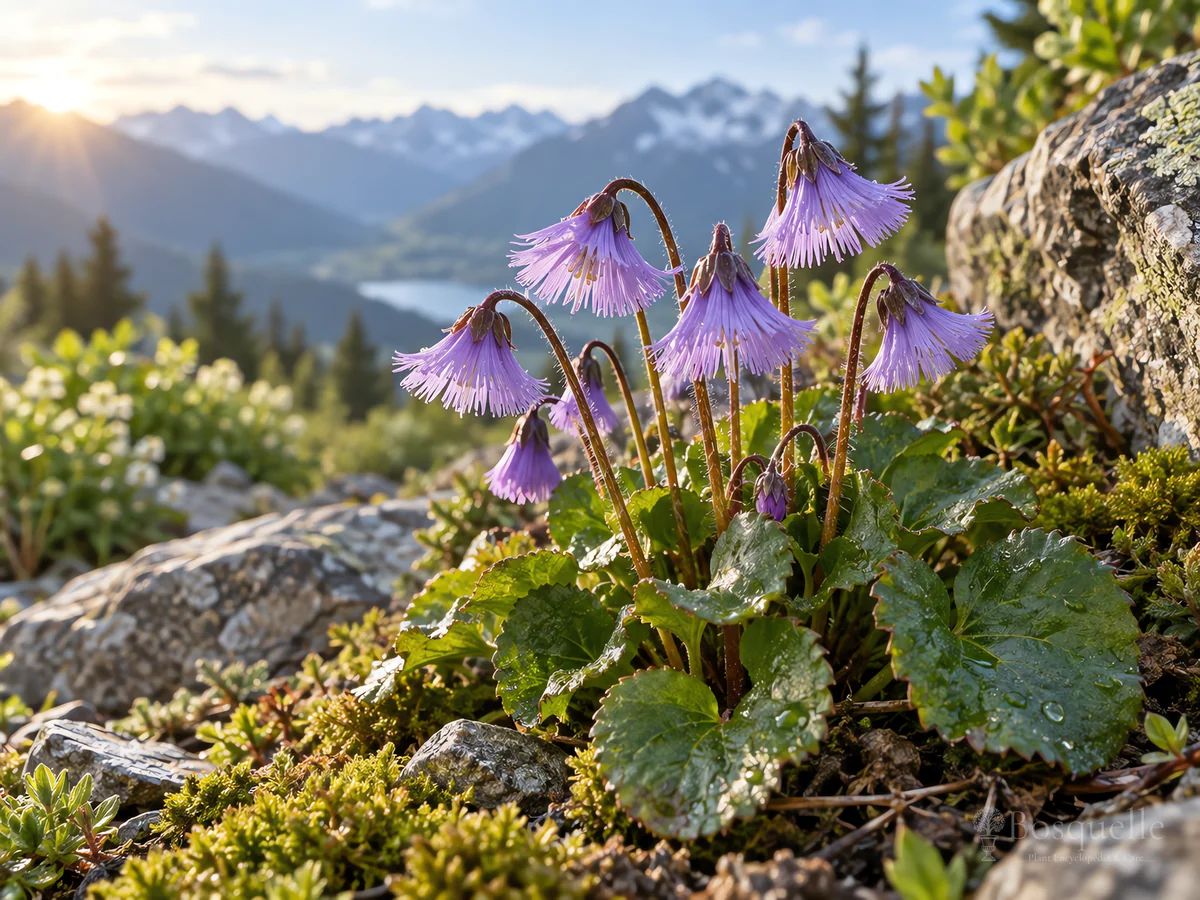
Grow alpine snowbell in cool sun, in moist grit that drains, and keep winter rain off the crown. The plant is Soldanella alpina, a tiny alpine primrose with fringed violet bells — not a Japanese snowbell tree, and not sea bindweed.
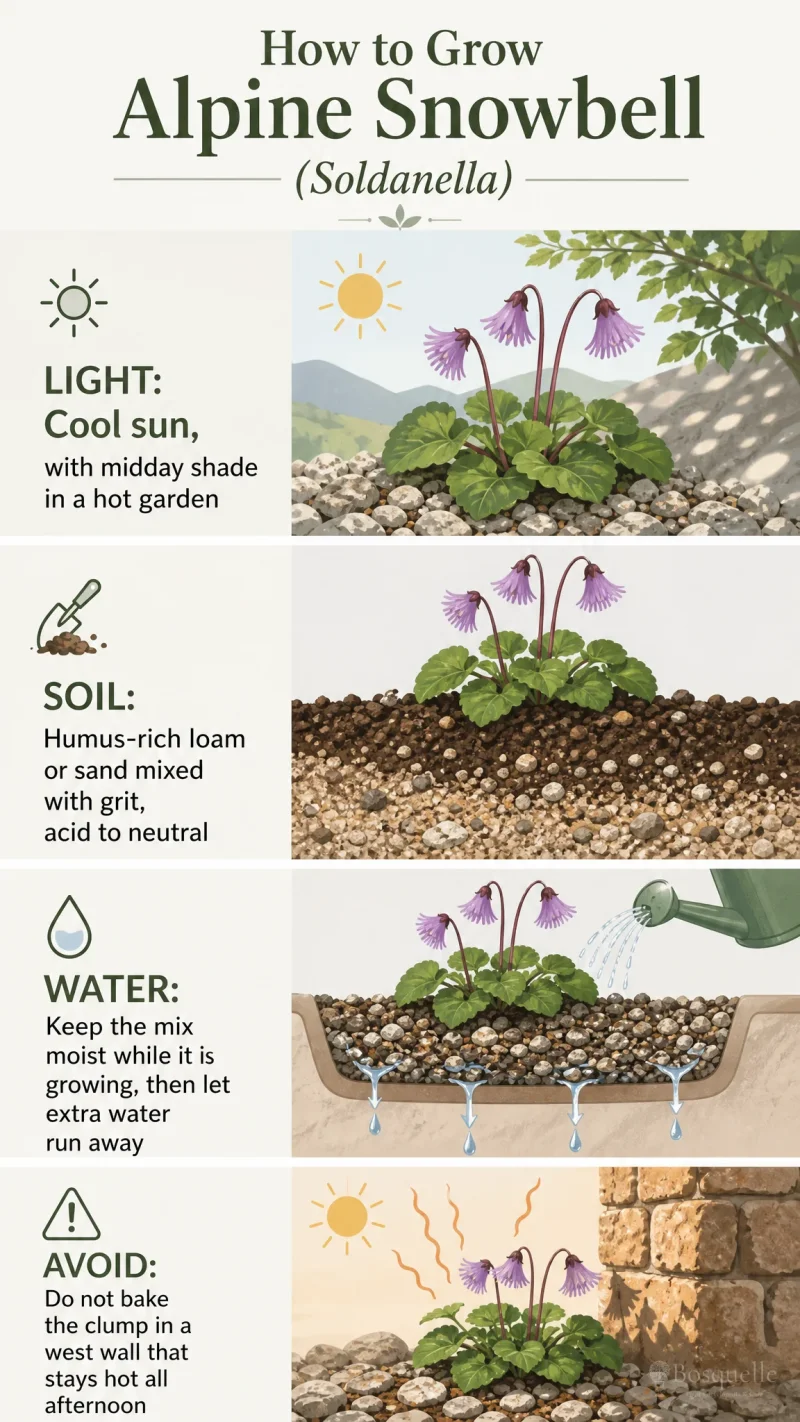
Give it cool sun, moist grit that drains, and keep winter rain off the crown
| Factor | Recommended | Avoid |
|---|---|---|
| Light | Cool sun, with midday shade in a hot garden | Do not bake the clump in a west wall that stays hot all afternoon |
| Water | Keep the mix moist while it is growing, then let extra water run away | Do not let the roots sit in a hole that stays wet, and do not let the mix bake dry in summer |
| Soil | Humus-rich loam or sand mixed with grit, acid to neutral | Do not plant it in packed clay, and do not bury the crown |
| Home | A rock pocket, a north slope, or a draining trough or alpine pan | Do not grow it as a warm indoor houseplant |
| Size | Leave room for a 3 to 5 inch evergreen clump of round, leathery leaves | Do not treat it as a tree or a fast groundcover |
Alpine snowbell is Soldanella alpina. It wants cool sun and a mix that stays moist without holding a puddle around the crown. In a hot garden, give it midday shade. Full afternoon sun on a west wall scorches the round leaves and dries the mix too fast. [1] A rock garden, a north-facing slope, or a stone trough with a drainage hole is the usual home, because extra water has somewhere to go. [2] Surround the crown with grit so rain does not sit on the leaves in winter. The plant is hardy in the cold, but a crown that stays wet through a mild, rainy winter is the usual reason it rots. [3]
If you grow it in a trough, move the pan under a cold frame or a pane of glass when winter rain sets in, or set a small ledge above the clump on open rockwork. Keep the frame cool and dry. Do not wrap the plant in plastic. In spring, water again so the mix stays moist while the bells open. [4]
How much sun does alpine snowbell need?
Cool sun, with midday shade in a hot garden. A west wall that stays hot all afternoon is too much.
How do I water alpine snowbell in the ground?
Keep the mix moist while it is growing, and let extra water drain away. Do not leave the roots in a puddle.
How do I keep winter rain off the crown?
Top-dress grit around the crown. In a wet winter, move a trough under a cold frame, or set a ledge above the clump on open rockwork.
Plant a nursery clump in grit, with the crown at the soil
Buy a nursery plant. Set the crown at the soil surface, not buried, in a mix of humus and grit. Backfill so the round leaves sit above the mix, then top-dress grit around the crown so winter rain sheds. Water until the mix is moist and extra water runs out.
- Choose a rock pocket, a north slope, or a trough with a drainage hole, in cool sun with midday shade if the garden runs hot.
- Set the clump so the crown sits even with the soil. Do not bury the growing point.
- Backfill with a humus-rich mix plus grit. Top-dress grit around the crown.
- Water until the mix is moist and extra water drains away. Keep it moist through the first growing season.
How do I plant alpine snowbell?
Set a nursery clump with the crown at the soil, in humus and grit. Top-dress grit around the crown, and water until extra water drains away.
Not Japanese snowbell — and not sea bindweed
Japanese snowbell is a small flowering tree with hanging white bells. If the tag says Styrax, that job is How to Grow Japanese Snowbell. Alpine snowbell is a 3 to 5 inch alpine primrose with round leaves and fringed violet bells in early spring.
Sea bindweed is Calystegia soldanella, a trailing dune plant with kidney-shaped leaves and pink trumpets. The shared epithet is only a name collision. If you bought a beach morning glory, that job is How to Grow Calystegia.
Oconee bells is Shortia, a woodland evergreen with one nodding fringed bell in shade and leaf mold — that job is How to Grow Oconee Bells. Garden primroses are cousins in the same family, with open faces rather than deeply fringed alpine bells — that job is How to Grow Primroses. A snowdrop is a winter bulb, not this evergreen clump — that job is How to Grow Snowdrops. Snowbelle is a mock-orange shrub — that job is How to Grow Mock Orange. Blue moonwort is an old catalog name for this alpine, not Lunaria and not a fern.
Is alpine snowbell the same as Japanese snowbell?
No. Alpine snowbell is a tiny alpine primrose. Japanese snowbell is a Styrax tree with hanging white bells.
If you have a nursery clump, set it in cool sun in moist grit that drains, and keep winter rain off the crown.
FAQ
Is there more than one kind of alpine snowbell?
This catalog holds one species, Soldanella alpina. Other European names such as Soldanella minima and Soldanella montana show up in alpine lists, but they are not separate cards here. All of them still want cool sun, moist grit, and a crown that does not sit in winter rain.
Can I grow it as a houseplant?
No. A draining trough or alpine pan outdoors, or under a cold frame in winter, is the usual container. A warm indoor windowsill is the wrong home.
Do I need to prune alpine snowbell?
No. Pull a spent flower stalk or a rotten outer leaf if you want it tidy. Do not cut the clump back as if it were a shrub.
Can I dig it from the mountains?
No. Buy a nursery plant. Wild stands have been collected too hard already, and a dug clump rarely settles.
How do I get more plants?
Start more plants from a clump you already have on How to Propagate Alpine Snowbell.
Related guides

Recommended plants

References
- [1] Royal Horticultural Society -
https://www.rhs.org.uk/plants/17459/soldanella-alpina/details - [2] Alpine Garden Society -
http://encyclopaedia.alpinegardensociety.net/plants/Soldanella - [3] GardenersHQ -
https://www.gardenershq.com/Soldanella-Alpine-Snowbell.php - [4] The Gardener (Thomson) -
https://www.chestofbooks.com/gardening-horticulture/Gardener-3/Soldanella.html
This note is part of Soldanella Guides.
More first-season notes by plant are gathered in How to Grow Guides.
Updated: Reviewed by Bosquelle Editors