
Grow oconee bells in shade, in acid leaf mold that stays moist and still drains. The plant is Shortia galacifolia, a rare Appalachian evergreen with one nodding bell — not galax, and not a galaxy petunia.
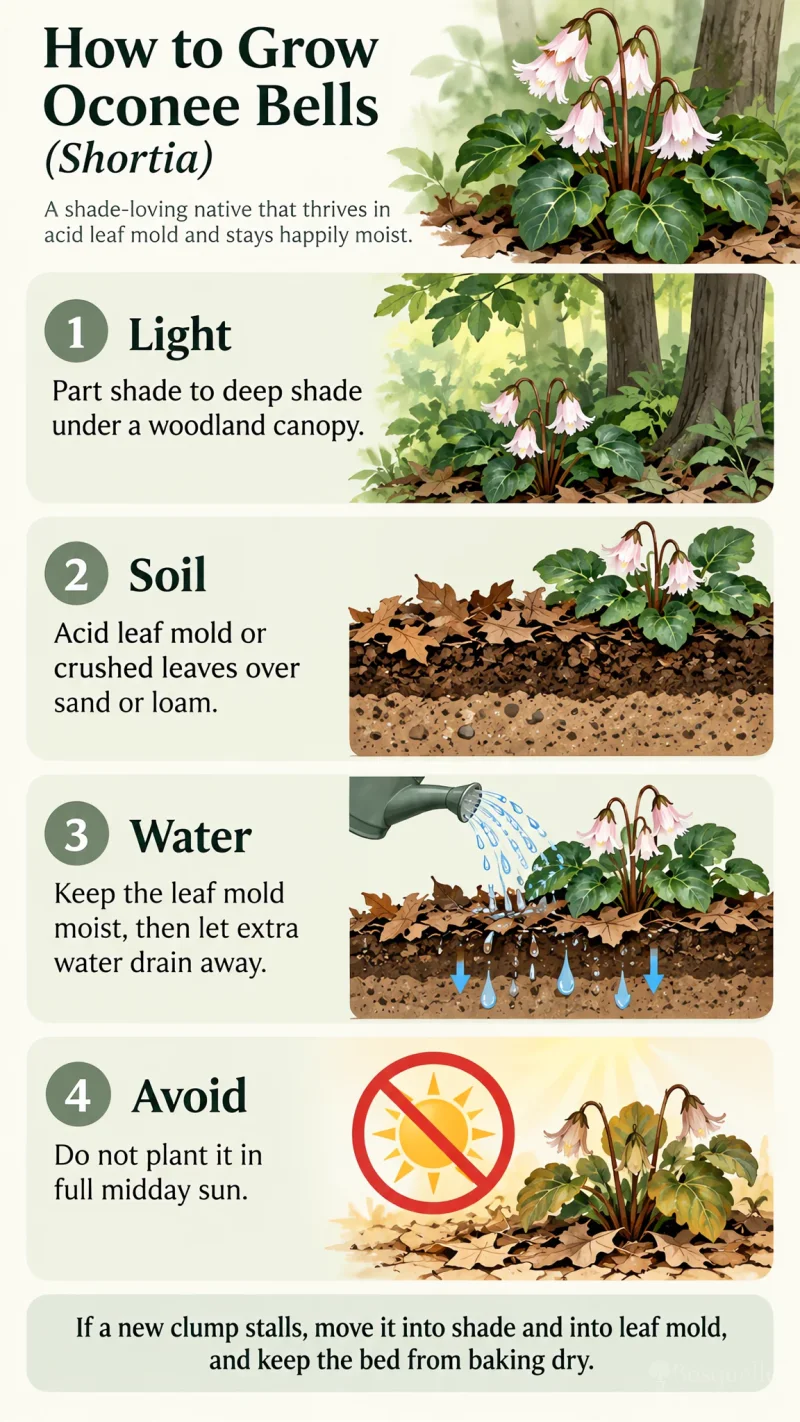
Give it shade, acid leaf mold, and soil that stays moist
| Factor | Recommended | Avoid |
|---|---|---|
| Light | Part shade to deep shade under a woodland canopy | Do not plant it in full midday sun |
| Water | Keep the leaf mold moist, then let extra water drain away | Do not let the bed bake dry in summer, and do not leave the roots in a hole that stays wet |
| Soil | Acid leaf mold or crushed leaves over sand or loam | Do not plant it in packed mineral dirt, and do not add lime |
| Size | Leave room for a 4 to 8 inch plant that slowly becomes a small carpet | Do not treat it as a fast hedge |
Oconee bells is Shortia galacifolia. It wants cool shade and an acid organic layer that stays moist. Full sun scorches new plants, so a woodland canopy, a north bed, or the shade of rhododendron and mountain laurel is the usual home. [1] The roots sit in leaf mold, not in hungry mineral soil, and they are slow to take. Bare yard dirt that has been stripped and packed is the main reason a new clump stalls, so add crushed leaves before you plant. [2] Once it is in, do not let the bed bake dry in warm weather. The first roots are fine and shallow, so a light layer of crushed leaves or pine needles in spring keeps them cool. Do not pile wet mulch on the crowns, and do not pour on fertilizer. [3] Leaves stay glossy green in summer and often turn bronze or maroon when the canopy opens in winter. That color is normal. A clump spreads slowly on short runners, so do not expect a finished carpet in one season. [4]
How much sun does oconee bells need?
Give it part shade or deep shade. Full midday sun scorches new plants.
How do I water oconee bells in the ground?
Keep the leaf mold moist, then let extra water drain away. A dry summer bed and a soggy hole both stall the roots.
Why did the leaves turn bronze?
Winter color is normal. The leaves often bronze or redden when the canopy is open, then green up when shade returns.
Plant a nursery clump in leaf mold, in shade
Plant a bought clump in spring or early fall, into a few inches of crushed leaves, still in shade. Set it at the same depth it grew in the pot. Do not drop it into bare dirt in the open, and do not dig a wild stand.
- Pick shade. Full sun at planting is the usual reason a new clump dies.
- Work crushed leaves or leaf mold into the top few inches. Do not plant into packed mineral dirt.
- Slide the nursery clump out. Set it even with the surrounding leaf mold. Do not bury the crown.
- Water it in, mulch lightly with crushed leaves or pine needles, keep that mulch off the crown, and keep the bed moist through the first summers.
How do I plant oconee bells?
Plant a nursery clump in shade, in leaf mold, at the same depth it grew in the pot. Water it in, and keep the bed from baking dry.
Not galax — and not a galaxy petunia
Galax is a cousin with round, shiny leaves, but the flowers give it away. Galax packs tiny white blooms on a tall spike in early summer. Oconee bells holds one nodding white or pale pink bell, with fringed petals, in early spring. The leaves on oconee bells are smaller, with obvious pale veins and coarser teeth. Read How to Grow Galax if the flowers are a spike. Galax also spreads faster and will crowd this plant, so do not mix the two as one carpet.
A galaxy petunia is a sun annual with speckled petals. If the tag says Night Sky or galaxy flower, it is not this woodland evergreen. Read How to Grow Petunias if the plant wants a hot, bright bed.
Soldanella is a European alpine snowbell, not this Appalachian plant. Nippon bells is a Japanese Shortia, and it is not the shop card here.
Is oconee bells the same as galax?
No. Galax flowers sit in a tall spike of tiny blooms. Oconee bells has one nodding bell, smaller leaves, and obvious pale veins.
If a new clump stalls, move it into shade and into leaf mold, and keep the bed from baking dry.
FAQ
Is there more than one kind of oconee bells?
Shortia galacifolia is the plant here. Oconee bells is the shop name. Nippon bells is a Japanese species, not a second type in this catalog.
Can I grow oconee bells in a pot?
A pot dries too fast for this woodland clump unless you can keep it shaded and moist every day. A shaded bed of leaf mold is the usual home.
Do I need to prune oconee bells?
No hedge cut. Pick out brown leaves and heavy litter that smothers the crowns. The evergreen foliage is the plant.
Can I dig oconee bells from the woods?
Buy a nursery plant. Wild stands are rare, and collecting them is not the way to start a bed. Do not make a tea or an oil from the leaves.
How do I get more plants?
Divide rooted runners after bloom. That method is on How to Propagate Oconee Bells.
Related guides

Recommended plants
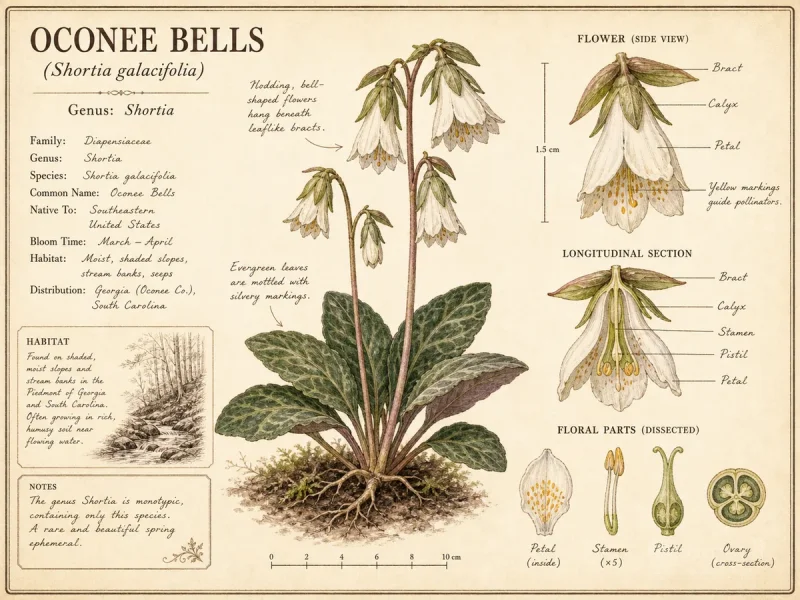
References
- [1] NC State Extension Gardener -
https://plants.ces.ncsu.edu/plants/shortia-galacifolia/ - [2] Lady Bird Johnson Wildflower Center -
https://www.wildflower.org/plants/result.php?id_plant=SHGA - [3] New York Botanical Garden -
https://www.nybg.org/blogs/plant-talk/2012/12/tip-of-the-week/oconee-bells/ - [4] Georgia Biodiversity Portal -
https://georgiabiodiversity.org/portal/profile?es_id=19423&group=all
This note is part of Shortia Guides.
More first-season notes by plant are gathered in How to Grow Guides.
Updated: Reviewed by Bosquelle Editors