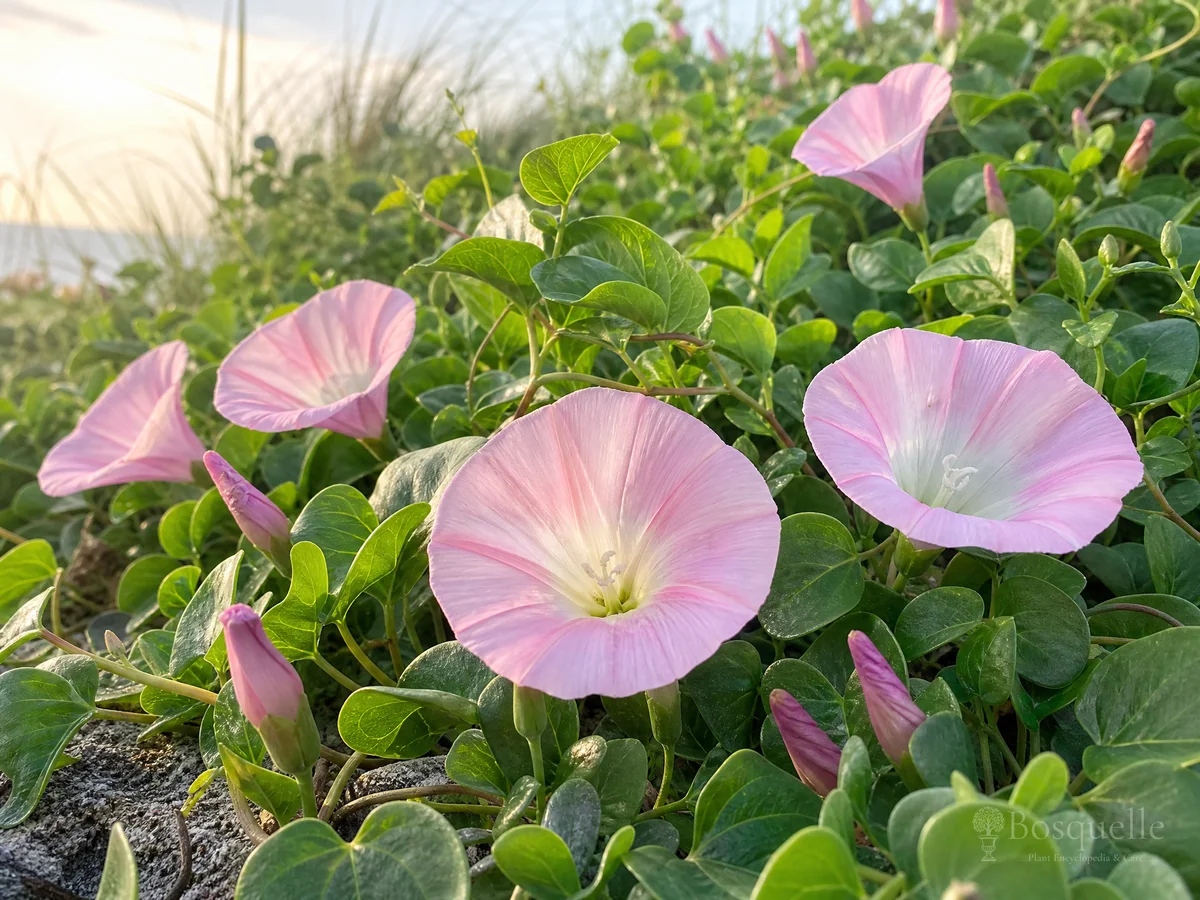
Grow Calystegia in full sun and sharp sand. It is also sold as sea bindweed or beach morning glory. It is not railroad vine or a climbing morning glory.

Give it full sun and sharp sand, and let the sand dry
| Factor | Recommended | Avoid |
|---|---|---|
| Light | Full sun on an open coast or gravel bed | Do not plant it in shade |
| Water | Water to settle it, then let the sand dry | Do not keep the sand wet |
| Soil | Sharp sand or sandy gravel | Do not plant it in wet clay |
| Salt | Salt spray is fine | Do not treat inland wet clay as a beach |
| Winter | Leave the rhizomes in sand | Do not lift it into a wet pot for winter |
Calystegia wants open sun and sand that drains at once. Shade and wet clay rot the rhizomes, because this plant lives on dunes and coastal gravel, not in a rich border. [1] beach morning glory uses that sand as fleshy kidney-shaped leaves and pink trumpets with white stripes. It is a trailing mat, not a fence vine.
How much sun does Calystegia need?
Give it full sun. Shade leaves weak stems and few flowers.
How wet should the sand stay?
Water to settle a new plant, then let the sand dry. Salt spray is fine. Wet clay around the rhizomes is the usual cause of rot.
Plant it shallow in sand, with room to trail
Plant in spring from a potted plant or a rooted rhizome. Set it shallow in sharp sand, with the buds near the surface, and give it about 24 to 36 inches to trail. [2] The stems creep on the sand. They do not need a trellis, and a deep, rich hole holds water against the rhizomes.
- Plant in spring in full sun sand, once the ground is workable.
- Set the rhizome shallow in sharp sand, with the buds near the surface, not buried in a deep, rich hole.
- Give it about 24 to 36 inches to trail. The stems creep; they do not climb a fence.
- Water to settle the sand, then let it dry. Do not keep extras in wet compost.
How do I plant Calystegia?
Set the rhizome shallow in sharp sand in spring, buds near the surface. Give it room to trail, water to settle it, then let the sand dry.
Split a rhizome in spring, or pin a stem under sand
Most gardeners start a new patch from a rooted piece, not from seed. Lift a rhizome in early spring, or nick a trailing stem and cover the nick with sand so it roots in place. [3] Keep sand on the roots when you move a piece, and replant at the same shallow depth.
- Lift a rooted rhizome in early spring while the plant is still low.
- Keep sand on the roots, and replant at once at the same shallow depth.
- Or nick a trailing stem and pin the nick under sand so it roots in place.
- Keep the new piece in sharp sand that dries between waterings.
Can I divide Calystegia?
Yes. Lift a rooted rhizome in early spring, or nick a trailing stem and cover the nick with sand. Replant in sharp sand at the same shallow depth.
Leave the trailing stems — do not train it on a trellis
The stems trail on sand. They are not hedge bindweed on a fence, and they do not need tying or a weekly cut. Leave the rhizomes in sand through winter. New stems come from those rhizomes in spring. Cut only the winter-dead stems after they brown if you want a cleaner mat.
- Let the stems trail on the sand. Do not tie them to a fence.
- Leave the rhizomes in sand through winter. New stems come from those rhizomes in spring.
- Cut winter-dead stems after they brown, if you want a cleaner mat.
- Do not spray it as field bindweed. This trailing dune plant is not that weed.
Do I prune Calystegia?
No regular cut. Let the stems trail. Leave the rhizomes in sand through winter, and cut only winter-dead stems after they brown.
Not railroad vine — and not a climbing morning glory or field bindweed
A tag that says beach morning glory is often Ipomoea — railroad vine or Ipomoea beach morning-glory, with notched leaves and long runners. Calystegia has kidney-shaped fleshy leaves and two bracts around the calyx. [4] Calystegia grows along the ground in sandy dunes. See How to Grow Morning Glory.
Field bindweed is Convolvulus arvensis, a deep-rooted weed, not a dune mat — see How to Grow Convolvulus for ornamental bindweed relatives, not for killing field bindweed. Hedge bindweed climbs hedges with triangular leaves. Alpine snowbell is Soldanella, a mountain primrose, not this dune vine.
Is this railroad vine or Ipomoea beach morning glory?
No. Railroad vine and Ipomoea beach morning-glory are Ipomoea, with notched leaves and long runners. Calystegia has kidney-shaped fleshy leaves and stays in a low sand mat.
Set Calystegia in full sun and sharp sand, plant it shallow, and let the sand dry.
FAQ
Can I grow Calystegia in a pot?
You can, in a pot with a hole and sharp sand. Let the sand dry between waterings. It is happier in open sand once it is rooted.
Can I grow it from seed?
You can sow fresh seed in sand, but most gardeners split a rhizome in spring. The new plants still need full sun and sand that drains.
Can I grow it indoors?
No. Indoor morning-glory pots in shops are almost always Ipomoea. Calystegia is a dune plant. Keep it in open sand outdoors.
Can I eat it?
Do not eat the leaves or rhizomes. Scotch scurvy grass is an old folk name, not a salad crop. Grow it for the sand mat, not as food.
Is there more than one Calystegia?
Calystegia soldanella is the plant here. Climbing morning glory is Ipomoea. Hedge bindweed is a different plant.
Recommended plants

References
- [1] Royal Horticultural Society -
https://www.rhs.org.uk/plants/143538/calystegia-soldanella/details - [2] Gardenia -
https://www.gardenia.net/plant/calystegia-soldanella - [3] University of Washington ESRM -
https://courses.washington.edu/esrm412/protocols/2008/CASO2.pdf - [4] Theodore Payne Foundation -
https://theodorepayne.org/nativeplantdatabase/index.php?title=Calystegia_soldanella
More first-season notes by plant are gathered in How to Grow Guides.
Updated: Reviewed by Bosquelle Editors