
After dark, shake a notched rhododendron, yew, or strawberry onto a pale sheet and drop the adults in soapy water, because they play dead and they cannot fly. Then drench warm, moist soil with insect-killing nematodes so the cream grubs on the roots die before they girdle the crown. A spray on notched leaves does not reach those grubs.
People call the group root weevils. Then the real names: strawberry root weevil, black vine weevil, lilac root weevil, and close Otiorhynchus relatives. They are snout beetles. Adults chew half-moon notches at the leaf edge at night and hide in mulch by day. The larvae are legless, cream, and C-shaped, with a brown head, and they feed on roots. A wilted heuchera in a still-moist pot is often black vine weevil. See vine weevil for that container.
Pick them after dark, then drench the soil for the grubs
Adults climb after sunset and chew the leaf edge. The larvae do the real harm underground, so a foliar spray that never touches the soil does not save a plant whose roots are already being eaten. Pick the night feeders first, because they cannot fly and they drop when you shake the plant. Then treat the soil while it is warm and moist, so the nematodes can find the grubs.
- Confirm. Half-moon or C-shaped notches sit only at the leaf margin. An hour after dark, a slow snout beetle on the foliage, or a cream legless grub with a brown head on the roots of a wilted plant, is this insect. Ragged holes with a slime trail are slugs, not this insect.
- Shake after dark. Spread a pale sheet under the plant, because the beetles vanish on bare soil. Shake the branches. They play dead. Dump them in soapy water. Check again on the next warm nights, because adults keep coming for weeks.
- Stop the climb on a yew, lilac, or other single-trunk shrub. Wrap the stem with tape or fabric, then put a sticky band on the wrap, not on the bark. Prune branches that touch the ground, a fence, or another plant, or they walk around the band. Refresh the band when it fills with litter.
- Drench the soil with labeled insect-killing nematodes, usually Heterorhabditis, once the soil is about 55°F or warmer and you have seen the first notches or young grubs. Midsummer through early fall is the usual window. Pull mulch back so the drench reaches the root zone, water before and after, and keep the soil moist, not soggy, for about two weeks. Apply on a cloudy day or in the evening, because sunlight kills the nematodes on the surface. They do not usually last through winter, so you treat again next year if notches return.
- Check new pots before they join the bed. Slide the root ball out. Chewed roots or cream grubs go back to the nursery or into the trash, soil and all. Do not dump that mix on the compost.
A labeled pyrethroid on the lower trunk, applied late in the day and off bloom, can knock adults as they climb. Skip the brand aisle as the first move. The night pick and the nematode drench are the finish that actually reduces next year’s grubs.
Do root weevils fly?
No. The wing covers are fused. They walk, drop, and hitchhike in pots. That is why a sticky band on a single trunk works, and why a notched nursery plant is how they arrive.
Notches on a healthy shrub can wait. A wilted pot does not
The notches are the damage you see. They are usually looks on an established rhododendron or yew that still puts out new growth and still takes up water. Last year’s notched leaves often show a brown edge. This year’s feeding is on the new growth and starts low, then moves up. Heavy notching on almost every leaf is a warning that many larvae may already be on the roots, so dig at the crown and look before you assume the shrub is only cosmetic.
A plant that yellows, wilts while the soil is still moist, or fails to push in spring is the larval job. Young strawberries, cuttings, and anything in a pot go first, because there is little root to spare. Tip that pot. If the roots are a chewed stub and cream grubs are in the mix, discard the plant and the soil. Do not compost them. An established landscape shrub with a few notches and a sound crown can wait on the spray aisle while you pick adults and drench the soil.
Inspect nursery stock for fresh notches before you buy. Adults walk, they do not fly, so a clean bed stays cleaner if you do not carry larvae in on a new root ball.
Will root weevils kill my rhododendron?
A healthy established shrub with a few notches usually lives. Larvae can girdle a young plant, a strawberry, or a pot, and heavy root feeding can kill. Wilt while the soil is still moist is the warning, not the notches alone.
Half-moon notches sit at the edge, not in the middle of the leaf
The adult is a hard snout beetle with elbowed antennae. Wing covers are fused, so it walks. It hides in mulch and debris by day and climbs about an hour after sunset. Disturbed, it drops and lies still. Strawberry root weevil is the small dark one, about a quarter inch, and it is the usual wanderer into houses in hot, dry weather. Black vine weevil is larger, about three-eighths to a half inch, dull black with faint pale flecks, and it is the one that wrecks yew, rhododendron, and container plants. Lilac root weevil and rough strawberry root weevil chew the same notches. You do not need a species lecture to start picking. Night feeding plus the notch pattern is enough.
The larva is cream, legless, and C-shaped, up to about half an inch, with a brown or tan head. It overwinters in the soil, feeds hardest in spring, pupates, and the next adults emerge from late spring into early summer. Most of these weevils are females that lay eggs without males. Eggs go into soil cracks near the plant they have been chewing. One generation a year is normal outdoors.
| Where you see it | What it is | Try this |
|---|---|---|
| Half-moon notches only at the leaf edge; slow snout beetle after dark | Adult root weevils | Shake onto a pale sheet; sticky band on a single trunk |
| Wilt while the soil is still moist; cream legless grub with a brown head on the roots | Root weevil larvae | Dump a ruined pot; nematode drench if the plant can still take up water |
| Ragged holes into the middle of the leaf, slime trail | Slugs | See slugs — not this night shake |
| Dark open tunnels in the upper third of a carrot | Carrot weevil | See carrot weevil — not this shrub notch |
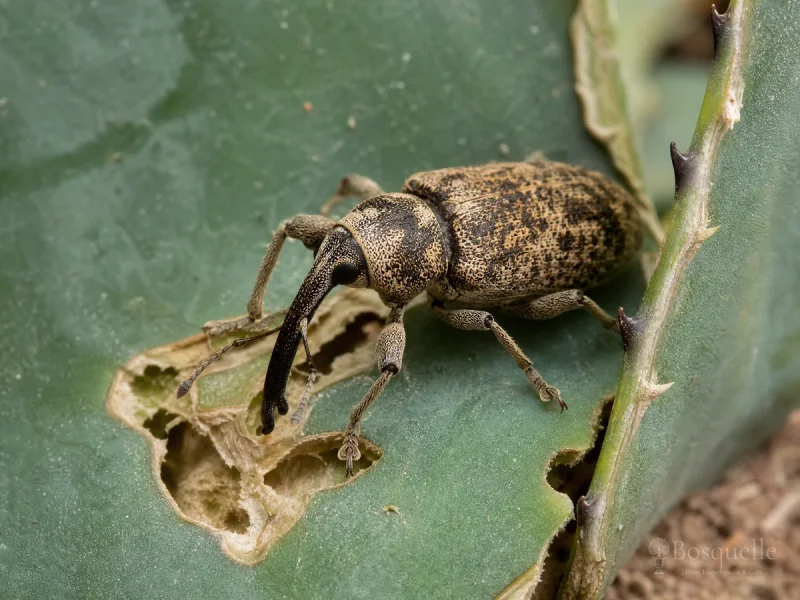
| Collapsed agave or yucca crown | Agave snout weevil | See agave snout weevil — not this landscape notch |
| C-shaped grub with legs in the soil | White grub or cutworm, not this weevil | See Japanese beetle or cutworm |
| Tiny beetles in flour, rice, or pasta | Pantry weevils | Vacuum the cupboard. They are not this garden insect |
Slime is slugs. Weevils in the flour are a different insect
Slugs rasp ragged holes that can sit in the middle of a hosta or rhododendron leaf, and they leave a slime trail. Root weevils cut a clean half-moon only at the margin and leave no slime. See slugs. Do not run a slug bait calendar here if the edge is notched and the center of the leaf is untouched.
Black vine weevil is one of these root weevils. The container job — a wilted heuchera or hosta in a still-moist pot, cream grubs on the root ball — is vine weevil. Do not paste that pot-tipping ladder here as a second essay. The night shake and the nematode drench are the same family of work on landscape shrubs and strawberry.
Carrot weevil tunnels the crown of carrot, parsley, and celery. See carrot weevil. A collapsed agave is agave snout weevil. A C-shaped grub that has legs is a white grub or a cutworm, not a weevil larva. Beetles in the flour are pantry weevils. They breed in dry goods. They do not notch a yew. Vacuum the cupboard. Do not treat the rhododendron for pantry insects, and do not treat the flour for root weevils.
Indoors, strawberry root weevil is sometimes taken for a tick. It has six legs and a snout. Ticks have eight legs and no snout. Vacuum it. It does not bite, and it does not infest food.
Is black vine weevil a root weevil?
Yes. It is the larger dark one on yew, rhododendron, and many containers. See vine weevil for a wilted heuchera pot. The night shake and the nematode drench on landscape shrubs stay here.
Related reading
- Vine weevil — cream grubs in a wilted heuchera or hosta pot, not this whole landscape group.
- Slugs — ragged holes and a slime trail, not a half-moon at the leaf edge.
- Carrot weevil — tunnels in the upper third of a carrot, not a shrub notch.
- Agave snout weevil — a collapsing agave crown, not notches on yew or rhododendron.
- Cutworms — a C-shaped grub with legs at the soil line, not a legless weevil larva.
FAQ
Do root weevils bite people or pets?
No. They chew leaves and roots. Strawberry root weevils that wander indoors do not bite, sting, eat furnishings, or infest food. Vacuum them and seal the gaps they crawled through.
How do I get strawberry weevils out of the house?
Vacuum or sweep them. They wander in during hot, dry weather, often to sinks and tubs, and they do not breed indoors. Household aerosols do little. Seal cracks, and do not spray the living room as the garden plan.
Are strawberry root weevils ticks?
No. The weevil has six legs and a snout. A tick has eight legs and no snout. Vacuum the weevil. It is a nuisance, not a blood feeder.
Will diatomaceous earth get rid of root weevils?
Dust at the base may nick a few walking adults while it stays dry. Rain and watering cancel it, and it does not reach larvae on the roots. Night picking and a nematode drench are the method.
Will dish soap kill root weevils?
Kitchen dish liquid can burn the leaf and has no plant directions. Adults hide by day and the grubs are in the soil, so a soap spray on the tops is not the finish. Pick at night, then drench the soil.
Are weevils in the flour the same as root weevils?
No. Pantry weevils breed in rice, flour, and pasta. Root weevils notch garden plants and cannot fly into a cupboard. Vacuum dry goods if that is the find. Do not drench the rhododendron for flour beetles.
Can I compost a pot full of weevil grubs?
No. Bag the plant and the mix. Larvae can finish in home compost and walk back to the next pot. A landscape shrub with a few notches does not need that dump.
Related pests





Related diseases



Updated: Reviewed by Bosquelle Editors