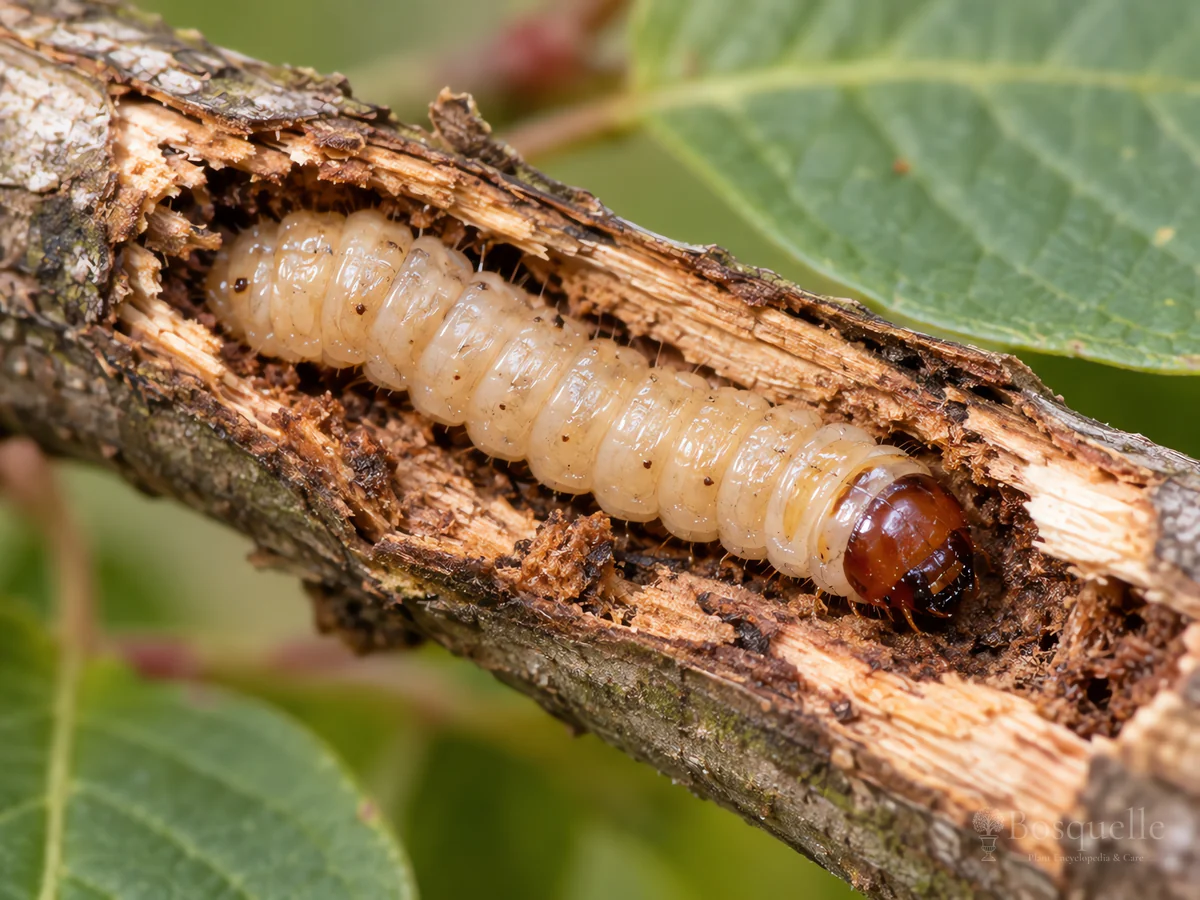
Clip several inches below the wilted twig and destroy that wood. The grub is in the pith. A spray on the leaves will not reach it. Reddish sawdust on the trunk is a different insect.
Dogwood twig borer is a native longhorned beetle, Oberea tripunctata. Some gardeners still say elm twig girdler. The adult is about half an inch to five-eighths of an inch long, skinny, with long antennae, a dark head, and two or three black spots on the thorax. The wing covers are yellow-tan with a dark stripe down the middle. The larva is a yellowish, legless grub that hollows a live green shoot. Flowering dogwood takes this in the canopy, one twig at a time.
- A row of round holes and a hollow pith confirm it.
- Clip several inches below the grub and bag the cutting.
- A leaf spray will not finish a grub already in the twig.
Clip several inches below the wilted twig
Find every flagging shoot. Cut several inches below the lowest round holes, or below the wilt if you cannot see holes yet. Split the cutting. You should see a yellowish grub in the pith, or an empty tunnel that still holds this year's insect. If the grub is still above your cut, cut again farther back. Get the wood off the lot. Bag it, burn it where that is legal, or send it with yard waste that will not sit under the tree. Beetles still come out of a pile on the ground.
Do this as soon as you see wilt in early summer. If you missed that week, clip through winter, before adults emerge in late spring. Do not compost the tips. Do not leave them under the flowering dogwood. Fail if the plan is a bottle on the leaves and the grub is still in the twig.
How do I get rid of dogwood twig borer?
Clip several inches below the wilted twig, below the grub. Destroy that wood. A spray on the leaves will not reach a larva already in the pith.
When should I prune an infested twig?
As soon as you see wilt in early summer. If you missed that, clip before adults emerge in late spring. Cut below the grub, not at the first wilted leaf.
Can I compost the infested twigs?
No. Bag them or get them off the lot. Adults still emerge from a home pile. Clip below the grub first.
A row of round holes down the stem confirms this beetle
The first useful sign is one wilted twig while the rest of the crown still looks fine. Near the tip, the female chews two rings of punctures a quarter to half an inch apart and lays an egg between them. The grub then bores down the center. It pushes sawdust out through a line of closely spaced round holes. Split the stem. A yellowish grub in a hollow pith confirms this insect. A broken end may show a V-shaped cut. Adults also chew long, thin holes in the leaves along the veins. You do not need to catch a beetle. The holes and the grub are the confirm.
The same beetle can hollow a shoot on elm, viburnum, or azalea. The job is still clip below the grub. Wilt with no holes and no hollow pith is not this insect.
| Where you see it | What it is | Try this |
|---|---|---|
| One wilted twig; two rings near the tip; a row of round holes; yellowish grub in the pith | Dogwood twig borer | Clip several inches below the grub and destroy the wood |
| Reddish sawdust at a wound, crotch, or graft; wet or knotty bark | Dogwood borer | See dogwood borer — not this beetle |
| Spindle or club swell on a twig tip; orange maggots inside | Dogwood clubgall midge | See dogwood clubgall midge — no row of holes |
| Spots on leaves or flower bracts, then twig dieback; dead leaves hanging | Dogwood anthracnose | See dogwood anthracnose — not a grub in the pith |
| Leaves chewed; white-powder worms on the foliage | Dogwood sawfly | See dogwood sawfly |
| Sunken bark on a young trunk; D-shaped hole | Flatheaded appletree borer | Different beetle; see flatheaded appletree borer |
| Outside chew ring on oak, hickory, or pecan; twig hanging or on the ground | Twig girdler, a different beetle | Not this dogwood insect |
| Wilted leaves, no holes, no hollow pith | Drought or leaf scorch | Water; check the bark again |
What does dogwood twig borer damage look like?
One flagging twig, two rings of punctures near the tip, and a row of round holes pushing sawdust. Split the stem. A yellowish grub sits in the pith.
Reddish sawdust on the trunk is dogwood borer
Dogwood borer is a clearwing moth, not this beetle. It works the trunk, crotches, and wounds and pushes reddish-brown sawdust. See dogwood borer. Do not push a wire into a flagging twig, and do not run that moth's trunk spray here.
A spindle swell near a twig tip is dogwood clubgall midge. There is no row of sawdust holes. Chewed leaves and larvae with a white powder coat are dogwood sawfly. Spots on bracts and leaves that then kill twigs are dogwood anthracnose. A D-shaped hole and sunken bark on a young trunk is flatheaded appletree borer. An outside chew ring on oak or pecan is a different longhorned beetle. A catch-all “borers” label does not tell you which wood is dying.
Is it dogwood twig borer or dogwood borer?
Twig borer wilts one stem and leaves a row of holes down that twig. Dogwood borer is a moth that works the trunk and wounds and pushes reddish sawdust. See dogwood borer for the trunk. Do not wire a flagging tip as if it were a trunk gallery.
Is elm twig girdler the same insect?
Yes as a nickname for this beetle. The oak twig girdler is a different longhorned beetle that chews a ring around oak, hickory, or pecan from the outside. That collect-the-fallen-twigs job is not this flowering-dogwood clip.
This beetle kills twigs, not the whole dogwood
This is a minor, sporadic pest on a landscape flowering dogwood. One hollowed shoot dies or snaps. The tree usually lives. Clip anyway, because the adult comes out of that twig next spring. A young tree that loses many tips in one summer looks thin. Water it, and keep clipping as new flagging shows.
On a small azalea, blueberry, or sourwood shrub, the grub can keep boring toward the crown and take more of the top. That is still a clip job, not a reason to drench the soil. If the whole crown is declining and you see reddish frass on the trunk, you have the moth, not this beetle.
Will dogwood twig borer kill the tree?
Usually not. It kills twigs. A landscape flowering dogwood usually lives. Clip anyway so next year's beetles do not emerge from those shoots.
A spray on the leaves will not reach the grub
Once the larva is in the pith, soap, oil, and neem sit on the bark and miss it. A kitchen mix will not rewind a hollow twig. A labeled product is last, and only as a barrier against adults and new eggs on the new shoots in late spring, after last year's clipping was heavy. Skip it in a light year. This insect is sporadic. You do not spray every May on a calendar.
Keep pyrethroid mixes off ponds and streams. Coat the new growth, not the lawn. Fail if a dish-soap rinse is the finish and you never split a twig.
Do I need to spray every year?
No. This insect is sporadic. Clip the twigs you have. A labeled late-spring spray is last, and only after a heavy year.
Confirm the holes, then clip below the grub
- Confirm this beetle. One wilted twig, a row of round holes, and a yellowish grub in the pith. Reddish frass on the trunk is a different insect.
- Clip several inches below the lowest holes. Split the cutting. If the grub is still above the cut, go farther back.
- Destroy the wood. Bag it or get it off the lot. Do not compost it under the tree.
- Wait on a spray unless last year was heavy. A labeled late-spring spray on new shoots is last. Soap and oil will not reach the grub.
- Watch next May. Adults emerge from twigs you missed. Clip again when new wilt shows.
Related reading
- Dogwood borer — reddish frass on the trunk, not a row of holes on one twig.
- Dogwood clubgall midge — a spindle swell on a twig tip, no sawdust line.
- Dogwood sawfly — chewed leaves, not a hollow pith.
- Dogwood anthracnose — leaf and bract spots, then twig dieback.
- How to grow dogwood — cool roots, mulch off the bark, flowering dogwood out of a hot lawn.
FAQ
Does neem oil kill dogwood twig borer?
Not once the grub is in the pith. Oil needs contact on a soft insect. This job is clip and destroy, or a labeled late-spring spray on new shoots if last year was heavy.
Will dish soap kill dogwood twig borer?
No. A kitchen mix on the leaves does not reach larvae in the pith, and it can burn foliage. It is not a labeled treatment for this beetle.
Do dogwood twig borers bite people?
No. Adults chew dogwood leaves and girdle shoots. They do not bite people or pets. The harm is to the twig.
Do they live on houseplants?
No. This beetle hollows outdoor woody shoots, usually flowering dogwood. A wilted houseplant stem is a different problem.
Related pests

Related diseases





Updated: Reviewed by Bosquelle Editors