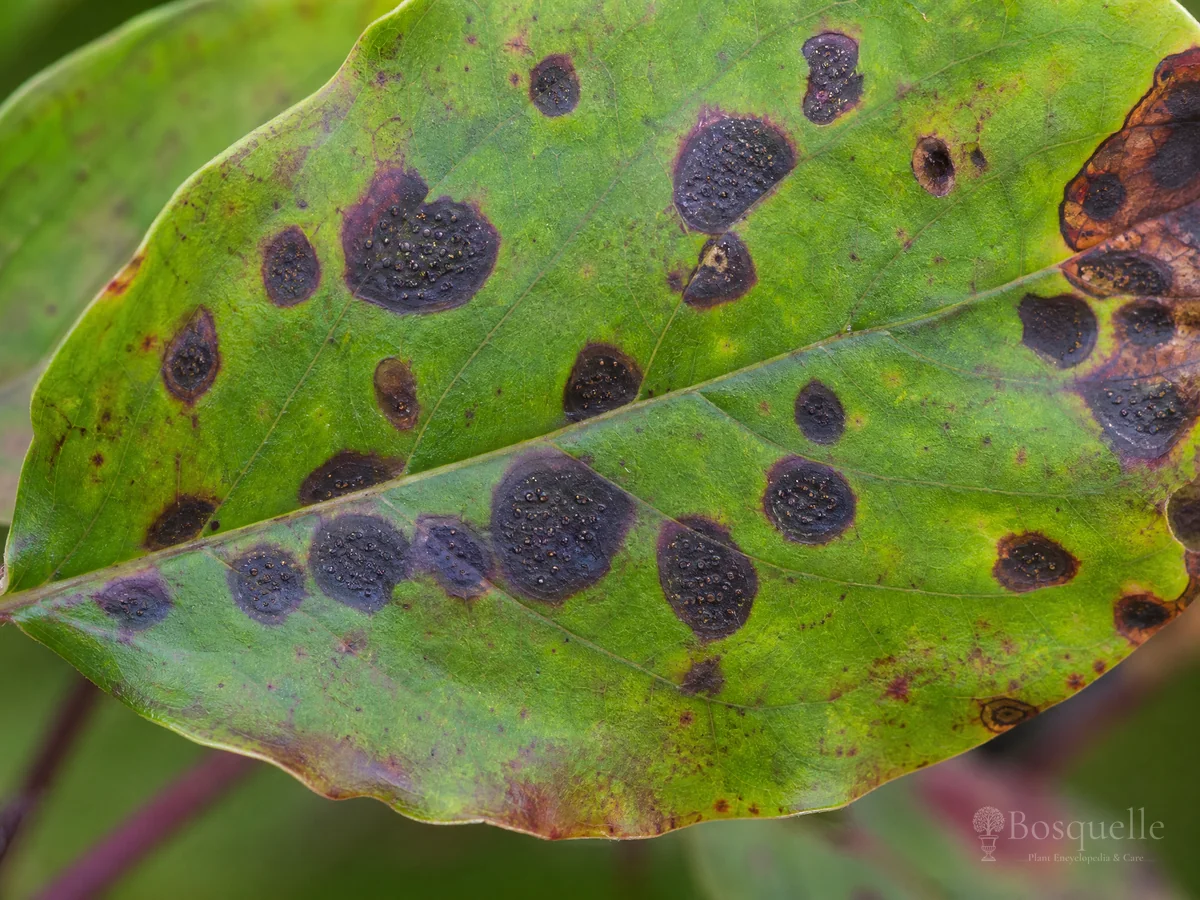
A spray on blighted hanging leaves will not take a canker off the trunk, because this fungus has already moved from that leaf into the twig, so prune those twigs on a dry day and pull the water sprouts before you reach for a bottle. Dogwood anthracnose is the fungus Discula destructiva. People still call it Discula anthracnose or lower-branch dieback, then it is this disease. It waits out winter in the cankers and in the gray leaves that stay stuck on the tips, then splashes onto new leaves when spring stays cool and wet.
On flowering dogwood and Pacific dogwood the first useful sign is a tan blotch with a purple or reddish margin, often on a lower or interior leaf, and that blotch can run down the midvein in a wedge. Blighted leaves droop and often cling through winter. Tiny pinhead spots with purple borders on the white bracts, with no twig dieback, are spot anthracnose, a different fungus. A white film in summer is powdery mildew. Uniform brown leaf edges after a hot, dry week, with no hanging blight, are drought, not this canker.
Prune the hanging blighted twigs on a dry day
Once a canker is on the main stem, a bottle will not rewind the wood, because protectants coat new leaves and they never reach a girdling patch of chocolate-brown sapwood. The useful job this season is to cut out the twigs that still hold gray leaves, because that is where the fungus waits, then to keep the remaining canopy dry enough that the next splash has less to land on. Wait for a dry day so you are not spreading wet spores down the row of cuts. Cut well below the sunken tan patch, through wood that is still pale, and destroy the pieces. Wipe the shears with rubbing alcohol or a ten-percent bleach mix between cuts, because a dirty blade will move the fungus onto a clean shoot.
Pull every water sprout on the trunk and the big limbs, because those succulent shoots are the usual door into the main stem, and a canker that starts there is the one that kills the tree. Rake fallen leaves and pull any gray leaves still clinging, then bag them or burn them where that is legal. Do not run those leaves through a chipper for mulch, and do not leave a cold pile of them under the tree, because the fruiting dots on that tissue shoot spores again as soon as spring wets them. Water the root zone in a drought with a soaker, not a sprinkler on the leaves, and keep two to three inches of mulch over the roots, pulled back from the bark, so a string trimmer does not open a wound for dogwood borer as well.
Skip the high-nitrogen feed that makes a flush of soft shoots. If the tree is still a flowering dogwood you mean to keep, and dieback has not reached the trunk, a labeled protectant has to start at bud break, while the new leaves are still unfolding, and it has to go on again on the label interval through leaf expansion in a wet spring. Chlorothalonil, mancozeb, and propiconazole are the names extension actually uses for this fungus. Read the current label for dogwood. A spray in July on already-blighted leaves does not take the canker off. If only a few green branches are left at the top, skip the bottle and take the tree down.
- Confirm. Tan blotches with purple margins on lower leaves, blighted leaves that hang, then a sunken twig. Tiny purple-border pinheads on the bracts with a full canopy are a different job.
- On a dry day, prune blighted twigs into healthy pale wood, destroy the pieces, and wipe the shears between cuts. Pull the water sprouts off the trunk and the big limbs.
- Rake fallen leaves and pull gray leaves still clinging. Bag or burn them. Do not mulch them back onto the bed.
- Water the roots in drought, keep overhead water off the leaves, and hold mulch off the bark.
- If the trunk is still clean and you want to keep a susceptible flowering dogwood, a labeled protectant from bud break through leaf expansion, on the label interval in wet weather. Skip it once cankers are on the main stem.
How do I get rid of dogwood anthracnose?
You cannot take a canker off the trunk with a spray. Prune blighted twigs on a dry day, cut into pale wood, pull the water sprouts, and destroy hanging and fallen leaves. A labeled protectant starts at bud break only if the trunk is still clean.
Will a spray save a tree that already has trunk cankers?
No. Protectants cover new leaves. They do not rewind chocolate-brown sapwood. If cankers have reached the main stem, or only a few green branches are left at the top, take the tree down.
When do I spray for dogwood anthracnose?
At bud break, then on the label interval until the leaves are fully expanded, and only on a high-value tree that does not already have trunk cankers. A July spray on blighted hanging leaves is too late for those leaves.
Tan blotches with purple margins, then gray leaves that cling, confirm this anthracnose
Look at the lower and interior leaves first, because that is where the splash lands and the canopy stays wet longest. The spot is tan to brown with a purple or dark margin. It may stay small in a dry spring, or it may run together into an irregular blotch, often starting near the tip and sliding down the midvein so the dead tissue looks like a wedge. In a cool, wet week the whole leaf blightens, droops, and often hangs on the twig instead of dropping cleanly. Flip a blighted leaf: tiny tan to brown dots the size of a printed period, scattered in the dead tissue, are the fruiting bodies that shed spores in rain.
From that leaf the fungus moves into the petiole and then the shoot. Twigs pick up sunken tan to brown patches with purple borders, then girdle, and the leaves beyond the girdle stay attached and turn gray. Water sprouts break below those cankers and get infected in the next wet spell, which is how the fungus reaches the trunk. On older wood, peel a little bark: infected sapwood is chocolate brown, and healthy wood is pale. Bracts can spot in a wet bloom, but bract spots alone, without hanging blight and twig dieback, are usually the other anthracnose. Cool shade, overhead water, and a tree already stressed by drought are the usual years on flowering dogwood and Pacific dogwood. Kousa dogwood can pick up a few leaf spots. It rarely builds the trunk cankers that kill a native tree, unless you keep the foliage wet with a sprinkler.
| Where you see it | What it is | Try this |
|---|---|---|
| Tan blotches with purple margins on lower leaves; gray leaves hang on the twig | Dogwood anthracnose | Prune on a dry day; skip a rescue spray on a cankered trunk |
| Tiny purple-border spots on bracts and leaves; centers may fall out; no dieback | Spot anthracnose | See spot anthracnose on dogwood — not this canker |
| White film, twisted or bronzed leaves in summer | Powdery mildew | See powdery mildew — not hanging blight |
| Even brown leaf edges after heat, no hanging gray leaves | Drought scorch | Water the roots; this is not a leaf-spot spray |
| Angular late-summer spots, canopy still full | Septoria or Cercospora leaf spot | Cosmetic; rake leaves, do not run this prune |
| Frass, knotty bark, a wilted limb with no leaf blotch | Dogwood borer | See dogwood borer — not a fungicide |
| One flagging twig, a row of holes, no hanging blight | Dogwood twig borer | See dogwood twig borer |
| Sunken, leaking patch at the soil line | Crown canker | A soil-line wound, not this leaf blotch |
What does dogwood anthracnose look like?
Tan to brown leaf blotches with purple margins, often on lower leaves, then blighted gray leaves that hang on the twig. Twigs sink and girdle. Under the bark the infected wood is chocolate brown.
Tiny purple-border spots and a white film are different jobs
Tiny spots about an eighth of an inch, with a reddish-purple border, first on the white bracts and then on the leaves, are spot anthracnose. The centers can dry and drop out, so the leaf looks shot-holed. That fungus does not move into branches and it does not kill the tree. Do not prune the canopy to the ground for pinhead bract spots, and do not run this Discula prune-and-spray calendar on a tree whose only mark is those small rings. See that disease if the bracts are the problem and the twigs are still sound.
A dusty white coat on the leaf, or leaves that twist, bronze, and look scorched in summer without hanging gray tissue, is powdery mildew. In many eastern yards that film is now the common dogwood disease, and this anthracnose is the less common killer. Do not copy a mildew sulfur program onto hanging blighted leaves. Chewed leaves with a white-powder worm are dogwood sawfly, not a fungus. Reddish frass on wounded bark is dogwood borer. One wilting twig with a row of holes is dogwood twig borer. See those pests if the wood is the problem and the leaves have no purple-margin blotch.
Even browning of the leaf edge after a hot, windy week, with the rest of the canopy still attached at the petiole, is drought scorch. Flowering dogwood is shallow-rooted, so that scorch is common in full sun with dry soil, and a fungicide will not green the margin. Water the roots. A sunken, wet patch at the soil line, with pale small leaves on one side of the tree, is crown canker from a wound at the flare, not this leaf blotch moving down from the crown. Do not recut that collar as if it were Discula.
Is dogwood anthracnose the same as spot anthracnose?
No. Spot anthracnose makes tiny purple-border spots on bracts and leaves and does not kill the tree. This anthracnose blightens whole leaves, hangs them on the twig, and cankers the wood. See spot anthracnose on dogwood if the bracts are pinhead-spotted and the twigs are sound.
Once the trunk wood is chocolate brown, take the tree down
This fungus can kill a flowering dogwood in two or three wet years once cankers join on the trunk, so a tree with only a few green branches left at the top is not a spray candidate. Take it down, because those cankers keep shedding spores onto any native dogwood you plant in the same shade, and a bottle will not un-girdle the stem. If you still have only leaf blotches and a few blighted tips, prune them, keep the roots watered, and decide next spring whether the canopy came back. Several years of lower-branch dieback with more water sprouts each June means the tree is already on the way out.
Do not dig a wild flowering dogwood from the woods and move it into the yard, because that is a common way the fungus enters a clean neighborhood. For a new tree, kousa dogwood is the usual replace, and the Rutgers hybrids — Stellar Pink, Celestial, Constellation, Aurora — were bred so you are not running this calendar every wet April. Appalachian Spring is the flowering dogwood name garden centers actually stock for this fungus. Tatarian dogwood, red osier, and Cornelian cherry are shrub or small-tree cousins that resist it. Resistant is not a promise against powdery mildew or borers, and a kousa under a sprinkler can still spot, so keep the water on the soil.
Will dogwood anthracnose kill my tree?
It can, on flowering dogwood and Pacific dogwood, once cankers join on the trunk. Early leaf and twig infection can still be pruned. A tree with only a few green branches at the top will not come back.
Does kousa dogwood get anthracnose?
Kousa is much more resistant and usually shows only minor leaf spots. It is not immune. Overhead watering that keeps the foliage wet can overcome that resistance, so water the soil, not the canopy.
Should I transplant a dogwood from the woods?
No. Wild flowering dogwood often carries this fungus, and moving it is a common way a clean yard gets it. Buy a nursery tree, and prefer kousa or a hybrid if anthracnose is already in the neighborhood.
Related reading
- Spot anthracnose on dogwood — tiny purple-border spots on bracts, not hanging blight or twig cankers.
- Powdery mildew — a white film in summer, not gray leaves that cling.
- Dogwood borer — reddish frass on wounded bark, not a leaf blotch.
- Dogwood twig borer — one flagging twig and a row of holes, not hanging blight.
FAQ
Can I compost leaves from an infected dogwood?
Do not. The fungus overwinters on those leaves and in the gray ones still stuck on the twigs. Bag them, burn them where it is legal, or send them out with yard waste that is not chipped back onto dogwoods. A cold heap under the tree is a spring spore source.
Does baking soda or neem oil get rid of dogwood anthracnose?
A kitchen baking-soda mix is not a labeled dogwood program, and neem is a weak leaf-spot leftover, not a canker cure. Prune, dry the canopy, and use a product labeled for dogwood anthracnose if the trunk is still clean. Neem will not take a canker off the wood.
Related diseases




Related pests



Updated: Reviewed by Bosquelle Editors