Cup a hand under the new fuchsia or dahlia tip and tap. Capsid bugs drop. Catch what you can, then pinch the tattered leaves. By the time the brown-edged holes show, the insect has often moved on. A spray on empty, already-torn leaves will not rewind last week's feeding.
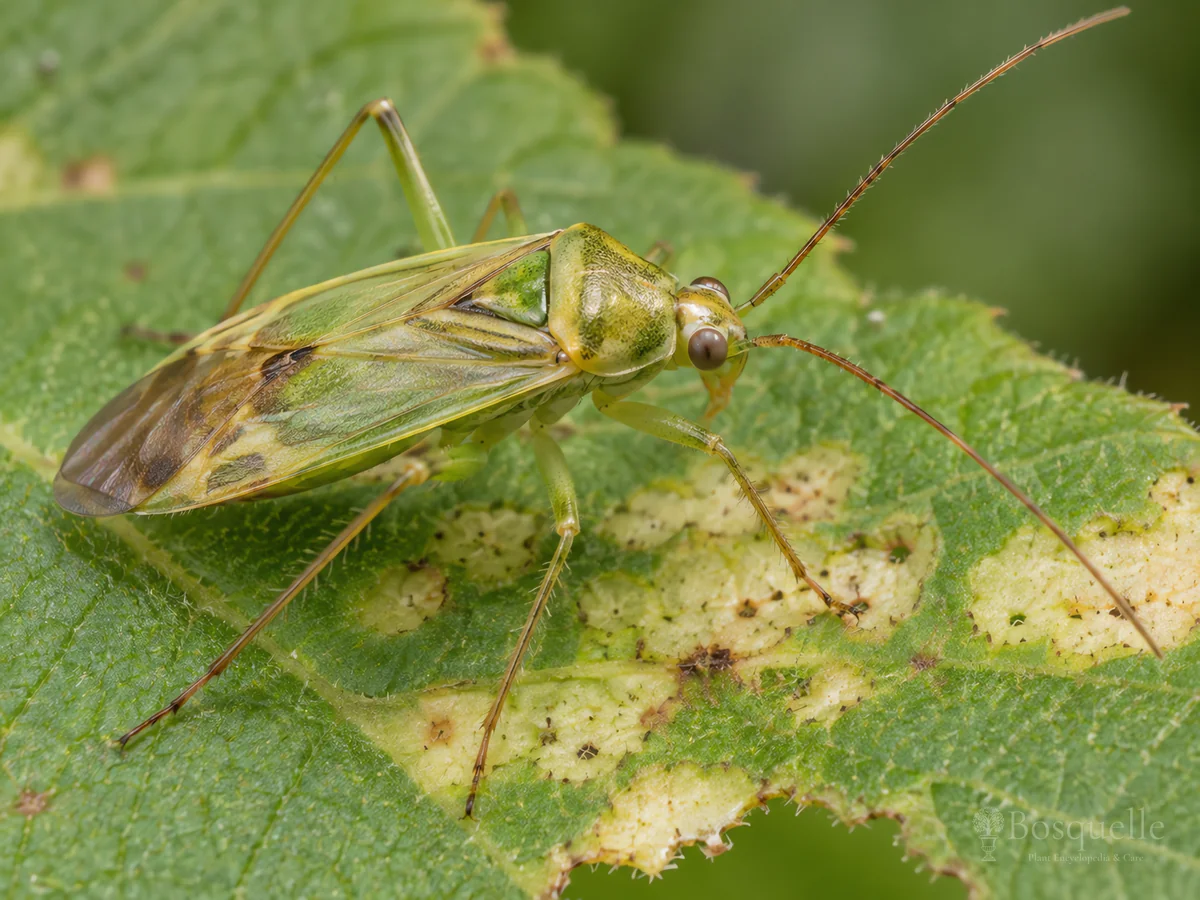
These are capsid bugs. U.S. gardeners usually say plant bug once. They are true bugs about a quarter inch long, green or brown, with long antennae and a clear diamond where the wings fold. They inject saliva that kills a speck of tissue. As the leaf grows, that speck tears into a ragged hole. The common green capsid, Lygocoris pabulinus, is the usual tatter on fuchsia, dahlia, rose, and hydrangea. Apple capsid, Plesiocoris rugicollis, leaves corky bumps on fruit. A mottled adult with a yellow triangle is a different insect.
- Cup under the tip. They drop.
- Brown-edged holes that tear as the leaf grows confirm it.
- A spray on last week's holes will not rewind the feeding.
Cup a hand under the new tip. They drop.
Look at dawn, while the bugs are still sluggish. Hold a pale card or your palm under the newest leaves and tap the shoot. Adults and nymphs drop, then run for cover. Catch and crush what falls. A small vacuum works on a tough stem. Do not rip the soft tip you are trying to save.
Pinch the worst tattered leaves so the plant puts out clean growth. Check again in a few days. Fresh holes on the newest flush mean they came back. Fail if you fog last week's empty holes and call that the finish.
Why do I never see the insect?
They drop or fly at a touch, and the holes show days later. Tap the newest tip over a pale card at dawn. That is how you confirm it.
Will a vacuum finish them?
A small vacuum can lift bugs off a tough stem. Do not shred the new tip. Empty the canister outside. Vacuum does not rewind holes already in the leaf.
Brown-edged holes that tear as the leaf grows
The first holes are pinpricks on the youngest leaves at the shoot tip. Each hole has a brown or yellow rim where saliva killed the cells. As that leaf expands, the dead specks tear into ragged holes and the blade comes out misshapen. Flower buds on fuchsia may never open. Dahlia and chrysanthemum blooms can open notched or lopsided. The insect itself is easy to miss. It does not sit in a sticky colony.
The adult is about a quarter inch long. Wings rest flat. The basal two-thirds look thicker and colored; the outer third is clear, so a diamond shows at the rear. Nymphs are pale green and wingless. Look from May into early fall on new growth, not on old, tough leaves.
| Where you see it | What it is | Try this |
|---|---|---|
| New fuchsia, dahlia, rose, or hydrangea tips; brown-edged holes that enlarge | Capsid feeding | Cup under the tip; pinch tattered leaves |
| Pale green, about 1/4 inch, diamond at the wing tips, drops when touched | Adult or nymph | Catch at dawn; they will not sit like aphids |
| Uniform square pale-to-brown spots on mint or basil | Four-lined plant bug | See four-lined plant bug — not this tatter |
| Mottled brown with a yellow triangle; nubbin strawberries | Tarnished plant bug | See tarnished plant bug — not this tatter |
| Round shot holes; a beetle that jumps | Flea beetle | See flea beetle — not this saliva tear |
| Sticky tips, sitting clusters, no ragged holes | Aphids | See aphids — not this insect |
| Spots with a yellow halo; the tissue is still there | Leaf-spot leftover | Do not spray a fungicide for this tatter |
Is this a fungus or leaf spot?
Leaf-spot marks keep a halo and the tissue is still there. Capsid holes tear open and the rim is brown or yellow. Do not spray a fungicide for this tatter.
Square mint spots and a yellow triangle are different insects
Uniform square spots on mint or basil, with no ragged brown-edged tears on a fuchsia tip, are four-lined plant bug. They also drop when you touch the shoot. Confirm the squares, then see four-lined plant bugs. Do not paste that herb method onto the dahlia.
A mottled adult with a pale yellow triangle behind the head, or strawberries that nubbin after a pretty bloom, is tarnished plant bug. Gardeners in Britain sometimes say bishop bug for a cousin in the same family. See tarnished plant bugs for that fruit and bud job. A tiny black hopper with pale stipple is garden fleahopper. Round shot holes from a jumping beetle are flea beetles. Aphids stay put in clusters and leave honeydew, not a row of expanding holes; see aphids.
Are capsid bugs the same as aphids?
No. Aphids sit in sticky clusters and do not drop at a tap. Capsid bugs are larger, fast, and they tear brown-edged holes as the leaf grows. See aphids for the sitting colony.
The plant usually lives. Beans do not need a spray.
By the time the leaf looks shredded, the bug has often moved to a newer tip or flown. The holes will not close, but a healthy fuchsia, rose, or potato puts out more growth. Beans and potatoes almost never need a bottle for this insect. Show blooms on dahlia and chrysanthemum are the exception: one feeding on a tight bud can notch the flower for good. Catch those plants early, or pinch the ruined bud and wait for the next one.
Clearing weeds and fallen debris under a problem plant removes hiding places for some of these insects over winter. It does not rewind holes already in the canopy. Fail if the plan is a midsummer spray on shredded old leaves while the newest tips go unchecked.
Will my fuchsia die from capsid bugs?
Usually not. The holes stay, but the plant puts out more growth. Pinch the worst tips. Flower buds that were probed may fail, then later buds can open clean.
Should I spray beans or potatoes?
No. Vegetables grow through this feeding. Catch bugs on a show dahlia or fuchsia if you want the bloom. Leave the bean row alone.
Corky bumps on apple are skin-deep
When apple capsid feeds on a young fruitlet, the mature apple can carry raised corky bumps or a scabby patch. The blemish is in the skin. Eating and keeping quality hold. Cut the cork off if you want; do not spray the tree for a cosmetic scar. Pear can take the same mark. A strawberry that buttons after bloom is a different insect — see tarnished plant bug, not this cork.
Can I eat apples with corky capsid bumps?
Yes. The bump is in the skin. Eating and keeping quality hold. Cut the cork off if you want. Do not spray the tree for a cosmetic scar.
A labeled soap is last. Skip open flowers.
Insecticidal soap, or a dish-soap mix, kills nymphs it actually wets on the new tips. It does not stay on the leaf and it does not rewind holes that already tore. Adults fly off a noon spray. If you treat, do it at dawn on tips where you still see bugs, and skip open flowers so bees are not in the mix. A labeled pyrethrin product is the same last step, and it also hits the insects that eat these bugs. Skip the brand aisle if the missing step is a dawn check you have not done.
Does dish soap kill capsid bugs?
A soap mix kills nymphs it actually wets on the new tips. It does not rewind holes that already tore, and it misses adults that fly off. Catch first. Soap is last.
Confirm the holes, then catch or pinch
- Confirm the tatter. Brown-edged holes on the newest leaves that enlarge as the leaf grows. Cup a hand or a pale card under the tip at dawn and tap. They drop.
- If you see square spots on mint, stop and see four-lined plant bugs. If strawberries nubbin and the adult has a yellow triangle, see tarnished plant bugs. If a beetle jumps and leaves round shot holes, see flea beetles.
- Catch what drops. Crush them. Pinch the worst tattered tips. A vacuum is optional on a tough stem.
- Wait on beans, potatoes, and a tough shrub. The plant usually lives. Vegetables do not need a spray for this.
- Eat corky apples. The bump is skin-deep. Do not spray the tree for a cosmetic scar.
- Soap last, only while you can still wet nymphs on new tips. Skip open flowers. Do not fog last week's empty holes.
Related reading
- Tarnished plant bug — mottled adult with a yellow triangle; blasted buds and catfacing fruit, not this brown-edged tatter.
- Four-lined plant bug — uniform square spots on mint and herbs, not ragged fuchsia holes.
- Flea beetle — round shot holes from a jumping beetle, not saliva tears.
- Aphids — sitting colonies and honeydew, not a diamond-winged drop-away bug.
FAQ
Do capsid bugs bite people?
They are not a biting pest of people or pets. Rare defensive probes from some plant bugs can itch like a small mosquito bite. They do not spread a disease you treat for. Catch them. Do not crush one in your hand for fun.
Are some capsid bugs beneficial?
Yes. Many species in this family eat mites, aphids, and other small insects. The tatter on fuchsia is the plant-feeding few. Do not fog the whole border for one shredded tip.
Do capsid bugs live on houseplants?
No. This is an outdoor new-growth job. Tiny bugs in potting mix or on a windowsill pothos are a different leftover, not this tatter.
When are capsid bugs active?
From late spring into early fall on new tips. Damage often shows a week or more after feeding. Check the newest flush at dawn, not last month's leaves.
Related pests





Related diseases



Updated: Reviewed by Bosquelle Editors