
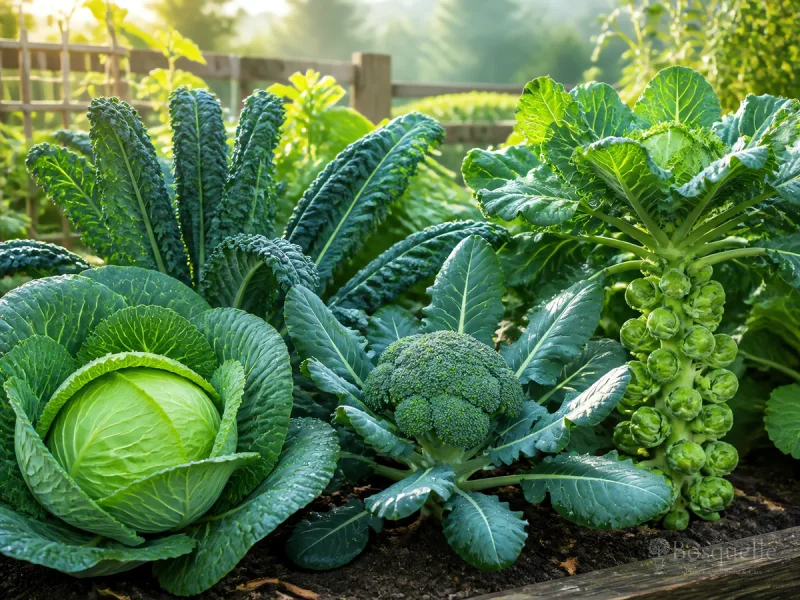
The brassica family covers crops harvested as a dense head, loose leaves, a curd, axillary sprouts, or a swollen stem. cabbage, kale, broccoli, cauliflower, Brussels sprouts, and bok choy all share cool-season needs but differ in how and when you harvest them.

Choose by what you harvest — head, leaf, curd, sprout, or stem
| Factor | Recommended choice | What to know |
|---|---|---|
| Dense terminal head | Cabbage (green, red, savoy, pointed) | Harvest when firm; splits if overripe or after heavy rain |
| Continuous leaf harvest | Kale or collards | No heading; most frost-tolerant; sweetens after first frost |
| Curd (one per plant) | Cauliflower | Most timing-sensitive; needs blanching for white curds |
| Central head + side shoots | Broccoli (calabrese or sprouting types) | Harvest before flowers open; cut for side shoot regrowth |
| Axillary buds along a tall stalk | Brussels sprouts | Long season (80–100 days); sweetest after light frost |
| Fast leaf or head crop (40–60 days) | Bok choy or napa cabbage | Tolerates partial sun; bolt-prone in heat |
| Fall color display | Ornamental kale or cabbage | Bred for pink, white, or purple centers below 50°F; edible but bitter |
Know your USDA hardiness zone before you pick a type of brassica that will take your winter. Type your ZIP below.
2023 USDA ZIP listings (PRISM / USDA-ARS). Find Your USDA Hardiness Zone · Official USDA map.
All of these prefer full sun and fertile, consistently moist ground. Cauliflower is the least tolerant of temperature swings; any heat check during curd development can cause small, uneven curds. [1] Kale and Brussels sprouts are the most frost-tolerant; both sweeten noticeably after the first hard frost.
Which brassica is easiest for beginners?
Kale and bok choy. Kale does not need to head, so timing is less critical. Bok choy matures in 40 to 60 days, making it forgiving in a short cool season.
Can I grow broccoli and cabbage in the same bed?
Yes, but rotate them as a family. Any bed that has grown one brassica hosts the same diseases (clubroot, black rot) for the whole family. Wait three to four years before replanting any brassica in that spot.
Browse by kind
Each type below is a separate cultivar group within Brassica oleracea or B. rapa. They do not cross-categorize: a broccoli plant does not also produce a cabbage head.
- Cabbage (Capitata Group) — green, red, savoy, and pointed types; heads in 60 to 120 days depending on variety; stores well.
- Kale and collards (Acephala Group) — curly, lacinato (dinosaur), and flat types; harvest leaves for months; survives below 20°F in some climates.
- Broccoli (Italica Group) — calabrese types form one main head; sprouting types produce many smaller shoots over a longer season.
- Cauliflower (Botrytis Group) — white, orange, green (Romanesco), and purple curds; white types need leaves tied over the curd for blanching.
- Brussels sprouts (Gemmifera Group) — start indoors in early summer for fall harvest; does not transplant well in hot weather.
- Bok choy and Chinese cabbage (B. rapa) — bok choy is the chinensis group; napa cabbage is the pekensis group; both prefer partial shade in warm climates.
Is kohlrabi a brassica?
Yes. Kohlrabi is Brassica oleracea Gongylodes Group. It is not in our catalog yet, but it grows like other brassicas and shares the same rotation rules.
Ornamental kale and cabbage — fall display, not for eating
Ornamental types are the same species as vegetable brassicas but are selected for the color of their inner leaves, not flavor. The pink, white, and red centers intensify below 50°F, lasting into early winter. [2] Plant them as summer annuals fade, in full sun with moist, well-drained soil. They are edible but noticeably bitter and tough compared with vegetable types.
When do ornamental kale and cabbage color up?
When night temperatures drop below 50°F. In most U.S. climates, that means late September through October. Plant 6 to 10 weeks before first frost for full size before colors develop.
Match the type to your season length and what you harvest. Kale and bok choy are the most forgiving for beginners. All share cool-season timing and the same crop-rotation rules against clubroot and black rot. General care for all types is on How to Grow Cabbage.
FAQ
What is the difference between kale and cabbage?
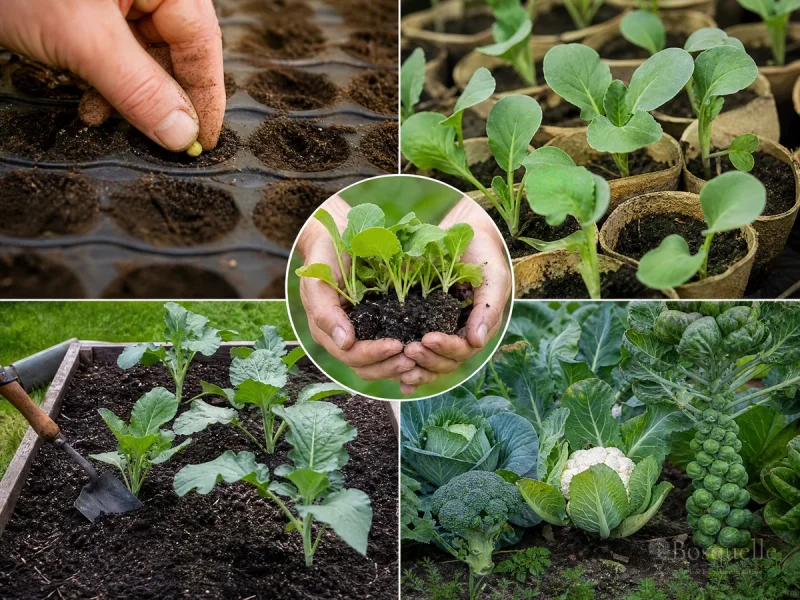
Cabbage forms a dense terminal head; kale grows as a rosette of leaves with no heading. Both are Brassica oleracea, and their seedlings are nearly identical. Label your trays.
Are all brassicas frost-hardy?
Most tolerate light frost (28–32°F), and kale and Brussels sprouts survive harder freezes. Young seedlings and transplants are more sensitive than mature plants. A hard freeze before cabbage heads firm can damage the outer leaves.
Related guides


References
This note is part of Brassica Guides.
More type comparisons by plant are gathered in Types of Plants Guides.
Updated: Reviewed by Bosquelle Editors