
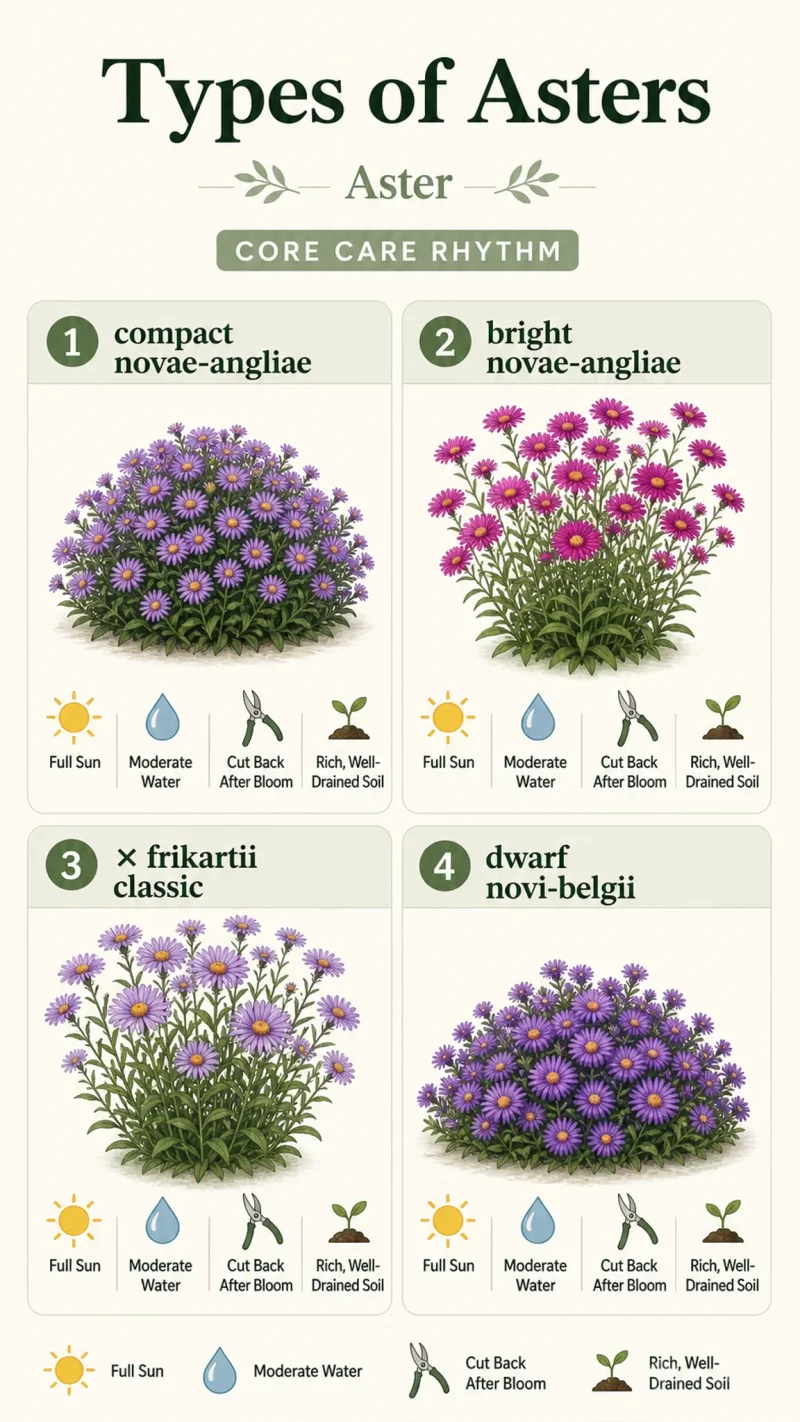
Choose asters by height, light, and mildew risk before color. Purple Dome is a compact New England dome. Professor Anton Kippenberg is a compact New York type. White Wood Aster wants part shade. They do not share one site.
Browse all 61 garden asters. Sun and air stay on How to Grow Asters. Pinch steps live on Pruning Asters.
Choose asters by height, light, and mildew
| Factor | Recommended | Avoid |
|---|---|---|
| New England | Sun; often taller; hairy leaves | A jammed, still pocket |
| New York / Michaelmas | Sun, extra air; compact types up front | Shade and wet leaves overnight |
| Heath / aromatic | Leaner, drier sun once rooted | Copying a wet New England soak |
| Wood / shade | Part shade and an edge | A hot dry full-sun strip |
Know your USDA hardiness zone before you pick a type of aster that will take your winter. Type your ZIP below.
2023 USDA ZIP listings (PRISM / USDA-ARS). Find Your USDA Hardiness Zone · Official USDA map.
Mönch is a long-season frikartii hybrid. Snow Flurry is a heath mat. October Skies is aromatic and leans dry. Shop class first, then color.
Sun and air stay the same for most garden types. This page only sorts height, light, and mildew class. Care stays on the grow page. Divide stays on the divide page.
Browse all asters by group in the catalog below. Use the groups as a shop filter, not as six care essays.
Wrong aster buys that look like a types page
A florist daisy as a landscape contract: cut stems do not tell you mildew risk or winter wet. Read height and class.
White Wood Aster in a hot dry strip: woodland types want part shade. Purple Dome wants the opposite light.
Professor Anton Kippenberg in a jammed, still pocket: New York types mildew fast without sun and space.
Color-series names as a site rule: pink versus purple does not change spacing. Height and light do.
A types page is not a care override. Every group below still wants air around the clump unless a woodland tag says shade.
What each type actually offers
New England asters: Aster novae-angliae and cultivars (Purple Dome, Alma Potschke, Harrington's Pink, and similar) — often taller sunny borders. Hairy leaves; confirm height on each profile.
Michaelmas / New York asters: Aster novi-belgii, dumosus, and compact New York / Michaelmas types (Professor Anton Kippenberg, Wood's Pink, and similar) — autumn daisies that need sun, spacing, and a spring divide.
Frikartii and long-season daisies: Aster × frikartii (Mönch, Jungfrau) and long-season border daisies such as Little Carlow — a longer bloom window than a short autumn flush alone.
Heath and aromatic asters: Fine-texture heath and aromatic types (ericoides Snow Flurry, oblongifolium October Skies and Raydon's Favorite, and similar) — often drier edges and low mats once rooted.
Wood and shade-edge asters: Woodland and part-shade types (Eurybia divaricata, cordifolium, lateriflorum, and similar) — an edge or morning sun, not a hot full-sun New England strip.
Other Aster in our library: These Aster entries do not yet match a height or light class. Read the profile before you assume full sun, part shade, or a compact New York habit.
Height is the last check on the tag. Compact New England sits near a path. Tall types belong at the back. Light class still comes first for wood types.
A color name is a shop label. It does not tell you whether the plant wants a woodland edge or a sunny Michaelmas row. Map the pot to class before you pay.
If two packets look the same in leaf, open the Latin. Novae-angliae sits with New England. Novi-belgii sits with New York. Oblongifolium sits with aromatic. Color is the last sort, not the first.
Full catalog by type group (61)
Groups follow New England, Michaelmas/New York, frikartii, heath/aromatic, wood/shade, and other. Photograph the tag. Series names proliferate.
If a woodland type and a New England dome both win the palette, plant them as two light jobs. A muddle trains you to blame the genus when shade killed the sun type.
Write class on the plant tag before the packet goes in the shed. A light mismatch is the usual types-page mistake, not a fertilizer mistake.
Compare two pots side by side when you can. A heath mat next to a tall New England is obvious in person. Phone thumbnails lie. Repeat once before payment: light, then height, then color.
New England asters (15)
Aster novae-angliae and cultivars (Purple Dome, Alma Potschke, Harrington's Pink, and similar) — often taller sunny borders. Hairy leaves; confirm height on each profile.
Michaelmas / New York asters (19)
Aster novi-belgii, dumosus, and compact New York / Michaelmas types (Professor Anton Kippenberg, Wood's Pink, and similar) — autumn daisies that need sun, spacing, and a spring divide.
Frikartii and long-season daisies (3)
Aster × frikartii (Mönch, Jungfrau) and long-season border daisies such as Little Carlow — a longer bloom window than a short autumn flush alone.
Heath and aromatic asters (9)
Fine-texture heath and aromatic types (ericoides Snow Flurry, oblongifolium October Skies and Raydon's Favorite, and similar) — often drier edges and low mats once rooted.
Wood and shade-edge asters (5)
Woodland and part-shade types (Eurybia divaricata, cordifolium, lateriflorum, and similar) — an edge or morning sun, not a hot full-sun New England strip.
Other Aster in our library (10)
These Aster entries do not yet match a height or light class. Read the profile before you assume full sun, part shade, or a compact New York habit.
Where care, partners, divide, and fall picks live
Sun, air, and water: How to Grow Asters. Pinch and winter cut: Pruning Asters. Neighbors: Aster Companion Plants. Spring divide: Dividing Asters. Late-season shortlist: Best Asters for Fall Color.
Pots are not a separate page in this cluster. Compact types can sit in a large drained container for a season. The grow page covers that extra in one paragraph.
Use this page to refuse a wrong buy, then leave. Do not reread the groups as six mini care guides. Sun and air do not change because the flower is pink instead of purple.
If the catalog row is thin in a group, that is a stock gap, not a missing class. Open the plant profile and still apply the same height and light check you used on the named examples above.
FAQ
How do I choose an aster type?
Pick New England, New York/Michaelmas, frikartii, heath/aromatic, or wood/shade by height and light, then color.
What is the difference between Purple Dome and Professor Anton Kippenberg?
Purple Dome is a compact New England type. Professor Anton Kippenberg is a compact New York type. Both want sun. The New York type mildews faster in still air.
Can I plant a wood aster in full sun?
Usually no. Wood types want part shade. Full-sun New England types want the opposite strip.
Are Michaelmas daisies different plants?
Michaelmas daisy is a garden name for New York asters and similar autumn daisies. Read the Latin.
Do types change how I divide?
Timing is still spring when new shoots show. See Dividing Asters.
Where is care?
How to Grow Asters.
Is this chrysanthemum?
No. Mums are a different genus. Asters are daisy-like fall perennials, many now classified as Symphyotrichum.
Can I mix New England and woodland types?
Yes as two light jobs, not in one hot strip or one deep-shade hole.
Related guides




This note is part of Aster Guides.
More type comparisons by plant are gathered in Types of Plants Guides.
Updated: Reviewed by Bosquelle Editors