
Grow yesterday-today-and-tomorrow in morning sun, in moist acidic soil that drains, and keep the water even so the roots never sit wet. Morning-noon-and-night is the same plant. Brunfelsia is the Latin. This is the shrub, not the 1963 film.
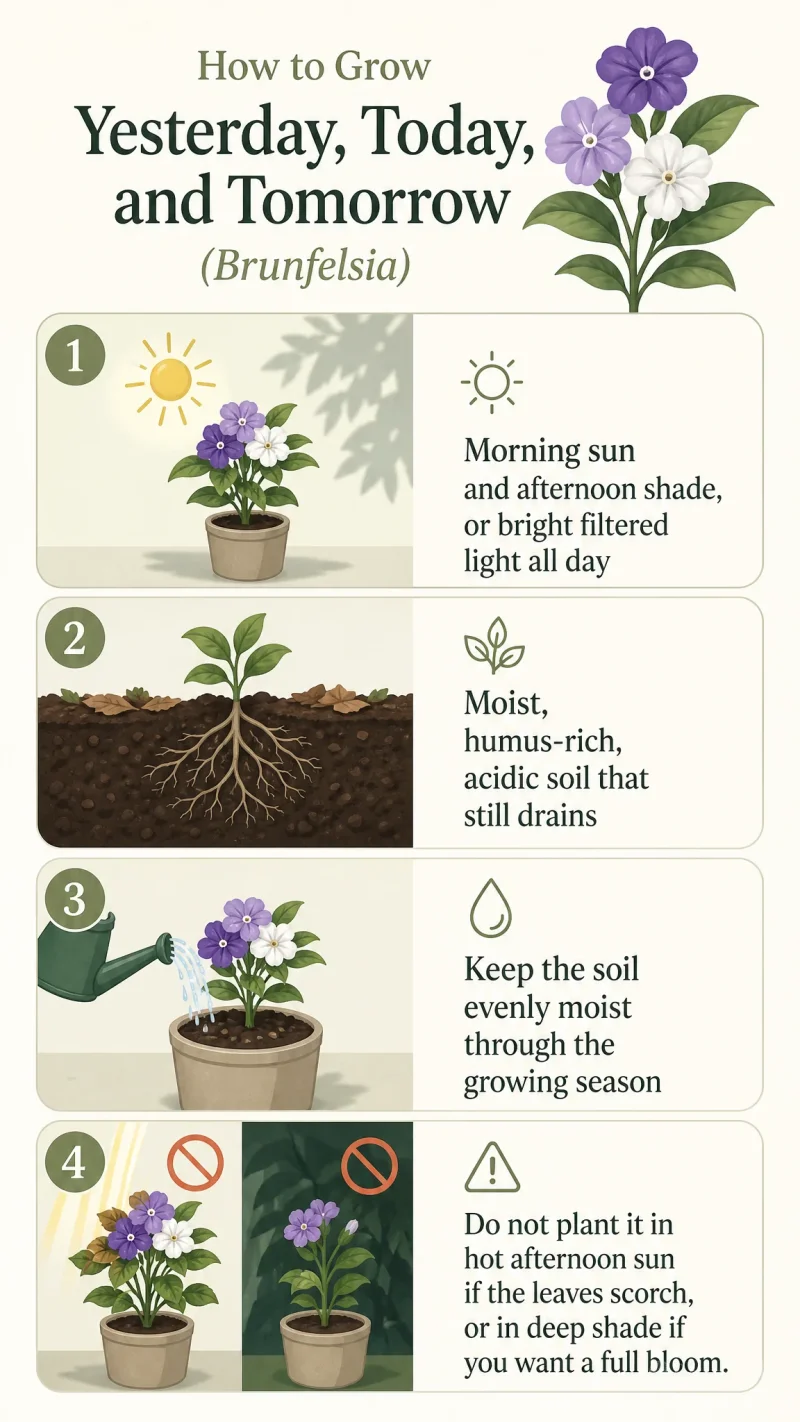
Give it morning sun, moist acidic soil that drains, and even water
| Factor | Recommended | Avoid |
|---|---|---|
| Light | Morning sun and afternoon shade, or bright filtered light all day | Do not plant it in hot afternoon sun if the leaves scorch, or in deep shade if you want a full bloom |
| Soil | Moist, humus-rich, acidic soil that still drains | Do not leave the roots in a wet pocket, and do not let the soil dry out for days |
| Water | Keep the soil evenly moist through the growing season | Do not water on a calendar that leaves the pot soggy |
| Feed | A balanced liquid feed every few weeks in spring and summer, if growth is thin | Do not feed in winter while the plant is resting |
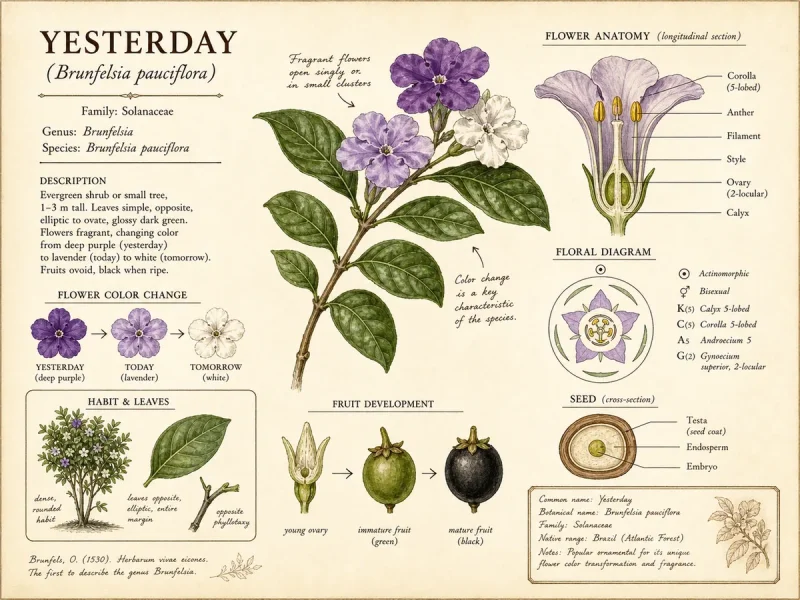
Yesterday-today-and-tomorrow is a woody shrub, about 3 to 8 feet tall, with glossy leaves and clusters of five-petal flowers. Give it morning sun and afternoon shade, or bright filtered light, and keep the mix moist without standing water. [1] Soggy soil around the roots is the primary cause of root rot. A long dry spell, or soil that stays alkaline, is why bloom thins and leaves yellow. [2] The flowers open purple, fade to lavender, then turn white over a few days. That fade is the pigment aging in the petals, not a soil-pH trick. [3]
- Choose morning sun and afternoon shade, or bright filtered light all day. Hot afternoon sun scorches the leaves. Deep shade is why the purple flush stays thin.
- Set it in moist, humus-rich, acidic soil that still drains. Compost in the hole is fine if water does not stand around the roots.
- Water through the growing season so the soil stays evenly moist. Let the surface dry slightly, then water again. Empty the saucer so the pot is not sitting in water.
Does yesterday-today-and-tomorrow need full sun?
Morning sun and afternoon shade, or bright filtered light. Hot afternoon sun scorches the leaves. Deep shade makes a thin bloom.
How often should I water yesterday-today-and-tomorrow?
Keep the soil evenly moist through the growing season. Water when the surface has just begun to dry. Do not leave the roots in standing water.
Why aren't the flowers changing color?
New flowers open purple, then fade to lavender and white over a few days. If you only see one color, the plant may not be blooming enough. Give it brighter morning light and even moisture.
Plant after frost, with the crown at soil level
Plant in spring after frost, or in any frost-free month where winter stays mild. Knock the plant from its pot and set the top of the root ball even with the surrounding soil. Dig a hole a little wider than the pot, and no deeper.
- Plant in spring after frost, or whenever the soil is workable in a frost-free garden. Do not set a tender shrub into frozen ground.
- Dig a hole about twice as wide as the root ball, and no deeper. Set the soil line even with the surrounding soil. Planting deeper than it grew in the pot is why the stem rots.
- Backfill with the same soil, mixed with a little compost if the ground is poor. Water when the hole is half full, let it drain, then finish filling and water again.
- Leave about 3 to 5 feet between plants so the shrub can fill. Water to settle the soil, then keep the moisture even through the first season.
When do I plant yesterday-today-and-tomorrow?
Plant in spring after frost, or in a frost-free month, with the crown at soil level. Leave about 3 to 5 feet between plants.
Grow it in a pot and bring it in before frost
Yesterday-today-and-tomorrow also grows in a large pot on a patio. Use a container with a drainage hole, fill it with a potting mix that drains, and water when the surface has just begun to dry. It is not winter hardy where frost hits, so bring the pot indoors before a freeze. Give it about three hours of sun inside, keep the mix moist but not soggy, and water less while it rests. [4]
- Choose a large pot with a drainage hole. Empty the saucer after you water so the roots do not sit wet.
- Fill it with a potting mix that drains. An acid mix sold for azaleas or camellias is fine if you add perlite so water does not linger.
- Set the pot in morning sun or bright filtered light outdoors. Water when the surface has just begun to dry.
- Bring the pot indoors before frost. Give it about three hours of sun in a bright window. Keep the mix moist, not soggy, and water less while growth slows. Do not feed it until new growth starts in spring.
Can I grow yesterday-today-and-tomorrow in a pot?
Yes. Use a large pot with a drainage hole, and bring it indoors before frost. Give it about three hours of sun inside, and keep the mix moist but not soggy.
Prune after bloom so it flowers on new wood
Flowers form on new growth, so a light prune after a bloom flush keeps the shrub dense and blooming. You do not have to prune it for it to flower. If you need to reduce size, wait until the first spring flush has faded, then cut the tallest stems. If you want another shrub from a stem you cut, see How to Propagate Yesterday, Today, and Tomorrow.
- After a bloom flush, snip spent clusters and cut lanky stems back to a set of leaves if you want a denser shrub.
- If you need to reduce height, wait until the first spring flowering has finished, then cut the tallest stems. Do not shear the plant in late winter if you want the first purple flush.
- After a freeze kills the top, wait for new growth, then cut the dead wood. Do not pull the plant because the top looks brown in late winter.
When do I prune yesterday-today-and-tomorrow?
After a bloom flush, because flowers form on new wood. For a harder size cut, wait until the first spring flowering has finished.
Not a petunia — and not browallia
Yesterday-today-and-tomorrow is Brunfelsia, a woody shrub whose flowers open purple and fade to white. A petunia is an annual bedding plant with similar five-petal faces, but it is not a shrub — see How to Grow Petunias. Browallia is another annual in the same family, sold as bush violet — see How to Grow Browallia. It does not fade through three colors on wood.
Hydrangea flowers also change color, but that shift is soil pH, not petals aging — see How to Grow Hydrangeas. Brazil raintree is a shop name for this shrub. Golden rain tree is a different plant, a canopy tree with yellow panicles — see How to Grow Golden Rain Tree. A tag that says lady of the night may be a night-scented Cestrum, Brunfelsia americana, or the lady-of-the-night orchid — see How to Grow Brassavola. Plumbago is a blue-flowered shrub often planted nearby — see How to Grow Plumbago. Angel's trumpet is Brugmansia, a hanging trumpet — see How to Grow Angel's Trumpet. If the tag is not Brunfelsia, you do not have this plant. The 1963 film of the same name is not a plant.
Is yesterday-today-and-tomorrow a petunia?
No. Yesterday-today-and-tomorrow is Brunfelsia, a woody shrub. Petunia is an annual. Browallia is another annual. Hydrangea color change is soil pH, not petals aging.
Set yesterday-today-and-tomorrow in morning sun, in moist acidic soil that drains, and keep the water even so the roots never sit wet.
FAQ
Is yesterday-today-and-tomorrow poisonous to dogs?
Yes. All parts are toxic if eaten, especially the berries. Keep dogs, cats, horses, and children from chewing the plant. This is not a treatment guide; call a veterinarian if an animal eats it.
Is Floribunda a different plant?
Floribunda is a garden name on the same Brunfelsia shrub, often sold for a heavier flush of purple flowers. Compact is a dwarf form of the same species. Read the tag for Brunfelsia pauciflora.
Is lady of the night the same shrub?
Not usually. Lady of the night is often a night-scented Cestrum, an orchid, or a cactus in search results. Brunfelsia americana is a related shrub that is not this one. Read the Latin on the tag.
Related guides

Recommended plants
References
- [1] NC State Extension -
https://plants.ces.ncsu.edu/plants/brunfelsia-pauciflora/ - [2] Harvest to Table -
https://harvesttotable.com/how-to-grow-brunfelsia/ - [3] University of Florida IFAS -
https://edis.ifas.ufl.edu/publication/FP077 - [4] South Florida Plant Guide -
https://www.south-florida-plant-guide.com/yesterday-today-and-tomorrow.html
This note is part of Brunfelsia Guides.
More first-season notes by plant are gathered in How to Grow Guides.
Updated: Reviewed by Bosquelle Editors