
Angel's trumpet grows as a woody shrub or small tree with pendulous, fragrant flowers that hang straight down — the key difference from Datura, whose flowers face upward. All parts of the plant are toxic; wear gloves when pruning. In USDA Zones 10–12 it grows in the ground year-round; in colder zones it needs a pot you can move indoors before frost.

Give it full sun, rich soil, and daily water in summer
| Factor | Recommended | Avoid |
|---|---|---|
| Light | Full sun to part shade; 6+ hours direct sun for best bloom | Deep shade — the plant grows but rarely flowers |
| Soil | Rich, moisture-retentive, well-drained loam or amended bed; pH 6.0–7.0 | Dry sandy soil or waterlogged clay — root problems set in fast |
| Water | Deep watering daily in summer heat; reduce in autumn; barely moist in winter dormancy | Letting it dry out — wilting is the first sign, and a dry plant stops flowering |
| Feed | Balanced liquid feed (monthly) in spring; switch to high-potassium feed weekly in summer to push flowers | Too much nitrogen — the plant runs to leaf growth at the expense of blooms |
| Frost hardiness | USDA Zones 10–12 in ground; move a pot indoors before night temperatures drop below 45°F | Any frost on in-ground plants — cold kills canes and can kill roots |
Plant angel's trumpet in the richest soil you have and improve drainage before planting if the bed is slow to drain. [1] In the ground in a warm climate, a mature plant needs very deep watering — large specimens may need daily soaking in peak summer heat to stay in active growth and bloom. [2] In spring, feed with a balanced formula once a month to build a framework of branches. Switch to a high-potassium feed weekly once the plant sets its first Y-fork and begins forming flower buds. [3]
Why won't my angel's trumpet bloom?
The four most common causes: not enough direct sun (needs 6+ hours), too much nitrogen fertilizer pushing leaf growth instead of flowers, overwatering keeping roots wet, and hard pruning below the Y-fork that removes all flowering wood. Switch to a high-potassium feed and let the top inch of soil dry slightly between waterings.
Prune above the Y-fork — that is where next season's flowers form
Angel's trumpet flowers only at the tips of branches that grew above the first Y-shaped fork in the main stem. [2] Understanding the Y is the only tricky part of pruning; everything else is straightforward.
- Find the first Y-fork on the main stem — the point where the trunk splits into two branches. Flowers form on growth above this junction.
- Keep at least 6 to 10 nodes on each branch above the Y when you cut. Pruning closer removes the dormant bud sites that produce next year's flowers.
- Cut in autumn before moving the plant indoors, or in late winter before new growth begins. Either timing is fine; autumn pruning makes the pot easier to store.
- Cut back to within about 1 inch of the older, thicker wood above the Y if you need to reduce the plant's size significantly.
- Remove any suckers growing from the base if you want to keep a single-trunk tree form. Leave them if you want a bushy, multi-stem shrub.
- Wear gloves and eye protection — the sap irritates skin and eyes. Clean your pruning shears before and after to avoid spreading disease.
Hard pruning below the Y is not fatal, but the plant will spend one full growing season rebuilding the branching structure before it flowers again. [1] If a plant has become badly overgrown, cutting it back hard in early spring is safe — it will regrow from the trunk.
Can I take cuttings from angel's trumpet?
Yes — Brugmansia roots readily from cuttings. Take a 6–10 inch semi-hardwood cutting from growth above the Y-fork in late spring or summer. Strip the lower leaves, leaving two or three at the tip. Root in water, changing it daily, or in a moist mix of equal parts perlite and potting mix. Roots typically appear within two to four weeks. Cuttings taken from above the Y will flower sooner than those taken from the base.
Warm group and cold group, and not a Datura
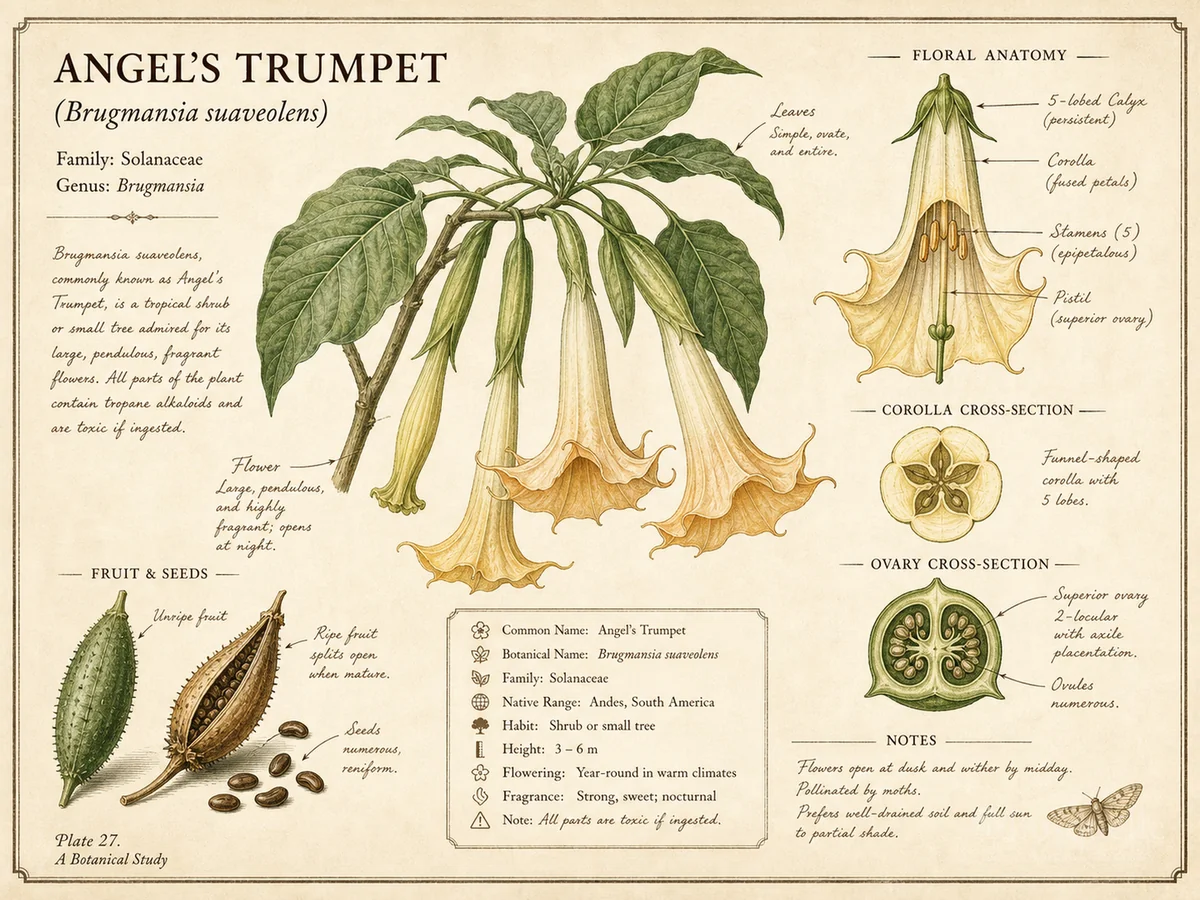
Angel's trumpet is a common name shared with Datura, a different genus. The easiest way to tell them apart: Brugmansia flowers hang straight down; Datura flowers point upward. [1] Brugmansia is a woody perennial shrub or tree that lives for many years; Datura is typically a herbaceous annual. Brugmansia seed pods are smooth; Datura pods are spiny.
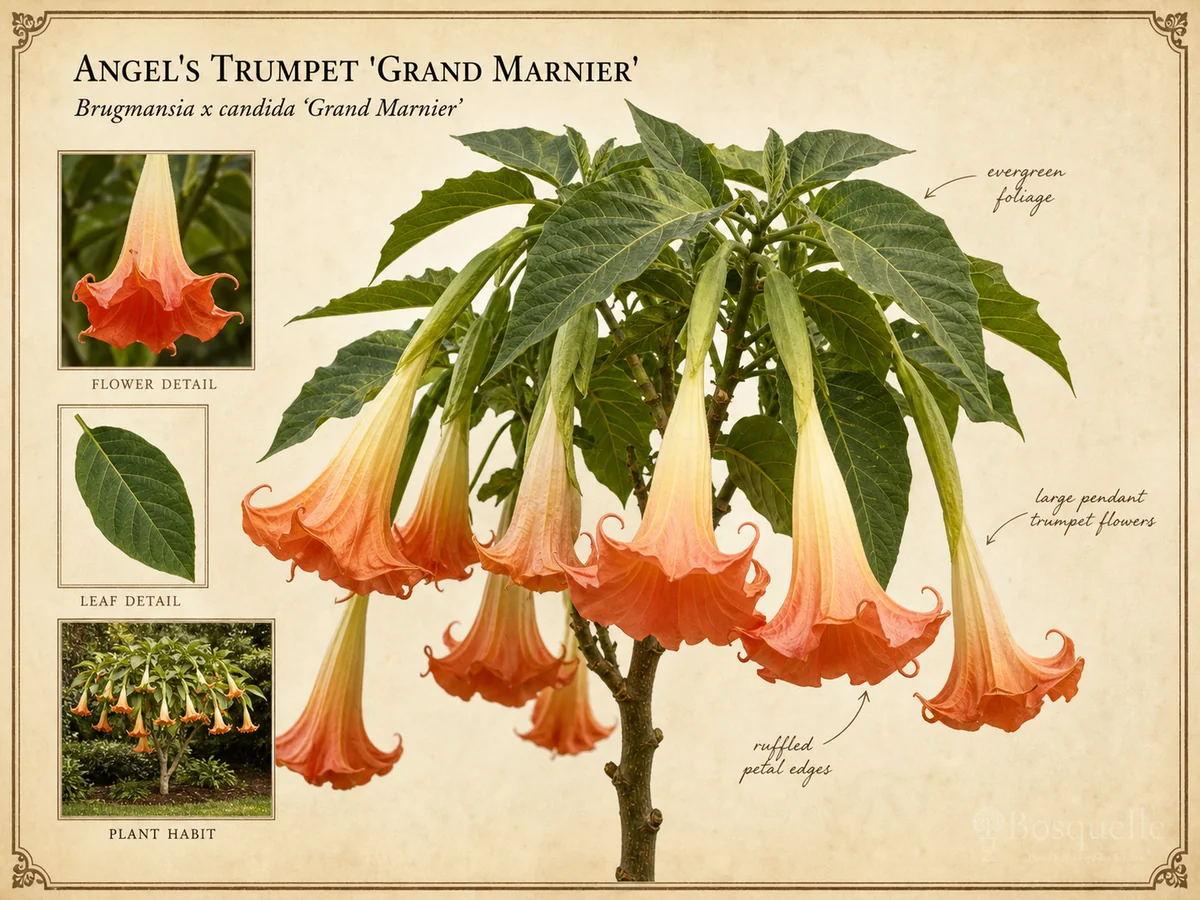
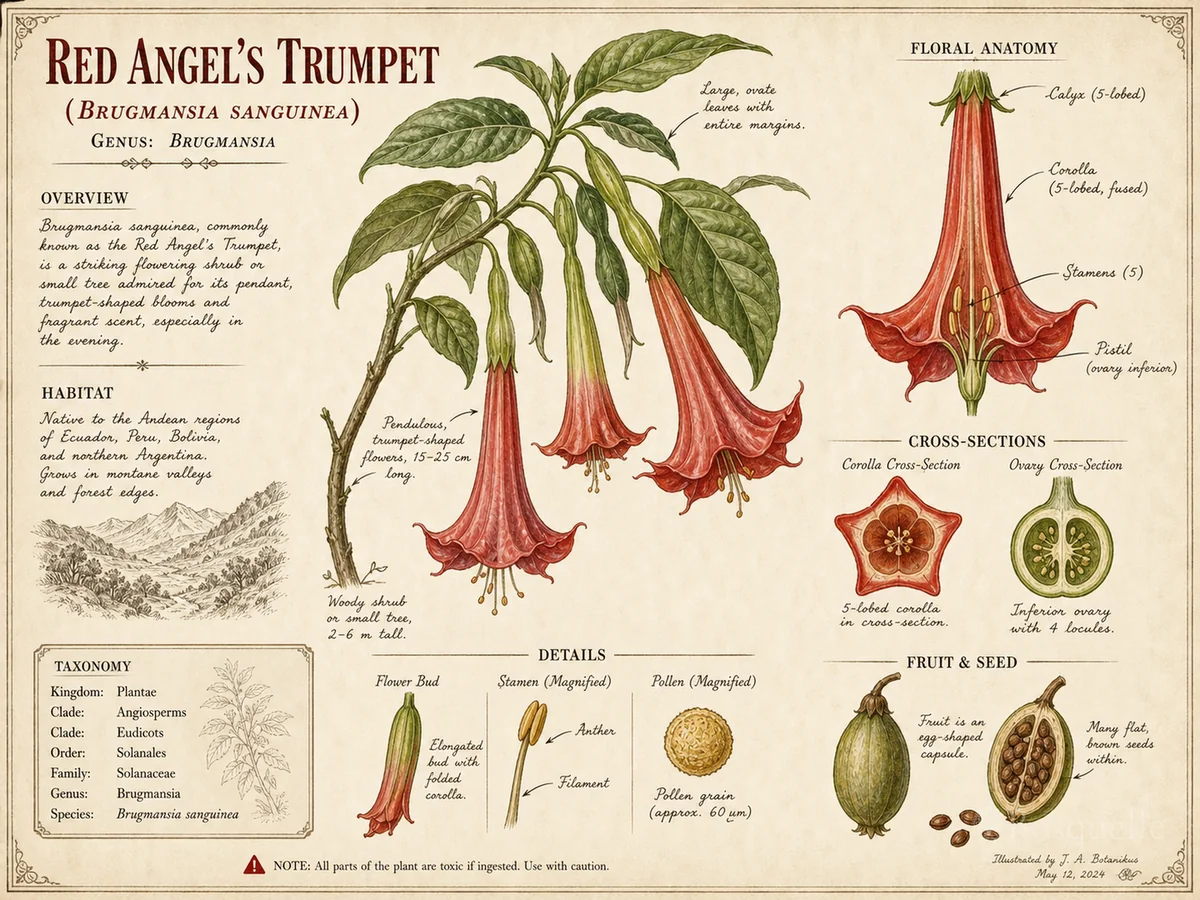
Within Brugmansia, seven species divide into two naturally isolated groups. The warm group — B. suaveolens, B. aurea, B. versicolor, and their hybrids — prefers warm, sunny conditions and is the source of most garden cultivars, including Grand Marnier and Charles Grimaldi. [3] The cold group — B. sanguinea, B. arborea, B. vulcanicola — tolerates cooler nights and is more suited to highland gardens; it will not flower well in consistently hot, humid summers.
Most plants sold at garden centers are warm-group hybrids. White, yellow, peach, and salmon colors belong to the warm group. Red and orange-red trumpets usually indicate B. sanguinea or a cold-group cross. In colder US zones, grow any Brugmansia in a pot you can move: see Brugmansia in Pots for the full pot-choice and overwintering sequence.
Is angel's trumpet toxic to dogs and cats?
All parts of Brugmansia are highly toxic — leaves, flowers, seeds, and sap all contain tropane alkaloids. Keep pets from chewing any part of the plant. The sap also irritates human skin; wear gloves whenever you prune or handle cuttings.
Angel's trumpet rewards consistent care with armloads of fragrant, dramatic blooms through summer and into fall. Match the sun, feed generously in summer, and learn the Y-fork before you pick up the pruning shears. If you grow it in a container in a zone that gets frost, move it indoors before temperatures drop to 45°F — see Brugmansia in Pots for the full container and overwintering sequence.
FAQ
Is angel's trumpet a perennial or an annual?
Brugmansia is a woody perennial. In USDA Zones 10–12 it stays in the ground year-round. In colder zones it survives in a container moved indoors each autumn and lives for many years with proper winter storage.
How big does angel's trumpet get?
In the ground in a warm climate, Brugmansia reaches 6 to 35 feet depending on species and conditions. In a container it typically stays 4 to 12 feet tall because annual pruning and pot size keep growth in check.
Does angel's trumpet need deadheading?
No deadheading is required — spent trumpets drop on their own. Light tip pruning after a flush of blooms pushes new shoots and more flower buds, which is more useful than removing individual spent flowers.
Does angel's trumpet attract hummingbirds or butterflies?
Yes. The long tubular flowers attract both hummingbirds and hawk moths, which are the main pollinators. Butterflies also visit. The evening fragrance draws moths after dark.
Is angel's trumpet deer resistant?
Yes. Deer generally avoid Brugmansia, which is consistent with its high toxin content. It is listed as deer resistant by North Carolina State Extension.
Can I grow angel's trumpet from seed?
Yes, but seed-grown plants take at least two years to flower and may not match the parent if it is a hybrid. Stem cuttings root easily and produce a flowering-size plant in one season — the preferred propagation method for named cultivars.
Related guides

Recommended plants


References
- [1] North Carolina Extension Gardener Plant Toolbox -
https://plants.ces.ncsu.edu/plants/brugmansia/ - [2] Royal Horticultural Society -
https://www.rhs.org.uk/plants/brugmansia/growing-guide - [3] BBC Gardeners' World Magazine -
https://www.gardenersworld.com/how-to/grow-plants/how-to-grow-brugmansia-angels-trumpets/
This note is part of Brugmansia Guides.
More first-season notes by plant are gathered in How to Grow Guides.
Updated: Reviewed by Bosquelle Editors