
Grow wood rush as an evergreen groundcover in shade, in soil that stays moist. Wood rush is Luzula.

Give it shade and moist soil — not a soggy hole
| Factor | Recommended | Avoid |
|---|---|---|
| Sun | Part shade or shade; full sun only if the soil stays moist | Do not site it in hot, dry full sun |
| Soil | Moist, humus-rich ground that is not waterlogged | Do not plant it where water stands after rain |
| Water | Keep the soil moist the first season, then water only in a long dry spell under trees | Do not water on a weekly calendar once the clump is set |
| Kind | Greater wood rush for a spreading carpet; snowy wood rush for white flower clusters | Do not treat it as a wet pond rush |
| Feed | A yearly mulch of compost or leaf mold | Do not dump extra fertilizer on the clump |
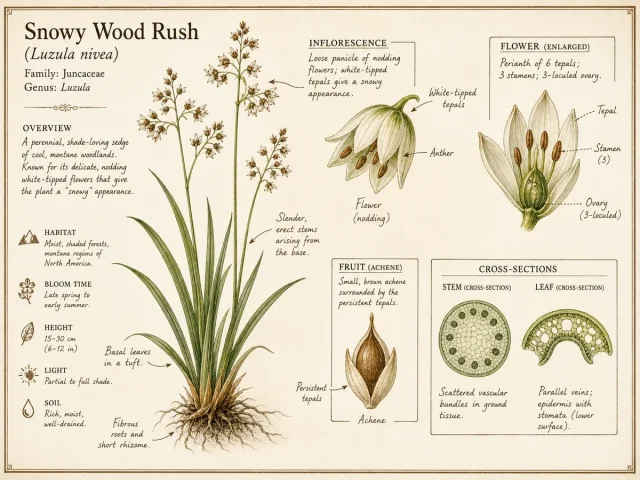
Wood rush wants shade and soil that stays moist, not a soggy hole. It makes a good groundcover in a woodland bed. Full sun is fine only when the roots stay moist. Hot, dry sun scorches the leaves. [1] Once the clump is established, greater wood rush can hold a dry-shade patch under trees, but that is not a reason to skip water the first season. [2] greater wood rush is the spreading evergreen carpet with brown flower sprays in late spring. snowy wood rush is the slower clump with shiny white flower clusters. Both want the same shade and moist soil.
Does wood rush need shade?
Yes. Part shade or shade. Full sun works only if the soil stays moist. Hot, dry sun scorches the leaves.
How often should I water wood rush?
Keep the soil moist the first season. After that, water in a long dry spell under trees. Do not leave the crown in standing water.
Which wood rush should I buy?
Buy greater wood rush for a spreading evergreen carpet. Buy snowy wood rush if you want the white flower clusters. Both want shade and moist soil.
Can it take dry shade?
Greater wood rush can hold dry shade once it is established. Water a new clump through the first season, and do not plant it in hot, dry full sun.
Plant at the same depth as the pot, in spring or fall
Plant a container clump in spring, or in fall if your winter is mild. Dig a hole about twice as wide as the root ball, and set the top of the root ball level with the soil. Too deep and the crown can rot. Too high and the roots dry out. [3]
- Water the pot, then let it drain. Dig a hole about twice as wide as the root ball, in shade, on ground that stays moist but is not waterlogged.
- Set the plant so the top of the root ball sits level with the soil. Backfill, firm gently, and water well.
- Mulch around the clump, not over the crown. Keep the soil moist until new growth shows.
Split a crowded clump in spring
Lift a tired clump in mid-spring, when the soil is not frozen and not waterlogged. Pull or cut it into pieces that each keep healthy roots and several shoots, then replant at the same depth and water until they take.
- Choose a spring day when the soil is workable. Dig the clump, and shake off loose soil.
- Split it with a sharp spade, or with two forks back to back. Keep pieces that have roots and green shoots. Discard the dead center.
- Replant at the same depth, and water until the divisions are growing.
When should I plant wood rush?
Plant in spring, or in fall if your winter is mild. Set the crown at the same depth as the pot, and keep the soil moist until it is established.
How do I divide wood rush?
Lift the clump in spring. Split it into pieces that each keep roots and shoots, replant at the same depth, and water until they take.
Not corkscrew rush — and not a sedge or Japanese forest grass
Wood rush is Luzula, a woodland plant with flat leaves that have white hairs on the edges. Corkscrew rush is Juncus, usually hairless, and it wants wet ground — see How to Grow Rush. If you searched for a wet, curly pond rush and landed here, you want corkscrew rush, not wood rush. [4]
A sedge is Carex. Sedges have triangular stems. Wood rush does not — see How to Grow Sedge. Japanese forest grass is Hakonechloa, a true grass for moist shade — see How to Grow Japanese Forest Grass. Liriope and mondo grass are strap-leaf shade plants, not this genus — see How to Grow Liriope and How to Grow Mondo Grass. If the tag says wood rush and the leaves have white hairs on the margins, you still have Luzula.
Is this corkscrew rush?
No. Corkscrew rush is Juncus, a wet plant with usually hairless stems. Wood rush has flat, hairy leaves and wants woodland shade.
Is this a sedge?
No. Sedges have triangular stems. Wood rush has flat leaves with white hairs on the edges.
Is this Japanese forest grass?
No. Japanese forest grass is Hakonechloa. Wood rush is in the rush family, with hairy leaf margins.
Comb out tattered leaves in early spring
The foliage is evergreen in a mild winter, so do not cut the clump to the ground in fall. In early spring, comb out dead, withered leaves with gloved hands, and snip brown tips. You can also snip spent flower stems if you want a tidier mound.
- Wait until early spring, before strong new growth. Do not shear the clump in fall.
- Comb out dead leaves with your fingers. Snip brown tips with scissors. Leave the green blades in place.
- Snip spent flower stems if you want a cleaner mound. Do not cut into the crown.
Should I cut it back in fall?
No. Leave the evergreen leaves through winter. Comb out tattered blades in early spring.
Will the leaves stay green in winter?
In a mild winter the clump stays green. After a hard winter, comb out the browned leaves in early spring. New growth fills in from the crown.
Plant the next clump in shade this spring, and keep the soil moist until it is established.
FAQ
Can I grow wood rush in a pot?
A pot that drains can hold a clump on a shaded patio if you keep the mix moist and empty the saucer. Divide and refresh the mix every year or two. A woodland bed holds a patch better.
Can I grow it from seed?
You can sow seed in pots outdoors in spring or fall, but seedlings are slow. Division is the reliable way to get a new clump.
Can I cut stems for a vase?
You can cut a few flower stems for the house. Leave most of the clump standing. This is a groundcover, not a cutting garden.
Do you list Aurea or Marginata?
No. This catalog holds snowy wood rush and greater wood rush. Gold or cream-edge forms are other nursery plants. Treat a hairy-leaf evergreen rush in shade as this genus.
Is this the native hairy woodrush?
No. Hairy woodrush and hedgehog woodrush are native woodland species we do not list. This page covers snowy wood rush and greater wood rush from the shop.
Recommended plants

References
- [1] Royal Horticultural Society -
https://www.rhs.org.uk/plants/10579/luzula-sylvatica/details - [2] Heritage Perennials -
https://www.perennials.com/plants/luzula-sylvatica.html - [3] Hayloft -
https://hayloft.co.uk/how-to-grow-luzula - [4] Missouri Department of Conservation -
https://mdc.mo.gov/discover-nature/field-guide/rushes
More first-season notes by plant are gathered in How to Grow Guides.
Updated: Reviewed by Bosquelle Editors