
Grow wild cucumber in full sun, in moist soil, and on a tall fence or arbor. Wild cucumber is Echinocystis lobata. It is not a garden cucumber.
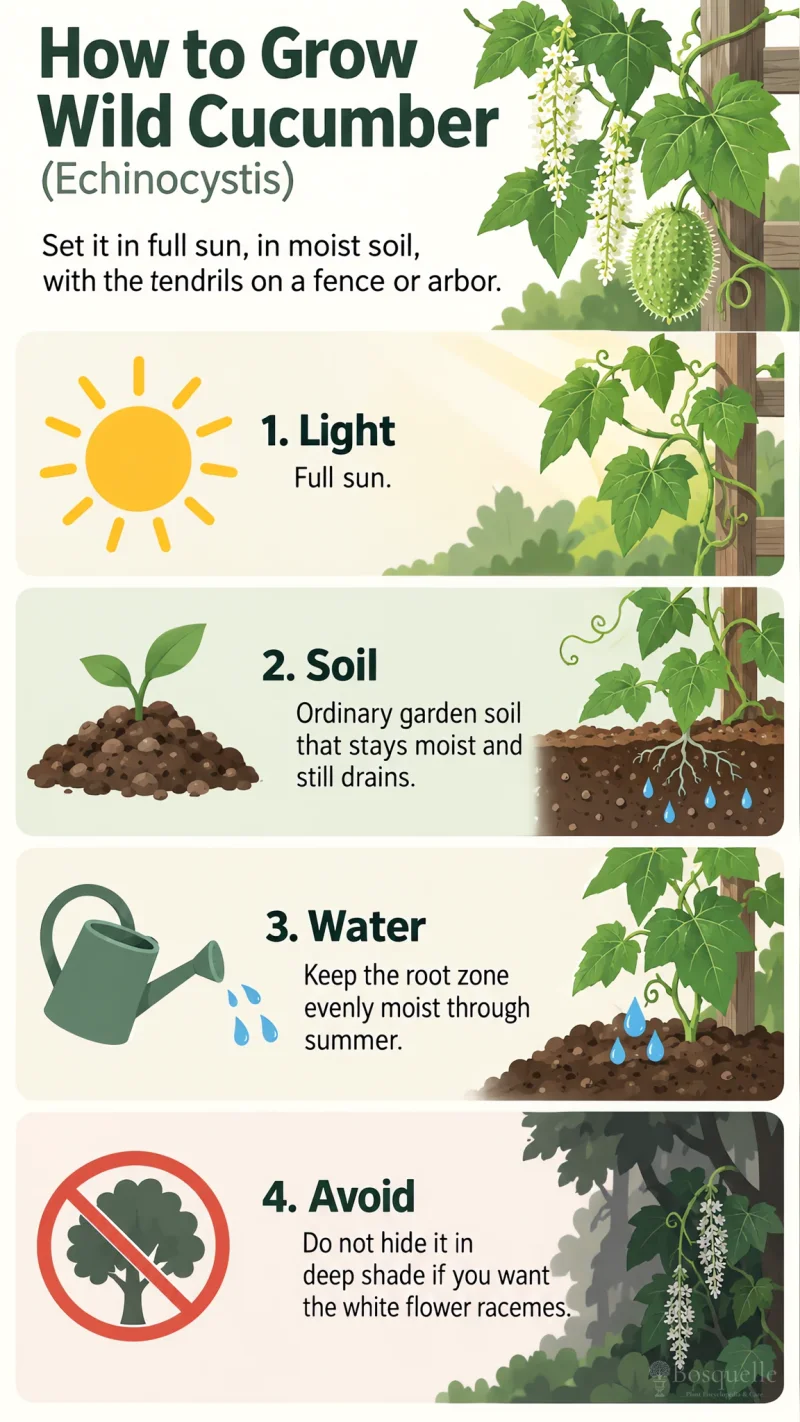
Give it full sun, moist soil, and a tall fence or arbor
| Factor | Recommended | Avoid |
|---|---|---|
| Light | Full sun | Do not hide it in deep shade if you want the white flower racemes |
| Soil | Ordinary garden soil that stays moist and still drains | Do not plant it on a dry, baked bank |
| Water | Keep the root zone evenly moist through summer | Do not leave the roots in standing water |
| Support | A sturdy fence, arbor, or pergola the three-forked tendrils can wrap | Do not let it climb a young tree or a thin shrub you still want to keep |
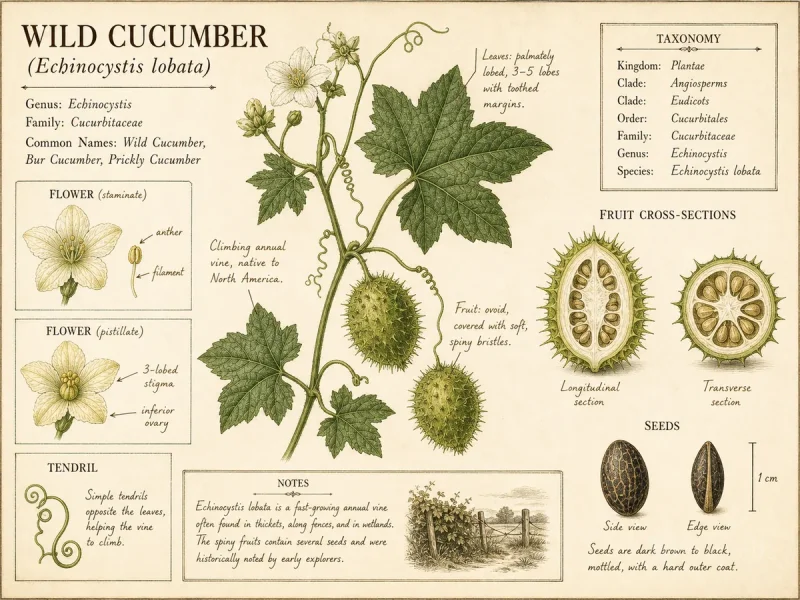
wild cucumber is an annual vine in the gourd family. Hairless, grooved stems run twenty-five to thirty feet in one summer, grabbing with three-forked tendrils. Pale white flowers open in midsummer, and the male racemes are fragrant. Give it sun and moist ground so the vine covers the support instead of searching for a tree. [1] [2] A fence, arbor, or pergola is the right job. The vine is native in much of the eastern and central United States, and it is not an invasive species there, but it will smother a young planting if you let the tendrils take a sapling. [3]
How much sun does wild cucumber need?
Full sun is the usual home. Moist soil still matters in afternoon heat. Deep shade makes a thin vine with few flowers.
Is wild cucumber an invasive plant?
In its native range it is a fast annual, not an invasive woody vine. Pull seedlings if you do not want it on a young tree, and pick the pods before they drop seed.
It dies after frost; next year comes from seed
Frost kills the vine. There is no crown to lift and store. Next summer's plants come from seed that overwintered on the ground, or from seed you sowed with a cold spell first.
Sow after a cold spell, then plant at the foot of a sturdy support
Seed is the usual start. The hard coat needs a long, cold, moist spell before it germinates well. File or nick the seed only if you want a poor stand — cold treatment works; damaging the coat does not. Sow in fall, or mix the seed with damp sand in a bag in the refrigerator for several months, then plant after frost at the foot of the support.
- Collect ripe pods in October, or buy seed, and keep the four flat seeds dry until you start the cold spell. [4]
- Sow outdoors in fall, or mix seed with damp sand and refrigerate it for about six months. Keep the sand barely moist, not soggy.
- After the last expected frost, plant one vine at the foot of a fence, arbor, or pergola. Set the seed about a half inch deep, or set a pot-grown seedling at the same depth it grew in the pot.
- Water to settle the soil, then keep the root zone moist while the tendrils find the support.
- If extra seedlings appear, pot them separately or pull them. Do not crowd several vines onto one thin post.
When do I plant wild cucumber?
Give the seed a cold, moist spell first, then plant after frost at the foot of a sturdy support. Fall sowing outdoors does that cold work for you.
How do I grow it from seed?
Use the cold spell, then plant one vine at the support after frost. Do not file the seed coat. Keep the soil moist until the tendrils grab.
Not a garden cucumber — and not bur cucumber or creeping jenny
Garden cucumber is Cucumis sativus, a yellow-flowered crop you pick green. This vine has six-petaled white flowers and a spiny, inflated pod that is not a slicing fruit. See How to Grow Cucumber. Squash and pumpkin are Cucurbita, with large yellow flowers and edible fruit. See How to Grow Squash.
Can you eat a wild cucumber?
No. The spiny pod is not a slicing cucumber. Do not eat it. Grow the vine for cover and the white flowers.
Is this the same as a garden cucumber?
No. A garden cucumber is Cucumis, grown for green fruit. This plant is Echinocystis, an ornamental annual with a dry, spiny pod.
Bur cucumber is Sicyos. It has hairy stems, five petals, and small clustered fruits with one seed each. This plant is hairless, with a single inflated pod that holds four seeds. One-seeded bur cucumber is a shop nickname for Sicyos, not a second kind of this vine.
Shops also print creeping jenny and mock orange on this plant. Creeping jenny is a low Lysimachia mat. See How to Grow Lysimachia. Mock orange is a Philadelphus shrub. See How to Grow Mock Orange. Squirting cucumber is Ecballium, a Mediterranean plant that jets wet seeds. This pod dries and opens at the bottom. California wild cucumber is Marah, a western perennial with a large tuber. Japanese hops is a different vine. See How to Grow Hops.
Set it in full sun in moist soil, with the tendrils on a fence or arbor. Sow after a cold spell, and do not buy a slicing cucumber, bur cucumber, or creeping jenny as this vine.
FAQ
Can I grow it in a pot?
A large tub that drains, set next to a tall support, can hold one vine for a summer. It is not a houseplant. A small windowsill pot dries too fast and has nowhere for the tendrils to run.
Do I prune it?
You do not shape this vine like a shrub. Guide the first tendrils onto the fence. Pull seedlings, or pick pods before they drop seed, if you do not want a thicket next year.
Can I take cuttings?
Seed is the usual way. This is an annual. A cutting is not the home method.
Can I eat the fruit?
No. Grow the vine for the cover and the white flowers. Do not eat the pods.
Is balsam apple or California wild cucumber a second kind we sell?
No. The plant we list is Echinocystis lobata. Balsam apple is a shop nickname for this vine. California wild cucumber is Marah, a western perennial we do not list.
Can I brew the root as tea?
Grow this plant for the vine and the flowers. Do not brew the root.
What does Epsom salt do for cucumber plants?
That question is about garden cucumber, Cucumis, not this ornamental vine. Grow wild cucumber in sun and moist soil on a tall support.
What is the best month to plant cucumber?
Garden cucumber goes in after frost in warm soil. This wild cucumber seed needs a cold spell first, then a planting after frost at a sturdy support.
Recommended plants
References
- [1] Wisconsin Horticulture -
https://hort.extension.wisc.edu/articles/wild-cucumber-echinocystis-lobata/ - [2] Lady Bird Johnson Wildflower Center -
https://www.wildflower.org/plants/result.php?id_plant=ECLO - [3] University of New Hampshire Extension -
https://extension.unh.edu/blog/2019/08/wild-cucumber-frequently-misidentified-native-vine - [4] University of Washington ESRM 412 -
https://courses.washington.edu/esrm412/protocols/2020/ECLO.pdf
More first-season notes by plant are gathered in How to Grow Guides.
Updated: Reviewed by Bosquelle Editors