
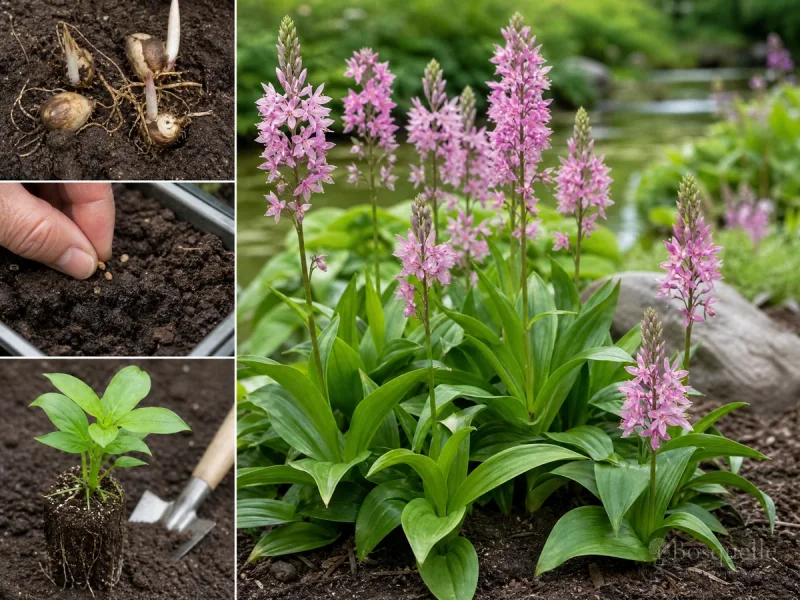
Grow swamp pink in soil that stays wet but is not flooded, in partial shade. Swamp pink is Helonias, an evergreen wetland rosette with a cone of small pink flowers. It is not swamp milkweed and not a grass-pink orchid.

Keep the soil saturated, not flooded, in partial shade
| Factor | Recommended | Avoid |
|---|---|---|
| Light | Partial shade to dappled shade under an open canopy | Do not plant it in a dry, full-sun border |
| Water | Keep the ground wet all year, with the water table near the surface | Do not let the soil dry, and do not stand the crown in floodwater |
| Soil | Acid peat, leaf mold, or other organic wetland soil | Do not use ordinary dry garden soil |
| Site | A seepage, bog edge, or other spot that stays wet | Do not treat it as a pond plant that lives underwater |
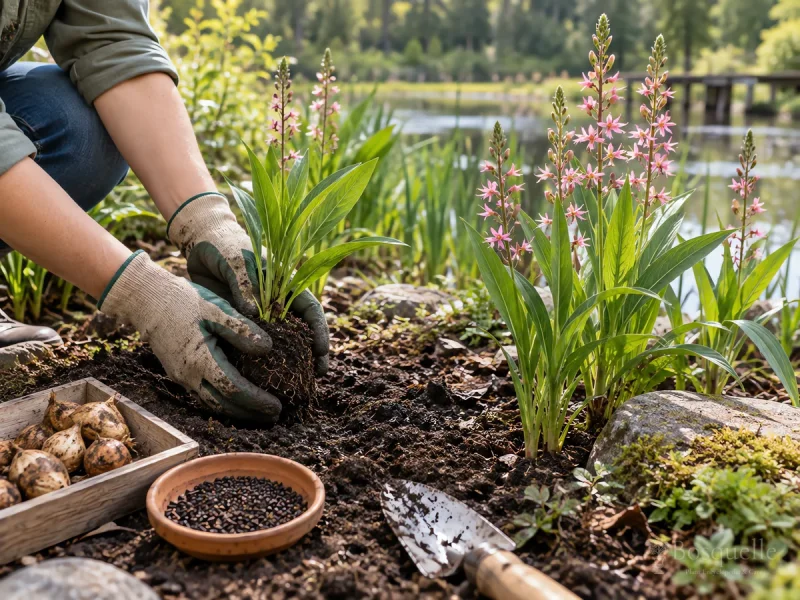
swamp pink is an evergreen wetland rosette. It needs ground that stays wet through the year, with the water table at or near the surface, but the crown must not sit in floodwater. [1] Partial shade or dappled light under trees is the usual home. A dry sunny border dries the peat, and a low pocket that holds floodwater rots the crown. Keep the soil acid and peaty, the way a seepage bog stays wet. [2] A nursery plant belongs in that wet ground, not in a wild bog. How to set it is on Planting Swamp Pink. [3]
How wet should the soil stay?
Wet all year, with the water table near the surface. Do not let it dry, and do not flood the crown.
How much sun does swamp pink need?
Partial shade to dappled shade. A dry full-sun border is the wrong home.
Leave the evergreen rosette — do not crush the flower button
The glossy leaves stay on through winter and often turn red-brown or purple in the cold. Leave them in place. If the plant will flower the next spring, a small button forms in the center of the rosette in fall. That button is next year's flower stalk, so do not step on it, bury it in leaves, or pick it. [4]
In spring a hollow stalk rises from that center and opens a tight cone of thirty to fifty small fragrant pink flowers with blue anthers, usually from March into May. Each rosette sends up only one stalk. Leave the stalk until it yellows. Do not cut the green leaves as if this were a deciduous border perennial.
- Leave the evergreen rosette in the wet ground through winter. Do not lift it and store it dry.
- Keep fallen leaves off the crown, so light reaches the foliage and the center stays open.
- Do not crush or pick the small button in the center. That is next spring's flower.
- After bloom, leave the stalk and the leaves until they yellow on their own.
Do I cut swamp pink back for winter?
No. Leave the evergreen leaves. Clear fallen leaves off the crown so it does not rot.
When does swamp pink flower?
In early spring, usually March through May. A small button in the center of the winter rosette is next year's stalk.
Not swamp milkweed — and not grass pink or garden pinks
Swamp milkweed is a tall wet-meadow milkweed with clusters of pink flowers and milky sap. See How to Grow Milkweed if that is the plant on the tag. Swamp pink is a low evergreen rosette with a cone of many tiny pink flowers on one hollow stalk.
Swamp rose is a wetland rose with hips and canes. See How to Grow Roses if you meant that shrub. Grass pink is Calopogon, a bog orchid with a grass-like leaf and the lip on top of the flower — see How to Grow Grass Pink if you bought an orchid. Garden pinks are Dianthus, a dryish border carnation cousin — see How to Grow Dianthus if the tag says pinks. Pink muhly is a grass — see How to Grow Pink Muhly Grass if the tag says muhly. Dragon's mouth is a one-flowered bog orchid — see How to Grow Dragon's Mouth if that is the plant.
Beargrass sometimes turns up under an old name, Helonias tenax. That plant is Xerophyllum, a dry western evergreen, not this eastern wetland rosette.
What is the swamp pink plant?
Helonias, an evergreen wetland rosette with a spring cone of small pink flowers. It is not swamp milkweed, not a rose, and not a grass-pink orchid.
How can I propagate swamp roses?
That question is about swamp rose, a wetland rose shrub, not this plant. For a rose, start from How to Grow Roses. To raise swamp pink, sow nursery seed on Growing Swamp Pink From Seed.
Does swamp rose spread?
Swamp rose can sucker as a shrub. Swamp pink spreads slowly by rhizomes in wet ground. They are not the same plant.
If the rosette yellows, check the water first: keep the ground wet, keep the crown out of floodwater, and leave the evergreen leaves in place.
FAQ
Is there more than one kind of swamp pink?
Helonias bullata is the only species in this genus. An Asian relative, Heloniopsis, is a different plant and is not in this catalog.
Can I grow it as a houseplant?
No. Grow it outdoors in wet, acid ground. A windowsill pot of ordinary mix will dry out or rot the crown.
Will it come back every year?
Yes, if the ground stays wet and the crown is not flooded. Leave the evergreen rosette in place through winter.
Is grass pink the same as swamp pink?
No. Grass pink is Calopogon, a bog orchid. Swamp pink is Helonias, an evergreen rosette in the trillium family.
Related guides
Recommended plants

References
- [1] NC State Extension -
https://plants.ces.ncsu.edu/plants/helonias-bullata/ - [2] U.S. Fish & Wildlife Service -
https://www.fws.gov/species/swamp-pink-helonias-bullata - [3] Toadshade Wildflower Farm -
https://toadshade.com/Helonias-bullata.html - [4] Georgia Biodiversity Portal -
https://www.georgiabiodiversity.com/portal/profile?es_id=21147&group=all
This note is part of Helonias Guides.
More first-season notes by plant are gathered in How to Grow Guides.
Updated: Reviewed by Bosquelle Editors