
Grow rattlesnake fern in woodland shade, in moist humus. Rattlesnake fern here is Botrychium virginianum, also called common grape fern — not the houseplant rattlesnake plant, and not rattlesnake master.
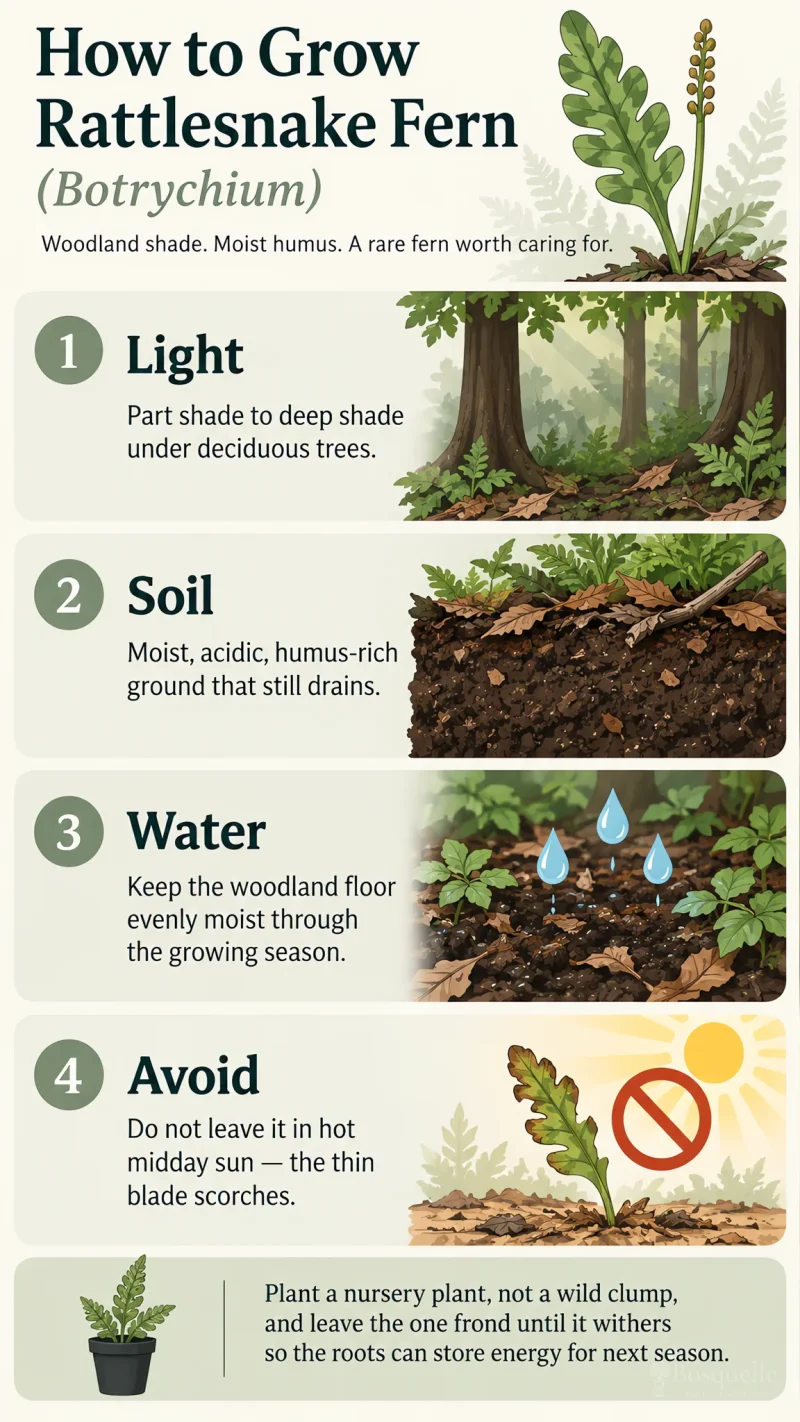
Give it woodland shade and moist, humus-rich soil
| Factor | Recommended | Avoid |
|---|---|---|
| Light | Part shade to deep shade under deciduous trees | Do not leave it in hot midday sun — the thin blade scorches |
| Soil | Moist, acidic, humus-rich ground that still drains | Do not plant it in bare, dry, or limey soil with no leaf mold |
| Water | Keep the woodland floor evenly moist through the growing season | Do not let the bed bake dry, and do not leave the crown in a puddle |
| Kind | Rattlesnake fern for a woodland floor with decaying leaves | Do not buy a rattlesnake plant, rattlesnake master, or Christmas fern and expect this stalk |
rattlesnake fern is a deciduous woodland fern with one annual stalk. That stalk splits well above the ground into a lacy sterile blade and a fertile spike of bead-like spore cases. [1] Site it in part shade or deep shade, in moist acidic humus. The roots depend on fungi in that soil, so a dry, disturbed bed is the wrong start. [2]
- Choose a shady woodland strip, a north slope, or the north side of deciduous trees.
- Keep the soil evenly moist through spring and summer. Water again before the leaf litter dries, and do not leave the crown sitting in a puddle.
- Work in leaf mold or decaying woodland debris so the mix stays humus-rich without turning to mud.
- Skip lime, wood ash, and a strong fertilizer around the roots — those change the fungi the plant needs.
How much shade does rattlesnake fern need?
Part shade to deep shade under trees. Morning sun is fine if the soil stays moist. Hot midday sun on dry ground scorches the thin blade.
How often should I water rattlesnake fern?
Keep the woodland floor evenly moist while the frond is up. Water more often in a dry spell. Do not let the bed bake, and do not leave the crown in a puddle.
Plant a nursery plant — do not dig a wild clump
This fern is hard to move. Digging a wild plant usually kills it because the fleshy roots need the fungi in that soil. If you can find a nursery plant, set it in already moist woodland shade and keep the nursery soil on the roots. [3]
- Leave wild plants in the woods. Do not cut a sod out of a trail edge or a neighbor's lot.
- Buy a nursery plant when one is offered. This fern is not a common garden-center fern, so a woodland specialty nursery is the usual source.
- Dig a hole as deep as the pot and a little wider, in already moist humus. Do not shake the soil off the roots.
- Set the crown at the same depth it grew in the pot. Do not bury the growing point.
- Water to settle, mulch with shredded leaves, and keep the mulch off the crown. Skip a starter fertilizer in the hole.
Can I dig rattlesnake fern from the woods?
No. Digging a wild clump usually kills it because the roots need the fungi in that soil. Leave wild plants in place and start from a nursery plant if you can find one.
When should I plant rattlesnake fern?
Plant a nursery plant in spring, or in fall where the soil stays moist, into woodland shade that is already damp. Do not plant into a dry hole and hope to catch up with the hose.
Do not split the clump
Division usually fails. The fleshy roots and the fungi around them need to stay together.
- Leave an established plant in place.
- Do not tease the roots apart or wash the soil off a nursery ball.
- If you must move a potted plant, keep the whole root ball intact and replant at once in moist shade.
Can I divide rattlesnake fern?
Usually no. Splitting the fleshy roots, or moving a wild clump, usually fails. Keep a nursery root ball intact and plant it as one piece.
Leave the single frond until it withers
Each plant makes one frond a year. That blade feeds the roots through summer, then yellows and disappears by late summer or fall. Do not shear a green plant to the ground.
- Leave the green sterile blade in place through the growing season. It is the only leaf.
- After the fertile spike browns and drops spores, you may cut that spent spike at the base if it bothers you.
- When the sterile blade yellows in late summer, let it wither. Do not pull a still-green stalk.
- Wait for a new frond in spring. The plant is underground in winter; it is not dead.
Do I cut rattlesnake fern back?
Leave the green frond until it yellows in late summer. You may take the spent fertile spike after spores drop. Do not shear a green plant to the ground.
Not a rattlesnake plant — and not rattlesnake master
A shop tag that says rattlesnake plant is usually a houseplant with long wavy leaves marked like a snake — that is Goeppertia, sold as Calathea. See How to Grow Peacock Plant for that indoor mix. Rattlesnake master is Eryngium, a prairie plant with yucca-like leaves and a thistle head — see How to Grow Sea Holly.
Rattlesnake plantain is a woodland orchid with a white-veined rosette, not a fern. Cutleaf grape fern is a relative with leathery evergreen blades; this plant is thin-textured and deciduous, and its sterile blade sits on a shared stalk well above the ground. [4] Christmas fern is Polystichum — see How to Grow Holly Fern if the fronds are leathery and stocking-shaped. A tag that says moonwort may be Lunaria, the silver-dollar plant — see How to Grow Lunaria.
Is this a rattlesnake plant?
No. Rattlesnake plant is Goeppertia, a houseplant with wavy spotted leaves. Rattlesnake fern is a woodland fern with one stalk that splits into a lacy blade and a fertile spike.
Is this rattlesnake master?
No. Rattlesnake master is Eryngium, a sunny prairie plant with yucca-like leaves. Rattlesnake fern is a moist-shade woodland fern.
Keep woodland shade and moist humus, plant a nursery plant instead of digging a wild clump, and leave the one frond until it withers so the roots can store what they need.
FAQ
Can I grow it from spores?
Spores sit on the fertile spike, but they make an underground stage that needs the right fungi and can take years. A nursery plant is the practical start. Spore culture is slow and easy to lose.
Does it come back after it withers?
Yes. The frond yellows in late summer and the plant is underground through winter. A new frond comes up in spring if the woodland floor stayed moist and undisturbed.
Can I grow it in a pot?
A dry indoor pot is the wrong job. This is an outdoor woodland fern. The houseplant sold as rattlesnake plant is Goeppertia, not this species.
Is this the same as cutleaf grape fern?
No. Cutleaf grape fern has leathery evergreen blades, and the split sits near the ground. Rattlesnake fern is thin, deciduous, and splits well above the ground.
Is Botrypus the same plant?
Yes. Some lists now file this plant as Botrypus virginianus. It is still rattlesnake fern, not a second garden kind.
What else likes that woodland shade?
Other woodland plants that want shade and soil that stays moist under deciduous trees. Do not pair it with a dry-bank shrub that needs the same bed to dry hard.
Recommended plants

References
- [1] NC State Extension -
https://plants.ces.ncsu.edu/plants/botrychium-virginianum/ - [2] Illinois Wildflowers -
https://www.illinoiswildflowers.info/grasses/plants/rattlesnake_fern.html - [3] Lady Bird Johnson Wildflower Center -
https://www.wildflower.org/plants/result.php?id_plant=BOVI - [4] Missouri Department of Conservation -
https://mdc.mo.gov/discover-nature/field-guide/rattlesnake-fern
More first-season notes by plant are gathered in How to Grow Guides.
Updated: Reviewed by Bosquelle Editors