
Grow Lunaria in part shade or sun, on moist soil that drains. Shops also call it a silver dollar plant or a money plant.
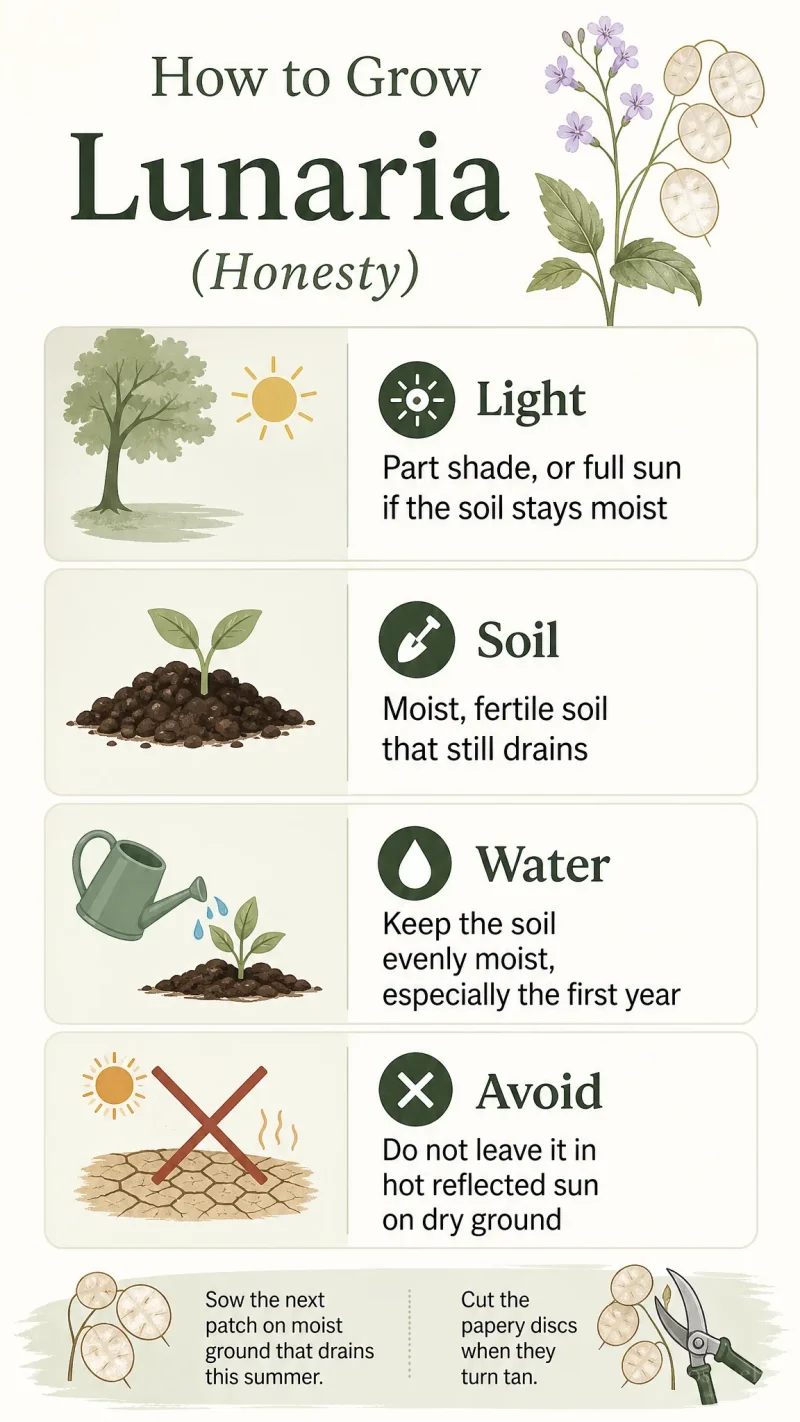
Give it part shade or sun, and moist soil that drains
| Factor | Recommended | Avoid |
|---|---|---|
| Light | Part shade, or full sun if the soil stays moist | Do not leave it in hot reflected sun on dry ground |
| Soil | Moist, fertile soil that still drains | Do not plant it in a hole that stays wet after rain |
| Water | Keep the soil evenly moist, especially the first year | Do not let the root zone bake, and do not leave it in standing water |
| Kind | Biennial Lunaria for round papery discs; perennial Lunaria for oval discs that return from the crown | Do not expect bloom the first year from seed |
| Feed | Little extra fertilizer in ordinary garden soil | Do not dump rich feed into a wet hole |
Lunaria wants part shade or sun and moist soil that drains. The common kind is a biennial: the first year is a leafy rosette, and the flowers and papery discs come the second spring. After the seed ripens, that plant dies. Soggy soil around the roots is the primary cause of root rot. [1] silver-dollar Lunaria is the round-disc biennial, 2 to 3 feet tall, with magenta, purple, or white flowers. perennial Lunaria wants the same moist woodland, with oval discs and a clump that comes back from the crown.
How much sun does Lunaria need?
Part shade is the usual woodland-edge site. Full sun works if you can keep the soil moist. Hot dry ground scorches the leaves.
How often do I water Lunaria?
Keep the soil evenly moist, especially the first year. Water again when a dry week hits, and do not leave the roots in standing water.
Biennial or perennial Lunaria?
Buy the biennial for the classic round discs. Buy perennial Lunaria if you want oval discs and a clump that returns from the crown. Both want moist soil that drains.
Sow in late summer, barely cover, and wait for bloom the next spring
Sow where the plants will bloom. Lunaria makes a taproot, so a mature plant does not like a move. Scatter seed in late summer on moist ground that drains, and barely cover it. Keep the surface moist until seedlings show. Sow again the next summer so a second set of rosettes is coming on while this year's stalks bloom. [2] [3]
- Choose a woodland-edge bed with part shade or sun and moist soil that drains. Pull weeds so the seedlings are not lost.
- Sow in late summer. Press the seed in so it is barely covered. Do not bury it deep.
- Keep the surface moist until seedlings show, usually in two to three weeks. Set young plants 12 to 18 inches apart while they are still small.
- Sow again the next summer if you want flowers every spring. Do not lift a flowering stalk if you can help it. A first-year rosette can move only if you keep the taproot intact.
When should I sow Lunaria seed?
Sow in late summer on the bed where the plants will bloom. The rosette overwinters, and the flowers come the next spring.
Can I transplant Lunaria?
Move only a young plant, and keep the taproot intact. A mature plant usually fails after a move.
Not a silver-dollar eucalyptus — and not a jade or Chinese money plant
A shop tag that says silver dollar plant is often a eucalyptus with round juvenile leaves, not this biennial — see How to Grow Eucalyptus. Jade is Crassula, a succulent you water when the mix is dry — see How to Grow Jade Plant. A shop money plant is often the Chinese money plant, Pilea, a dry indoor plant with coin leaves — see How to Grow Chinese Money Plant. If the tag says Lunaria, you still have this mustard-family biennial with papery discs.
Dame's rocket has the same purple four-petal flowers in spring, but its seed pods are long and skinny, not round discs. A silver-dollar vine is a succulent climber, not this woodland plant.
Is this a silver-dollar eucalyptus?
No. Eucalyptus is a woody plant grown for round juvenile leaves. Lunaria is a biennial grown for papery seed discs.
Is this a Chinese money plant or jade?
No. The Chinese money plant is Pilea, and jade is Crassula. Both are indoor succulents or houseplants. Lunaria is an outdoor biennial.
Is this dame's rocket?
No. Dame's rocket has long, skinny seed pods. Lunaria has flat, round or oval papery discs.
Cut the papery discs, peel the skins, and hang the stems to dry
The discs start green and turn tan and papery by midsummer. Cut the stems on a dry day, hang them until the skins loosen, then rub both outer covers off so the silvery disc shows. Catch the seeds if you want to sow, or leave some pods on the plant if you want the patch to seed itself. [4]
- Wait until the pods turn tan and feel papery, and cut before they shatter in wind or rain.
- Cut the stems on a dry day. Strip extra leaves so the bunch can dry without molding.
- Hang the bunch upside down in a dry, airy place for two to four weeks.
- Rub both outer skins off between your thumb and finger. Catch the seeds if you want to sow next summer. Cut the remaining stalks before they drop seed if you do not want a weedy patch.
When do I cut the papery discs?
Cut when the pods turn tan and papery, before they shatter. Hang them two to four weeks, then peel both outer skins.
Will it come back next year?
The biennial plant dies after the seed ripens. A patch returns if some seed can hit bare soil, or if you sow again the next summer. Perennial Lunaria comes back from the crown.
Sow the next patch on moist ground that drains this summer, and cut the papery discs when they turn tan.
FAQ
Can I grow Lunaria in a pot?
A deep pot that drains can hold a few plants on a patio. Empty the saucer. It is not a houseplant, and a shallow bowl dries too fast for the taproot.
Can I start it indoors?
Sow where the plants will bloom. The taproot does not like a move, so trays and later transplanting often fail.
Can I divide perennial Lunaria?
You can split a crowded perennial clump in spring. The biennial kind is grown from seed, not from a divided crown.
Do you list a white-flowered form?
No. This catalog holds the common biennial and perennial Lunaria. White flowers still want the same moist woodland.
What about clubroot?
Lunaria is a mustard-family plant, so clubroot can warp the roots in wet, acid ground. Plant in soil that drains, and do not leave the hole soggy.
Recommended plants

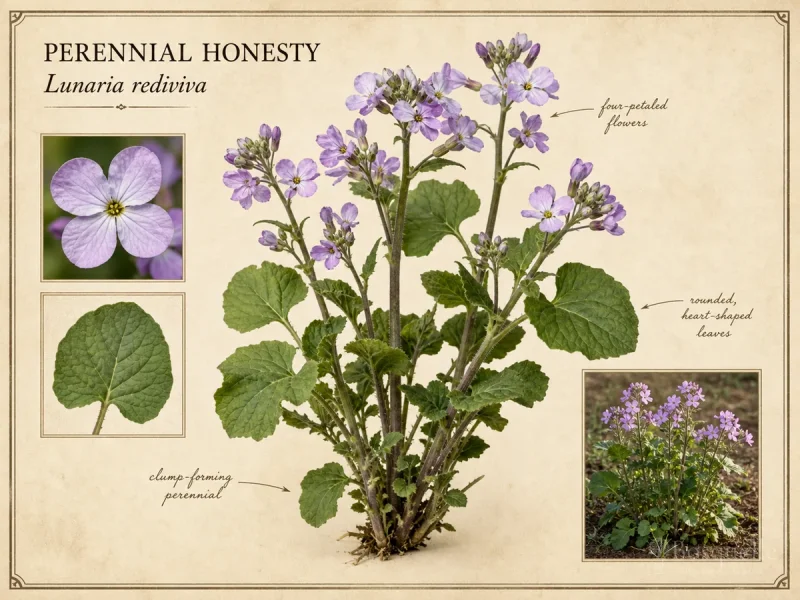
References
- [1] NC State Extension Gardener -
https://plants.ces.ncsu.edu/plants/lunaria-annua/ - [2] Clemson Home & Garden Information Center -
https://hgic.clemson.edu/factsheet/money-plant/ - [3] Farmer Bailey -
https://farmerbailey.com/pages/lunaria-growing-guide - [4] Harvest to Table -
https://harvesttotable.com/how-to-grow-lunaria/
More first-season notes by plant are gathered in How to Grow Guides.
Updated: Reviewed by Bosquelle Editors