
Grow Mexican sunflower in full sun and poor-to-average soil that drains, and water it until the plant settles in. Mexican sunflower is Tithonia rotundifolia — a heat-loving annual from Mexico, not a garden sunflower.
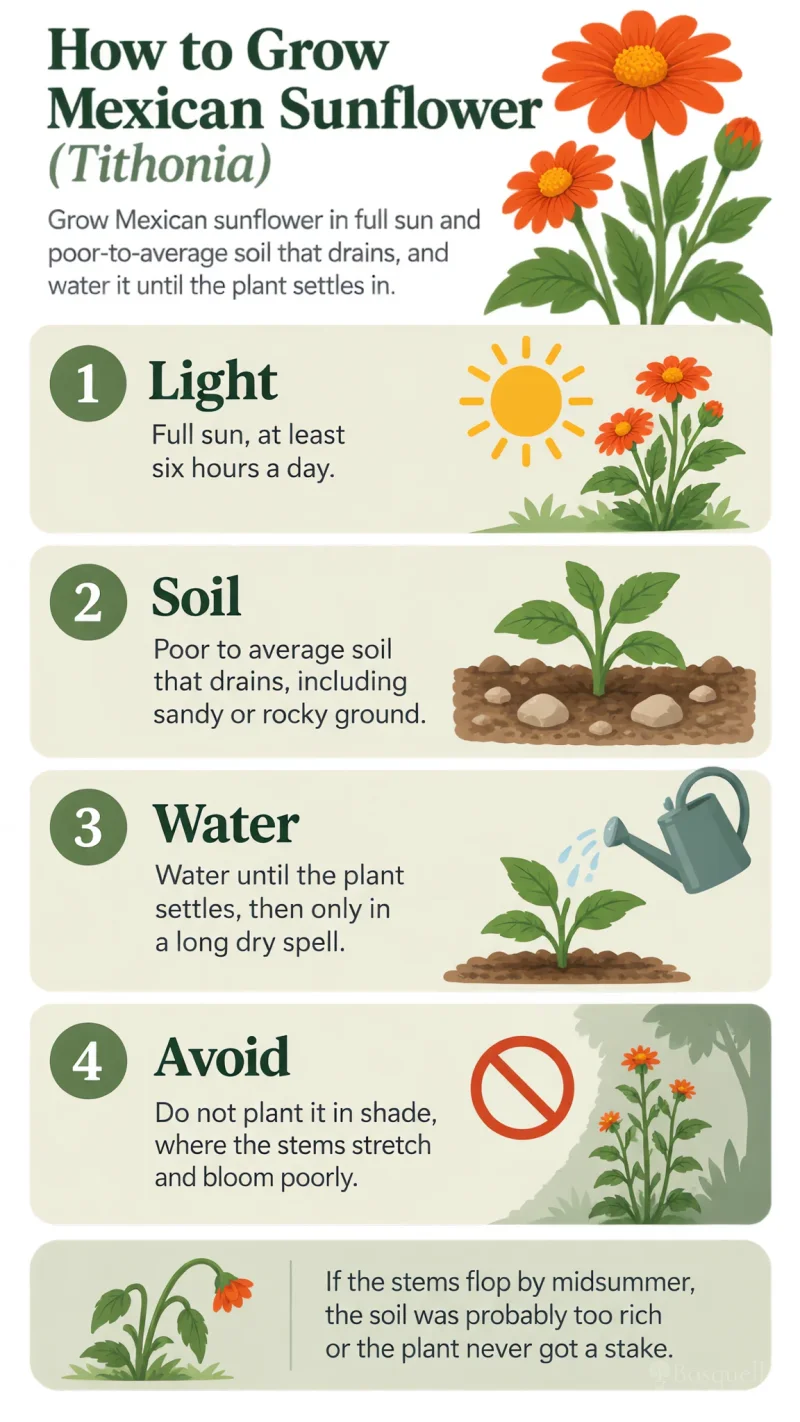
Give it full sun, lean soil that drains, and water until it settles
| Factor | Recommended | Avoid |
|---|---|---|
| Light | Full sun, at least six hours a day | Do not plant it in shade, where the stems stretch and bloom poorly |
| Soil | Poor to average soil that drains, including sandy or rocky ground | Do not plant it in rich, wet ground, which grows weak stems and few flowers |
| Water | Water until the plant settles, then only in a long dry spell | Do not keep the soil soggy, and do not feed it heavily with nitrogen |
| Feed | Little or none — lean soil keeps the stems sturdier | Do not fertilize richly, because soft growth leans and snaps |
| Deer | Deer usually leave the hairy leaves | Do not count on that if deer are starving in a hard winter |
Mexican sunflower is a fast annual that reaches about four to six feet in one summer, with coarse hairy leaves and brittle stems that hold 3-inch orange-red daisies. Sit it in full sun in soil that is only average, because rich ground and heavy fertilizer push foliage at the expense of flowers and leave stems that cannot hold themselves up. [1] It thrives in heat. Water a new planting until the roots take, then let dry spells pass; once it is settled it handles drought better than a weekly soak. [2] Deer usually skip the fuzzy leaves. Bees, butterflies, and hummingbirds work the heads from midsummer until frost.
How much sun does Mexican sunflower need?
Full sun. Give it at least six hours a day. In shade the stems stretch and you get fewer flowers.
Is Mexican sunflower drought tolerant?
Once it has settled, yes. Water it through the first weeks, then only in a long dry spell. Do not keep the soil wet.
Do deer eat Mexican sunflower?
Deer usually pass it by, because the leaves are coarse and hairy. That is not a promise in a hungry winter yard.
Plant after frost, two to three feet apart, and stake the tall ones
Set nursery six-packs out after the last frost, when nights stay warm, in a bed you will not need to move later. Plant each one at the same depth it grew in the pot, then water it in the same day. Space plants about two to three feet apart so neighboring stems can lean on each other; if you stake each plant, you can give them a little more room. [3] The stems are brittle, so a fence, a wall, or a stake on the windward side keeps a storm from snapping the hollow flower stalks. To raise it from seed instead of a six-pack, see Growing Mexican Sunflower From Seed.
- Wait until after the last frost, when nights stay warm.
- Set each plant at the same depth it grew in the pot, in full sun and soil that drains.
- Space plants about two to three feet apart, then water thoroughly the same day.
- Stake tall plants, or site them where a fence breaks the wind, because the stems snap easily.
When do I plant Mexican sunflower?
After the last frost, when nights stay warm. Set it at the same depth it grew in the pot, about two to three feet apart.
Pinch young plants, deadhead, or shear a third if they get lanky
Pinch the tips once while the plant is still young so it branches lower and stands better without a stake. If it races up lanky in early summer, cut it back by about a third; new side shoots fill in, and the plant stays shorter. Deadhead spent heads through the season if you want more flowers; leave some heads late if you want goldfinches on the seed, or if you plan to collect it.
- Pinch once on a young plant so it bushes out.
- Shear about a third in early summer if the stems are already too tall and thin.
- Deadhead for more bloom, or leave late heads for seed and birds.
Cut stems for a vase
The open daisies last in a vase. Cut a stem when the flower is open, and get it into water the same day so the hollow stalk does not wilt on the bench.
- Cut the stem when the flower is open.
- Stand it in a deep vase of warm water the same day.
Plant it with other hot-colored annuals that share full sun, such as How to Grow Zinnias, and keep rich feed and extra water off the bed.
Should I deadhead Mexican sunflower?
Cut spent heads if you want more flowers. Leave some late in the season if you want seed or goldfinches on the heads.
Not a garden sunflower — and not tree marigold
The common name is the usual mix-up. A garden sunflower is Helianthus, often one large head on a tall stalk, grown for seed or a cutting series. Mexican sunflower is a different genus: many orange-red daisies on a branched annual, with hairy triangular leaves. [4] If you meant the big annual, read How to Grow Sunflowers instead. False sunflower is Heliopsis, a perennial border clump — see How to Grow False Sunflower if that is the shop tag.
Tree marigold is Tithonia diversifolia, a perennial shrub with pointed leaf lobes and larger yellow heads. It is not the orange annual in the packet, so do not treat a woody Mexican sunflower as this plant. Zinnia can look similar in a small photo; zinnia heads are usually fuller, and the plant is a different genus — see How to Grow Zinnias if the tag says zinnia.
Is Mexican sunflower the same as a sunflower?
No. Garden sunflower is Helianthus. Mexican sunflower is Tithonia rotundifolia, a branched annual with orange-red daisies.
If the stems flop by midsummer, the soil was probably too rich or the plant never got a stake. Next year sit it in leaner ground, pinch it once while it is young, and keep extra fertilizer off.
FAQ
Is there more than one kind of Mexican sunflower?
Tithonia rotundifolia is the plant here. Tall packets and compact packets want the same full sun and lean soil; the compact ones stay shorter and can sit in a large pot.
Can I grow it in a pot?
A compact packet can live in a large pot with drain holes, in full sun. Water a pot more often than a bed, because mix dries fast in heat. Tall plants belong in the ground with a stake.
Will it come back after winter?
No. It is an annual, and frost ends it. Save seed from brown heads, or buy a new packet in spring. It may self-sow if you leave the heads.
What about slugs on the leaves?
Slugs and snails may chew young growth. Pick them off at dusk, and keep the crown from sitting wet. The plant has few other pest problems.
Related guides

Recommended plants

References
- [1] NC State Extension -
https://plants.ces.ncsu.edu/plants/tithonia-rotundifolia/ - [2] Missouri Botanical Garden -
https://www.missouribotanicalgarden.org/PlantFinder/PlantFinderDetails.aspx?taxonid=277484 - [3] University of Wisconsin Horticulture -
https://hort.extension.wisc.edu/articles/mexican-sunflower-tithonia-rotundifolia/ - [4] University of Illinois Extension -
https://extension.illinois.edu/blogs/good-growing/2023-09-08-brighten-your-fall-landscape-tithonia
This note is part of Tithonia Guides.
More first-season notes by plant are gathered in How to Grow Guides.
Updated: Reviewed by Bosquelle Editors