
Grow false sunflower in full sun and ordinary soil that drains. Tags may also say oxeye sunflower. It is not a Helianthus sunflower.

Give it full sun and average soil that drains
| Factor | Recommended | Avoid |
|---|---|---|
| Light | Full sun, six hours or more | Shade that weakens stems and thins bloom |
| Soil | Average dry to medium ground that drains after rain. Clay and poor soil are fine if water still moves | A low wet pocket, or rich feed that makes lanky stems |
| Water | Water to establish, then ordinary moisture. Drought is tolerated; regular water looks better | Standing water around the crown |
False sunflower is a prairie clump. Give it sun and it holds 3 to 6 feet of orange-yellow daisies through summer. [1] [2] Shade makes floppy stems that need a stake. Rich, wet ground does the same.
Do false sunflowers come back every year?
Yes. It is a hardy perennial. Clumps are often short-lived, so plan to divide or let seedlings fill gaps.
How long does false sunflower bloom?
From early or midsummer into early fall — often June into September if you deadhead.
Pair it with other full-sun prairie plants
Partners should want the same sun and average soil: ornamental grasses, coneflower, black-eyed Susan, blazing star, and other late-summer daisies. Leave a path so you can deadhead without trampling neighbours.
Plant after frost, with the crown at soil level
Plant nursery starts after frost in spring, or in early fall with enough weeks for roots to take. Set the crown at the same depth it grew in the pot. [3]
- Pick full sun and ground that drains after rain.
- Dig a hole as deep as the pot and a little wider. Do not bury the crown in a compost collar.
- Set the plant at pot depth, backfill with the soil you dug, and water to settle.
- Space clumps about 18 to 24 inches apart. Tall species needs room to 3 to 6 feet high.
- Water through the first weeks, then taper to ordinary moisture.
- Expect seedlings nearby. Pull extras if you want a fixed edge.
Will false sunflowers spread?
The clump widens slowly. The species also self-sows. It can look weedy in a tight bed, but it is not a farmland pest.
Is Heliopsis invasive?
No. Self-sowing in a happy bed is the usual spread. Deadhead if you do not want seedlings.
Grow compact kinds in a pot
A pot works for shorter cultivars if it is at least about 12 inches across, with drainage holes, and a mix that dries between waterings. Empty the saucer after rain. Full sun still applies. Ground is easier than a small bowl that stays wet.
Does Heliopsis do better in pots or ground?
Ground, if the soil drains. Use a pot for compact kinds on a patio. Tall species is a poor match for a small container.
Divide every few years to renew the clump
Clumps often fade after a few seasons. Division in fall or early spring keeps a stand going.
- Dig the clump when the soil is workable and not waterlogged.
- Split it into pieces that each have shoots and roots. Discard a dead woody center.
- Replant at the same depth, water in, and keep evenly moist until new growth takes.
Can you divide Heliopsis?
Yes. Divide in fall or early spring every few years. Stem cuttings in spring also work. Named colors are usually cloned, not grown from seed.
Deadhead, and cut back in late May for shorter stems
Spent blooms left on the plant end the show early. A late May cut keeps tall kinds from flopping.
- In late May, if you want a shorter finished plant, cut stems back by about one-third to one-half. Bloom may start a couple of weeks later.
- Through summer, snip spent heads down to a leaf pair so new buds keep coming.
- After the last bloom, either cut the stems to a few inches or leave the seed heads for birds through winter.
- In spring, clear the dead top before new growth starts. Skip the May height cut on already-short cultivars.
Do you cut down false sunflowers in the fall?
You can cut spent stems to a few inches after bloom, or leave them for seed-eating birds and cut in spring. Either timing works.
How to deadhead Heliopsis?
Follow the stem down from the spent flower and snip above the first pair of leaves. That prolongs bloom and limits seedlings.
Straight species, Asahi, or Burning Hearts
Culture is the same. Height and leaf color are the choice. Do not treat a shop list of twenty names as a different plant.
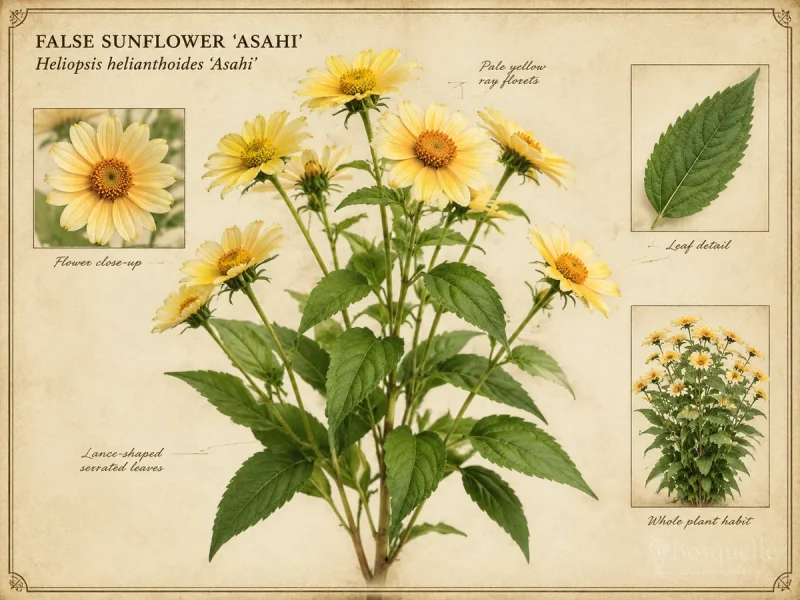
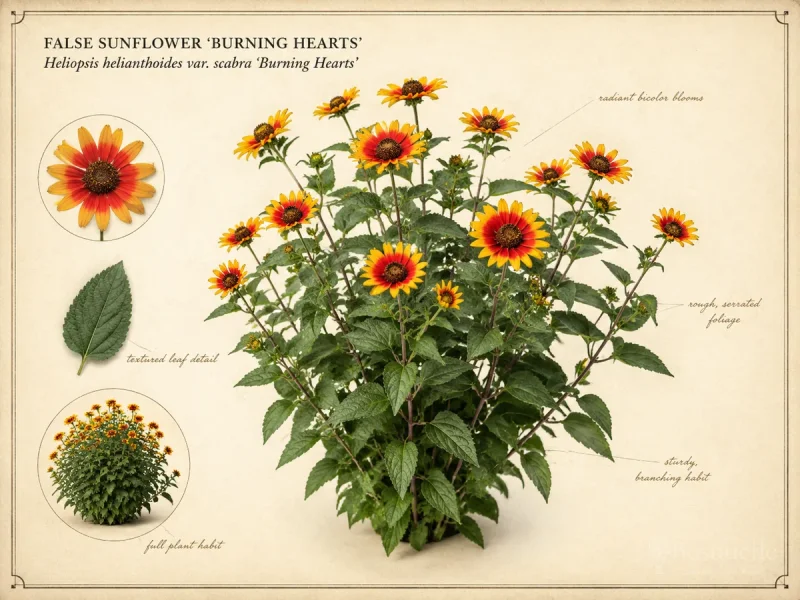
H. helianthoides is the straight prairie plant — 3 to 6 feet, sandpapery opposite leaves, gold daisies with a cone disk. ‘Asahi’ is a double golden selection, often around 30 inches, for denser flower heads. ‘Burning Hearts’ brings purple stems, dark foliage, and gold rays with a reddish disk on a 3 to 4 foot clump.
What are the best Heliopsis varieties?
Match height to the spot. Species for a tall prairie clump, Asahi for double gold on a shorter plant, Burning Hearts for dark leaves. Extra shop names use the same sun and soil.
Not a true sunflower — and not oxeye daisy
True sunflowers are Helianthus. False sunflower usually keeps its rays on the head as it fades, and holds the flower more upright. Many Helianthus heads nod, and the rays drop. The bracts under a Heliopsis head sit in two or three short rows, not a stack of long tapered ones. [4]
Oxeye daisy is a different white daisy. A tag that says bleeding heart false sunflower is a dark-leaf Heliopsis cultivar, not Dicentra bleeding heart.
What is the difference between Heliopsis and Helianthus?
Heliopsis is this perennial prairie daisy. Helianthus is true sunflower, including oilseed and giant annuals. Read the Latin on the tag before you copy sunflower crop culture.
Set it in full sun, plant after frost, deadhead through summer, cut back in late May if you want shorter stems, and read the tag so you did not buy a Helianthus sunflower.
FAQ
How easy is it to grow false sunflower from seed?
The species sows readily in fall or early spring and can bloom the first year. Named Asahi and Burning Hearts colors are usually cloned. Do not expect those colors from a mixed seed packet.
Is bleeding heart false sunflower a Dicentra?
No. That name is a Heliopsis cultivar, close to Burning Hearts. Dicentra bleeding heart is a different shade perennial.
Will deer eat false sunflower?
Deer usually leave the sandpapery leaves alone. Do not plant it as a guaranteed deer-proof hedge.
Can I use false sunflower as a cut flower?
Yes — the daisy stems last in a vase. This page is for keeping the plant alive in the border, not a cutting-garden calendar.
Recommended plants

References
- [1] NC State Extension -
https://plants.ces.ncsu.edu/plants/heliopsis-helianthoides/ - [2] University of Illinois Extension -
https://web.extension.illinois.edu/hortanswers/PlantDetail.cfm?PlantID=960&PlantTypeID=14 - [3] USDA NRCS -
https://plants.usda.gov/DocumentLibrary/plantguide/pdf/pg_hehe5.pdf - [4] Missouri State University -
https://ag.missouristate.edu/PBTrewatha/oxeye.htm
More first-season notes by plant are gathered in How to Grow Guides.
Updated: Reviewed by Bosquelle Editors