
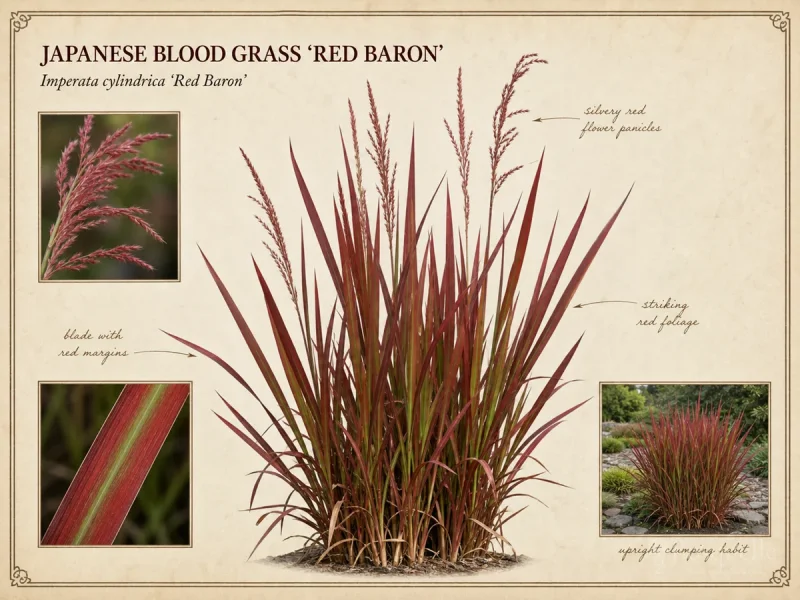
Grow Japanese blood grass in full sun, in moist soil that drains. Japanese blood grass here is Imperata cylindrica ‘Red Baron’, also sold as ‘Rubra’ — not the green cogongrass species, and not Japanese Bloodgood maple.

Give it full sun and moist soil that drains — that is where the blades turn red
| Factor | Recommended | Avoid |
|---|---|---|
| Light | Full sun for the strongest red; part sun is fine | Do not grow it in deep shade if you want blood-red tips |
| Soil | Moist soil that drains after rain | Do not leave the roots in standing water |
| Water | Keep the soil moist the first season | Do not let a new planting bake dry in the first summer |
| Drought | Once it is established, skip extra water except a long dry spell | Do not treat a new planting like a dry prairie grass |
| Kind | A named red cultivar, and only if your state allows it | Do not plant the tall green species |
Give it an open, sunny site and soil that stays moist without sitting wet. The blades emerge green with red tips, then the red runs down the leaf and deepens by fall, especially where morning or late-day sun lights the clump from behind. [1] Shade washes that red toward green. [2] Japanese blood grass 'Red Baron' is the short red ornamental in this catalog, about a foot to a foot and a half tall. cogon grass is the green species — do not plant that one.
- Set it in full sun. Part sun is acceptable, but the red is weaker there.
- Use moist soil that drains. Sand, loam, or a raised bed is fine if water does not stand around the roots.
- Water through the first season so the rhizomes take. Once the plant is established, it handles a dry spell better, but a long drought still browns the tips.
- Site it where you can see the blades against low sun. That is the color this grass is grown for.
How much sun does Japanese blood grass need?
Full sun for the strongest red. Part sun is fine, but deep shade fades the color toward green.
How often do I water Japanese blood grass?
Keep the soil moist through the first season. Once it is established, water during a long dry spell rather than on a weekly calendar.
Plant the red grass in a pot or a confined bed, and dig out any all-green shoots
Check whether your state allows Japanese blood grass before you buy. If you grow it, use only a named red cultivar, and keep the rhizomes in a pot or in a bed that cannot run into a field, a ditch, or woods. [3] Any shoot that turns all green is the aggressive species form — dig that section out and destroy it. [4] The red grass should show some red on the blades in every season; a plant that goes fully green is no longer the ornamental.
- Confirm your state allows Japanese blood grass before you order or plant it.
- Buy a named red cultivar. Do not plant a tall green cogongrass start, even if the tag says Japanese blood grass.
- Set it in a pot with a drainage hole, or in a rock garden or confined bed that cannot escape into a natural area. A pot needs more frequent watering than a bed.
- Set the crown at soil level, no deeper than it grew in the nursery pot. Space plants about 12 to 18 inches apart if you want a drift.
- Watch the clump through the summer. If a shoot is all green, trace it to the rhizome, lift that piece, and destroy it — do not compost it.
Is Japanese blood grass invasive?
The green species is a federal noxious weed. The red cultivar spreads slowly by rhizomes and can revert. Grow it in a pot or a confined bed, and dig out any all-green shoots.
Split a crowded clump in spring
The red ornamental is increased by division, not by seed. Lift a crowded clump in spring as new shoots show, split pieces that each have shoots and roots, and replant them at the same depth in a pot or a confined bed. Water until the new pieces take.
- Lift the clump in spring, before the blades are tall.
- Split so each piece has several shoots and a section of rhizome.
- Replant at the same depth, in a pot or a confined bed. Do not dump extras into a wild edge.
- Water until new growth is obvious.
Cut last year's blades in late winter, before new growth
This is a warm-season grass. Frost kills the blades, and they stand copper-brown until spring. Leave that foliage through winter, then cut it before the new shoots get tall. The plant is slow to emerge, so do not assume an empty crown in April is dead.
- Leave the copper-brown blades in place through winter.
- In late winter or early spring, before new shoots are several inches tall, cut the old foliage to the ground or to a few inches.
- If a flower spike appears in summer, cut it off before it sets the fluffy seed.
- Wait on new growth. Warm-season grasses often sit dormant later than cool-season lawn grass.
When do I cut back Japanese blood grass?
In late winter or early spring, before new shoots get tall. Leave the copper blades through winter.
Not cogongrass — and not maiden grass or fountain grass
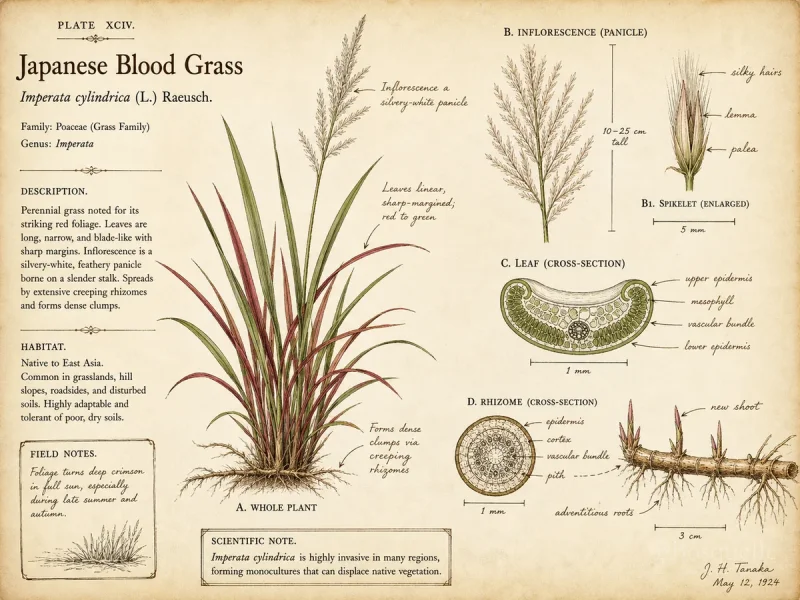
Cogongrass is the green species of the same plant: taller, with an off-center pale midrib and rhizomes that run far. Do not grow that grass, and do not ignore an all-green reversion in a red planting.
Maiden grass is Miscanthus — a tall clump with plumes. See How to Grow Miscanthus. Fountain grass is Pennisetum, a clump with bottlebrush flowers. See How to Grow Fountain Grass. Japanese forest grass is a shade woodland grass. See How to Grow Japanese Forest Grass. Japanese Bloodgood maple is a tree, not this grass. See How to Grow Maples.
If you want red-tinted native grass without this species, switchgrass is a clumping prairie grass. See How to Grow Switchgrass. Little bluestem is another native clump. See How to Grow Little Bluestem.
Is Japanese blood grass the same as cogongrass?
They are the same species. The red cultivar is the short ornamental. Cogongrass is the tall green form. Dig out any all-green shoots.
If a shoot in the clump is all green, dig that piece out today — that is the species form, not the red ornamental.
FAQ
Can I grow Japanese blood grass indoors?
No. It is an outdoor warm-season grass. A pot is for containing the rhizomes on a patio, not for a houseplant job.
Is ‘Rubra’ a different plant from ‘Red Baron’?
No. Nurseries sell the same short red ornamental as ‘Red Baron’, ‘Rubra’, or var. koenigii. The tall green plant is the species, not a second red cultivar.
Can I grow Japanese blood grass from seed?
Do not sow it. The red ornamental is increased by division. Seed belongs to the weedy species.
Recommended plants
References
- [1] NC State Extension Gardener -
https://plants.ces.ncsu.edu/plants/imperata-cylindrica-rubra/ - [2] University of Illinois Extension -
https://web.extension.illinois.edu/hortanswers/PlantDetail.cfm?PlantID=610&PlantTypeID=3 - [3] University of Wisconsin–Madison Extension -
https://hort.extension.wisc.edu/articles/japanese-bloodgrass-imperata-cylindrica-var-rubra/ - [4] The Morton Arboretum -
https://mortonarb.org/plant-and-protect/trees-and-plants/red-cogongrass/
More first-season notes by plant are gathered in How to Grow Guides.
Updated: Reviewed by Bosquelle Editors