
Grow switchgrass in full sun and ordinary soil that is not overly rich. Tags may also say Panicum. If the tag says maiden grass or fountain grass, that is a different genus.
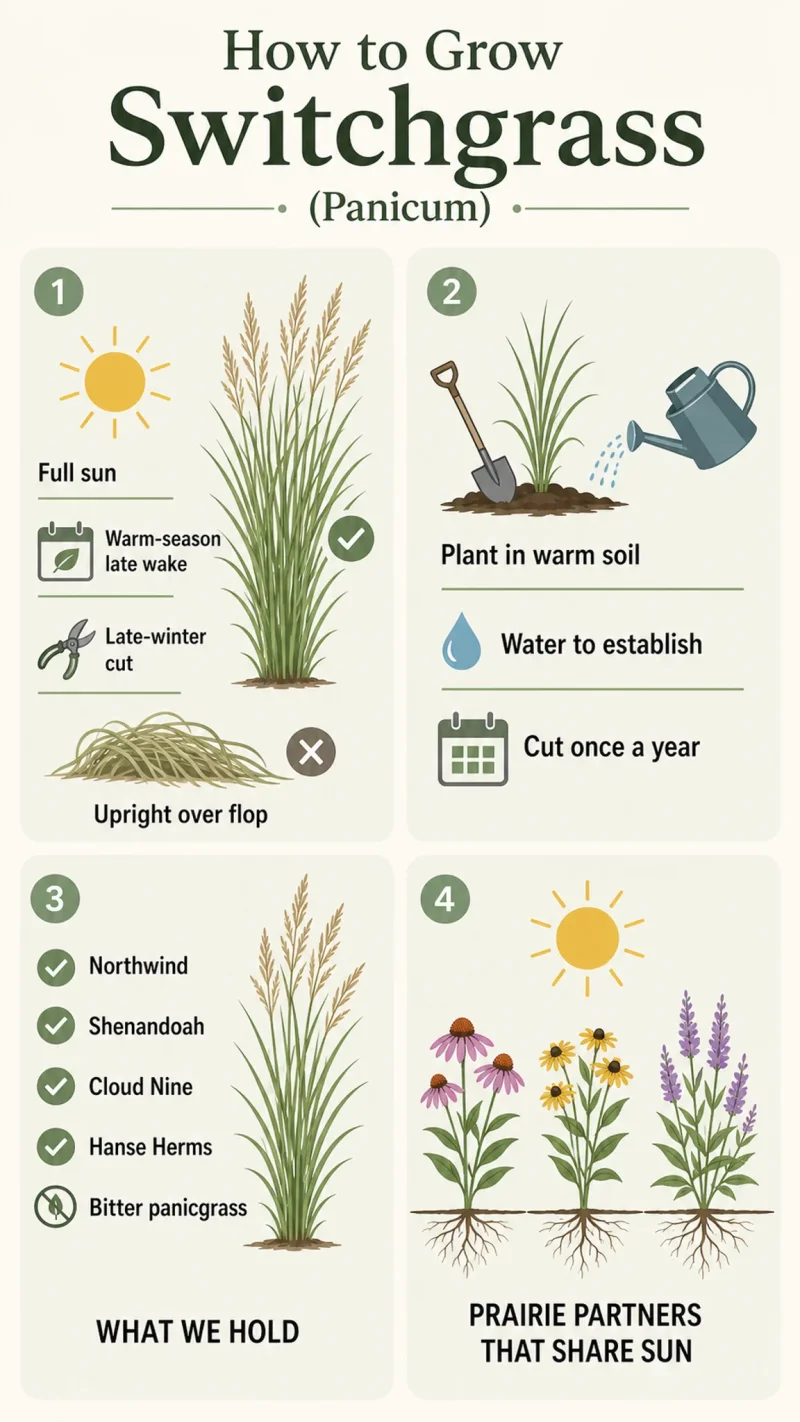
Give it full sun, ordinary soil, and space off the house
| Factor | Recommended | Avoid |
|---|---|---|
| Light | Full sun, six hours or more | Shade that opens the clump and lets stems lean |
| Soil | Average moist clay or sand. Skip a rich compost dump | Overly fertile ground that makes soft stems |
| Water | Water the first season, then ordinary moisture. Drought is tolerated once rooted | A soggy crown in shade |
| Fire | Keep dry winter clumps away from siding | A fuel load in the space next to the house |
| Spring wake | Wait for warm soil. The clump greens late | Digging a bare clump in early spring as if it died |
Switchgrass is a warm-season prairie grass. Give it sun and it holds a column of stems with airy late-summer panicles. Shade, or a rich wet bed, makes a leaning clump. [1] [2] Dry winter stems carry a high fire rating, so do not park them against the house.
Does switchgrass grow back every year?
Yes. It is a hardy perennial. It greens up late, after the soil warms, so a bare clump in April is not dead.
What are the common problems with switchgrass?
Floppy stems from shade or rich soil, and rust or crown rot when a wet clump sits in shade. Dry winter stems next to siding are a fire risk.
Pair it with other full-sun prairie plants
Partners should want the same sun and average soil: coneflower, black-eyed Susan, blazing star, aster, and other warm-season grasses. Leave a path so you can cut the clump in late winter without trampling neighbours.
Plant in warm soil, with the crown at pot depth
Plant a nursery clump after the soil has warmed in spring. In hot-summer regions you can also plant in a cooler stretch of early fall if roots still have weeks to take. Set the crown at the same depth it grew in the pot. [3]
- Wait until the soil is warm. Very early spring and a late cold fall are poor windows.
- Dig a hole as deep as the pot and two to three times as wide. Do not bury the crown in a compost collar.
- Set the plant at pot depth, or a little high so it can settle, then backfill with the soil you dug.
- Water to settle. Keep the root zone moist through the first season, then taper.
- Space clumps about 2 to 3 feet apart so mature stems have air.
When to plant switchgrass?
After the soil warms in spring. Warm-season roots stall in cold ground. Seed drills for wildlife cover are a different job than a garden clump.
How long does it take for switchgrass to establish?
A nursery clump takes the first season to root well. Seeded stands are slower and need a clean bed the first year.
Divide in spring, once the soil is warm
Named kinds stay true if you divide them. Seedlings often look nothing like the parent. Divide about every three years if the center thins.
- Wait for warm soil and short new shoots in spring.
- Slice an outer piece with roots, or dig the whole clump and split it into sections that each have shoots and roots.
- Replant at pot depth, water in, and keep moist until new growth takes.
Can you grow switchgrass from seed?
The species can be sown in warm soil. Named Northwind and Shenandoah colors are usually divided, not grown from a mixed packet.
Grow a small clump in a pot
A pot works for a compact clump if it has drainage holes and a mix that does not stay soggy. Full sun still applies. Ground is easier than a small bowl that sits wet. Empty the saucer after rain.
Does switchgrass do better in pots or ground?
Ground, in full sun. Use a pot for a small clump on a patio. A tall screen kind is a poor match for a small container.
Leave the winter stems, then cut them in late winter
Leave the tan stems and seed heads through winter for structure and birds. Cut before new shoots, not in fall as a habit.
- Leave the clump standing through winter unless heavy snow has already flattened it against a walk.
- In late winter or very early spring, before new green shows, cut the old stems to a few inches above the crown.
- On a large clump, tie the stems first so the cut is clean, then trim.
- If new shoots have already started, still remove the old straw so it does not mix with the new growth all season.
Do you have to cut back switchgrass?
Yes, once a year, in late winter or early spring. Leaving the stems until then is the usual garden calendar. Do not scalp it in midsummer.
When should I cut back switchgrass?
Late winter or early spring, before new growth. If heavy snow flattens a clump on a path, you can cut it halfway earlier.
Not maiden grass or fountain grass — those are other genera
Maiden grass is Miscanthus. Fountain grass is Pennisetum. Pampas is Cortaderia. Feather reed grass is Calamagrostis. Those plants have their own clumps, bloom times, and cut-back calendars. A tall blue switchgrass can fill a similar screen job, but it is still Panicum.
A wildlife seed drill or a biomass stand is not this garden clump. Read the Latin on the tag before you copy maiden-grass culture onto this plant.
Is switchgrass the same as maiden grass?
No. Maiden grass is Miscanthus. Switchgrass is Panicum. Full sun and a late-winter cut are similar ideas, not the same plant.
Northwind, Shenandoah, Cloud Nine, Hanse Herms, and bitter panicgrass
Culture is the same for the virgatum kinds: full sun, ordinary soil, one late-winter cut. Height and leaf color are the choice. Do not treat a shop list of twenty names as a different plant.
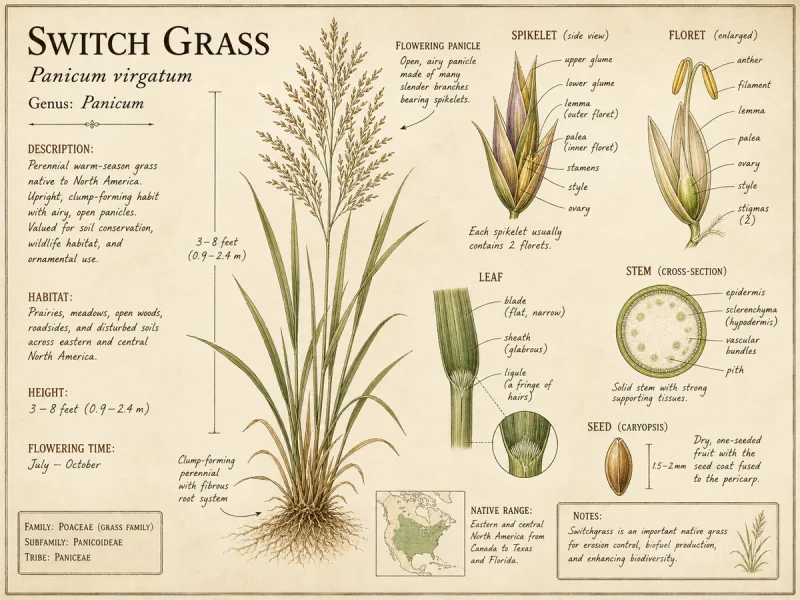
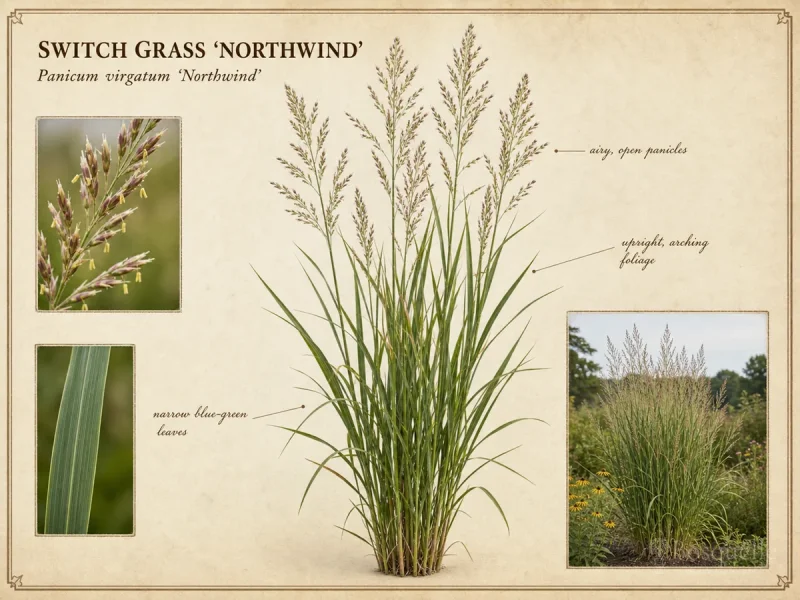
P. virgatum is the straight prairie plant — a clump that reaches about 3 to 6 feet, with airy panicles and short rhizomes. ‘Northwind’ is the stiff upright column that holds form in wind. ‘Shenandoah’ is shorter, with red leaf tips that deepen in fall. ‘Cloud Nine’ is a tall blue selection for a screen. ‘Hanse Herms’ is another named virgatum on the same sun and cut calendar. P. amarum is coastal panicgrass — salt and sand, and it flops if you dump too much organic matter on it. [4]
What is the difference between Northwind and Shenandoah?
Northwind is the stiff tall column. Shenandoah is shorter with wine-red foliage. Both want full sun and the same late-winter cut.
What is the shortest switchgrass variety?
Among these kinds, Shenandoah is the shorter clump. Extra shop dwarfs use the same sun and soil. Bitter panicgrass is a coastal species, not a dwarf virgatum.
Set it in full sun, plant once the soil is warm, leave the stems until late winter, and read the tag so you did not buy maiden grass.
FAQ
Does switchgrass spread or become invasive?
It creeps by short rhizomes and can self-sow. Give the clump room and pull extra seedlings. It is not a lawn takeover grass.
Is switchgrass grown as biofuel?
Farm and research stands exist. An ornamental garden clump is a different job than a biomass drill or a deer-cover seeding.
Will deer eat switchgrass?
Deer usually leave it alone. Do not plant it as a guaranteed deer-proof hedge.
Is switchgrass toxic to horses?
It is used as cattle forage in some stands, and it can be a problem for horses, goats, and sheep. Keep livestock from grazing an ornamental clump.
Recommended plants


References
- [1] NC State Extension Gardener -
https://plants.ces.ncsu.edu/plants/panicum-virgatum/ - [2] Wisconsin Horticulture -
https://hort.extension.wisc.edu/articles/switch-grass-panicum-virgatum/ - [3] Garden Design -
https://www.gardendesign.com/ornamental-grasses/switchgrass.html - [4] NC State Extension Gardener -
https://plants.ces.ncsu.edu/plants/panicum-amarum/
More first-season notes by plant are gathered in How to Grow Guides.
Updated: Reviewed by Bosquelle Editors