
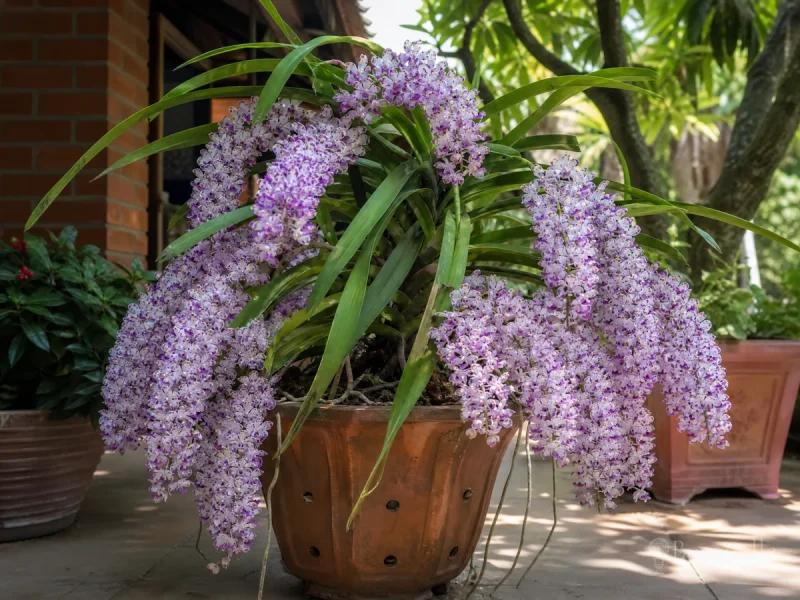
Grow foxtail orchid in bright filtered light, dunk the thick aerial roots, and let them dry by evening. Foxtail orchid is Rhynchostylis. Shops also say giant Rhynchostylis. It is not a foxtail fern.

Give it bright filtered light, dunk the roots, and let them dry by evening
| Factor | Recommended | Avoid |
|---|---|---|
| Light | Bright, filtered light — an east window, or a south window with a sheer curtain | Do not set it in hot midday sun, and do not grow it in a dim room if you want bloom |
| Water | Dunk the aerial roots until they turn green, then hang the plant so it dries by evening | Do not leave the roots sitting in a soggy mix or a saucer of water |
| Air | Humid air with a fan or an open greenhouse vent so wet roots can dry | Do not grow it in still, dry room air with no airflow |
| Warmth | Warm room temperatures; bring it in before nights drop near 50°F | Do not leave it out for a frost |
| Feed | A dilute balanced orchid fertilizer mixed into the water you dunk the roots in, in warm months | Do not feed a plant whose roots stay wet |
foxtail orchid is Rhynchostylis gigantea, a monopodial epiphyte with thick leathery leaves and stiff aerial roots. Give it bright filtered light, because too little light is the usual reason it never spikes, and hard noon sun scorches the leaves. [1] It wants less light than a Vanda. A sheer curtain on a south window, or shade cloth in a greenhouse, is enough. Dunk only the roots for a few minutes, then hang the plant so water runs off and the roots dry by evening. [2] Keep the air humid and moving. A humidifier helps more than a pebble tray. Water from above late in the day can pool in the leaf joints and rot the crown, so morning dunks are safer. [3] Feed at quarter to half strength in the water you dunk the roots in, once a week while it is in growth, then ease off in winter. A slatted basket with little or no mix is the vessel job on How to Repot Foxtail Orchid. [4]
How do I care for foxtail orchid?
Give it bright filtered light, dunk the aerial roots, and let them dry by evening. Keep the air humid and moving.
Does it like sun or shade?
Bright filtered light. Direct midday sun burns the leaves. A dim room makes leaf and little flower.
Ease off water in winter so a flower spike can form
This orchid blooms in winter, usually in January and February, on a hanging raceme packed with spicy-scented flowers that last about two weeks. In the cooler, drier months, dunk less often so the roots dry a little further between waterings, and skip weekly feed until new growth starts. Do not let the roots shrivel hard. Keep the plant indoors before nights drop near 50°F. If it never spikes, give it more filtered light and this drier rest, not more fertilizer.
When does it bloom?
Usually in January and February. The hanging raceme is packed with spicy-scented flowers that last about two weeks.
Cut the spent raceme when the flowers brown
When the last flowers fade, cut that raceme at the base with clean snips. Leave the thick green leaves in place. The lowest pair of leaves may yellow and drop once a year as the stem grows; pull those off after they loosen, and do not strip healthy leaves to force a shape.
- Wait until the flowers brown, then cut the raceme at the stem.
- Leave green leaves in place, and pull only yellow leaves after they loosen.
- Do not cut the growing tip of the stem.
Do I cut the flower spike?
Yes, after the flowers brown. Cut the spent raceme at the base, and leave the green leaves.
Wait for a keiki with its own roots before you cut it free
A keiki is a baby plant that sometimes forms on the stem or an old raceme. This orchid does not divide like a clump of pseudobulbs, and a leaf cutting will not root. Seed needs a sterile flask. If a keiki appears, wait until it has several leaves and its own roots about two inches long, then cut it free and hang it in a small basket the same way you grow the parent.
- Wait until the keiki has several leaves and at least two or three roots about two inches long.
- Cut it free with a sterile blade, leaving a short stub of stem on the baby.
- Hang it in a small slatted basket, keep the air humid, and dunk the new roots the same way you water the parent.
Can I take a keiki?
Yes, if one forms and already has its own roots. Do not cut a stem that has no roots of its own.
Not a foxtail fern — and not a moth orchid
Foxtail fern is Asparagus densiflorus ‘Myersii’, a pot plant with upright plumy stems and tuberous roots, not an orchid — see How to Grow Asparagus Fern. A grocery moth orchid is Phalaenopsis, with broad leaves in a cup of bark — see How to Grow Phalaenopsis. Vanda is a related orchid that wants harder light; tags that say Vanda densiflora or Vanda violacea are this same plant, not a second Vanda — see How to Grow Vanda if you bought a true Vanda. Foxtail lily is Eremurus, a border perennial with a tall flower wand — see How to Grow Eremurus. Foxtail barley is Hordeum, a grassy wild barley with long awns — see How to Grow Foxtail Barley.
Is this a foxtail fern?
No. Foxtail fern is an asparagus relative with plumy stems. Foxtail orchid is Rhynchostylis, with leathery leaves and a hanging flower raceme.
Is it a moth orchid?
No. A moth orchid is Phalaenopsis in a bark cup. This plant has stiff aerial roots and a dense hanging raceme.
Keep it in bright filtered light, and dunk the roots so they dry by evening. Remount it when the basket wood fails or the mix has gone mushy.
FAQ
Is there more than one kind of foxtail orchid?
This catalog holds Rhynchostylis gigantea. Spotted, white, and red clones show up under the same name. Rhynchostylis retusa is a related species with a longer raceme, not this card. Grow the plant you bought in the same bright filtered light.
Is foxtail orchid toxic to cats or dogs?
This plant is not listed by name on the ASPCA toxic and non-toxic lists. Keep pets from chewing the leaves, because a stomach upset can come from any plant material.
What about scale or mites?
Wipe them off the leaves as soon as you notice them, and keep wet roots in moving air so they dry by evening.
Related guides
Recommended plants

References
- [1] American Orchid Society -
https://www.aos.org/explore-orchids/rhynchostylis-gigantea - [2] American Orchid Society -
https://www.aos.org/explore/rhynchostylis - [3] Epic Gardening -
https://www.epicgardening.com/rhynchostylis-orchids/ - [4] Wikipedia -
https://en.wikipedia.org/wiki/Rhynchostylis_gigantea
This note is part of Rhynchostylis Guides.
More first-season notes by plant are gathered in How to Grow Guides.
Updated: Reviewed by Bosquelle Editors