
Grow foxtail barley in full sun on soil that drains. Foxtail barley is Hordeum, also sold as squirrel-tail grass.
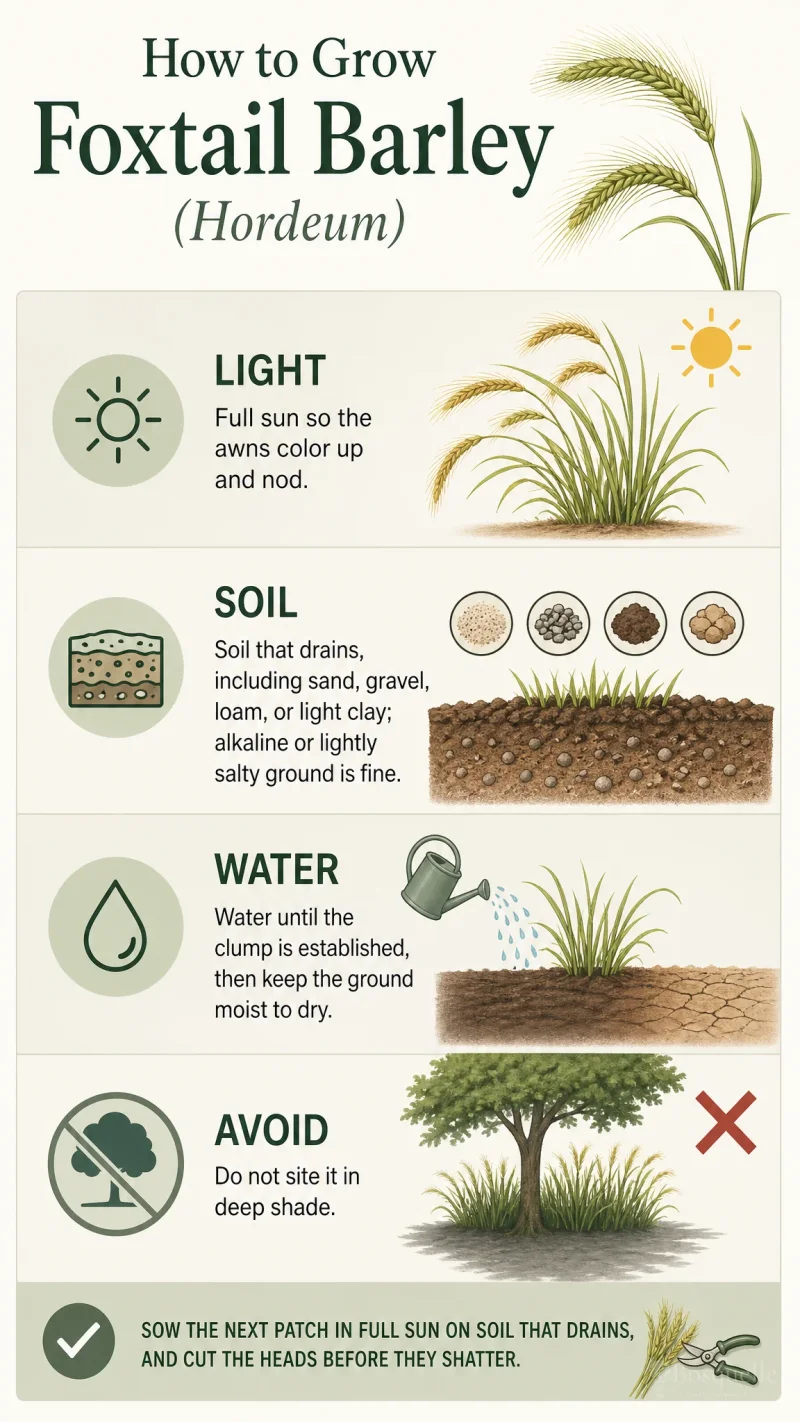
Give it full sun and soil that drains, and water it until it is established
| Factor | Recommended | Avoid |
|---|---|---|
| Light | Full sun so the awns color up and nod | Do not site it in deep shade |
| Water | Water until the clump is established, then keep the ground moist to dry | Do not treat it as a pond grass, and do not leave a new sowing dry in the first weeks |
| Soil | Soil that drains, including sand, gravel, loam, or light clay; alkaline or lightly salty ground is fine | Do not plant it in a soggy, airless hole |
| Spread | Expect self-sown seedlings; pull extras while they are small | Do not let ripe heads shatter if you want a tight patch |
| Feed | Lean ground is enough once the roots take | Do not dump nitrogen and flop the stems |
Foxtail barley wants full sun and soil that drains. Water a new sowing until the roots take, then let the ground run moist to on the dry side. Heat is fine; a long dry spell on a new patch is not, and a boggy hole rots the crown. [1] foxtail barley uses that same sun as a short-lived clump about one to two feet tall, with long nodding awns that go pink and then tan. Light salt and alkaline ground are ordinary for it, including a gravel strip or a dry roadside bank. [2] meadow barley uses the same full sun as a native bunchgrass two to three feet tall, but it wants moister meadow, stream-edge, or salt-marsh ground, and it only shrugs off a dry week after it is established. [3] Both plants are cool-season grasses. Growth is strongest in spring and fall, not in midsummer heat.
How much sun does foxtail barley need?
Give it full sun. Shade thins the clump and the awns stay dull.
Does it need a lot of water?
Water until it is established, then keep the ground moist to dry. Meadow barley wants more moisture than the long-awn kind. A new sowing should not dry out in the first weeks.
Sow it on the surface in cool soil
This grass is grown from seed. Sow it on the surface in late fall or in early spring, while the soil is still cool, in the same full sun and draining ground you will keep it in. Press the seed in and cover it only as deep as the seed is wide, then keep the bed moist until the seedlings stand. Direct sowing beats a windowsill start because the young roots do not like to be moved.
- Rake a weed-free patch in full sun on soil that drains, in late fall or early spring.
- Sow on the surface and press the seed in. Cover it only as deep as the seed is wide.
- Keep the bed moist until the seedlings stand, then water only as the surface dries.
- Pull extra seedlings while they are small if you want a patch, not a thicket.
When do I sow it?
Sow on the surface in late fall or early spring, while the soil is cool. Keep the bed moist until the seedlings stand.
Cut the seed heads before they shatter
The long awns are the show, and they are also how the plant moves. Heads dry to a bleached tan and break apart, and the barbs catch in fur and clothing. Cut the heads when they are fully formed if you want a dried bunch or if you do not want a carpet of seedlings next year. [4] Keep this grass out of a path that dogs use, because the awns can work into eyes, noses, and paws.
- Cut the heads when they have colored and filled, before they turn brittle and fall apart.
- Hang a dried bunch upside down in a loose cluster if you want stems for a vase, or drop the heads in the trash if you are stopping seed.
- Pull the shallow seedlings in spring if a few still germinate.
When do I cut the heads?
Cut them when they have filled and colored, before they turn tan and break apart. That is also when they dry well for a vase.
Cut last year's stems in late winter
The top slows in winter. New blades come from the crown in spring if the plant lived, or from seed if last year's heads shattered. Cut last year's tan stems close to the crown in late winter, before the new growth is buried in a mat.
- Leave the stems standing through winter if you want the form.
- In late winter, cut the tan stems close to the crown.
- Watch for self-sown seedlings as the soil warms, and thin them then.
Not foxtail fern — and not grain barley
A shop tag that says only foxtail is often foxtail fern, Asparagus densiflorus with upright bottlebrush stems for a pot — see How to Grow Asparagus Fern. Foxtail barley is a true grass with a nodding, bristly seed head, not a houseplant fern.
Grain barley is Hordeum vulgare, the cereal. Wheat is a different crop. Do not treat this ornamental grass as a food plot. Foxtail lily is Eremurus, a tall desert spike — see How to Grow Eremurus. Purple fountain grass is Pennisetum — see How to Grow Fountain Grass. Nodding wild rye is Elymus — see How to Grow Canada Wild Rye. Read the Latin: Hordeum jubatum for the long-awn ornamental, Hordeum brachyantherum for the meadow kind.
Is foxtail barley the same as foxtail fern?
No. Foxtail fern is Asparagus, a pot plant with bottlebrush stems. Foxtail barley is Hordeum, a sun grass with nodding awns.
Sow the next patch in full sun on soil that drains, and cut the heads before they shatter.
FAQ
Is meadow barley a different plant?
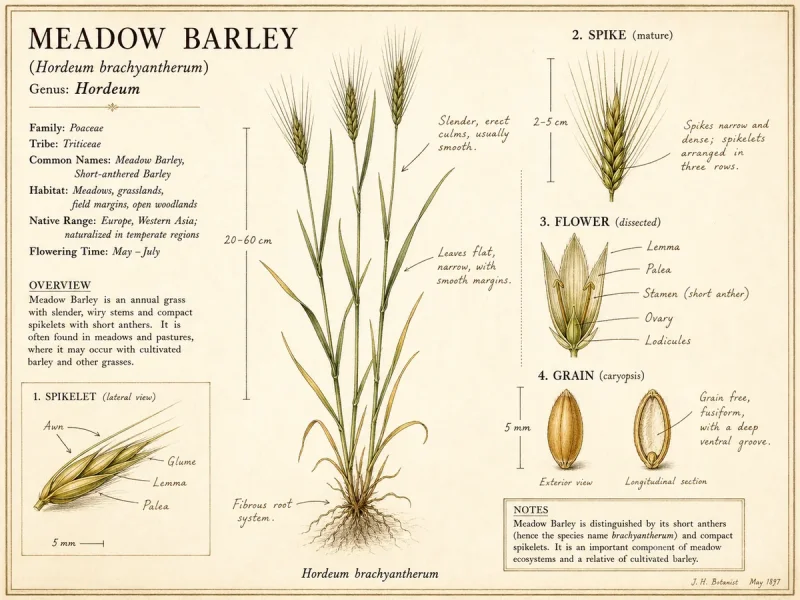
Meadow barley is Hordeum brachyantherum, the native meadow kind. Use the same full sun. Give it moister ground, and expect a narrower, shorter-awned head, not the long foxtail plume.
Can I grow foxtail barley in a pot?
Yes, in a pot with a hole, in full sun, in mix that drains. Water until the clump takes, then let the top dry a little. It is not a houseplant.
Is this the barley I eat?
No. The grain is Hordeum vulgare. These garden grasses are not a food crop. Do not cook the awns.
Are the awns dangerous to dogs?
Yes. The barbs can work into eyes, noses, and paws. Do not plant it where dogs run, and cut the heads before they shatter.
Recommended plants

References
- [1] Tennessee Smart Yards -
https://tnyards.utk.edu/hordeum-jubatum/ - [2] Prairie Moon Nursery -
https://www.prairiemoon.com/hordeum-jubatum-squirrel-tail-grass - [3] NRCS Plant Materials -
https://plants.usda.gov/DocumentLibrary/factsheet/pdf/fs_hobr2.pdf - [4] Lady Bird Johnson Wildflower Center -
https://www.wildflower.org/plants/result.php?id_plant=HOJU
More first-season notes by plant are gathered in How to Grow Guides.
Updated: Reviewed by Bosquelle Editors