
Grow death camas in sun or light shade and soil that drains, and keep the bulb dry after the leaves yellow. Death camas is Toxicoscordion fremontii, also sold as Fremont's star lily. Every part is poisonous, and it is not edible camas.
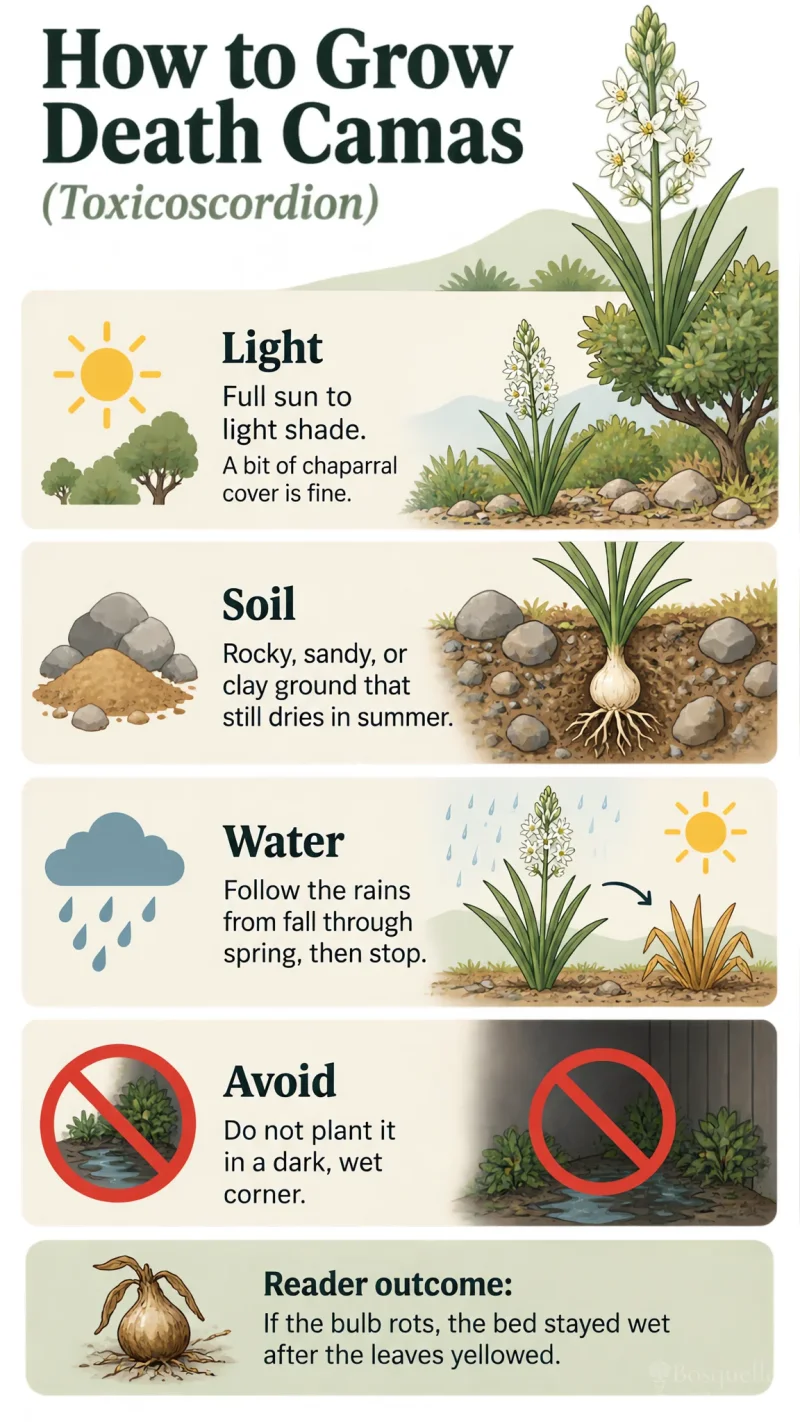
Give it sun or light shade, soil that drains, and a dry summer rest
| Factor | Recommended | Avoid |
|---|---|---|
| Light | Full sun to light shade; a bit of chaparral cover is fine | Do not plant it in a dark, wet corner |
| Soil | Rocky, sandy, or clay ground that still dries in summer | Do not keep the bulb in wet soil after the leaves yellow |
| Water | Follow the rains from fall through spring, then stop | Do not water it on a summer lawn schedule |
| Kind | Death camas for a dry native slope, labeled poisonous | Do not plant it where children or livestock graze, and do not buy it as edible camas |
death camas is a western native bulb with shiny, keeled leaves and cream-white star flowers in early spring. Sit it in full sun or light shade on a slope or in a bed that drains. It handles clay if that clay dries in summer; decomposed granite or grit is easier. [1] Water with the rains from fall through spring while the leaves are up. When the foliage yellows or the flowers finish, stop watering and leave the leaves until they brown, so the bulb can store food for next year. Summer water rots it. [2] Deer usually skip the foliage, though they may nip new leaves in early spring. Do not call it deer-proof.
How much sun does death camas need?
Full sun to light shade. It blooms in an open bed, and it also takes some cover from chaparral shrubs. A dark, wet corner rots the bulb.
Does it need water in summer?
No. Follow the rains while it is in leaf, then stop once the leaves yellow. A dry summer rest is how the bulb survives.
Do deer eat death camas?
Usually not, because the plant is poisonous. Deer may still nip emerging leaves in early spring. That is not a promise in a hungry yard.
Plant the bulb in fall, two to three times as deep as it is tall
Buy a nursery bulb. Do not dig a wild stand. Plant it in fall, as the rains return, in soil that drains. Set the bulb about two to three times as deep as it is tall — for a bulb about an inch high, that is two to three inches of soil over the top. Keep the black coat on, and point the growing tip up. Water it in with the first rains, then let the season do the rest. [3] Wear gloves when you handle the bulb, then wash your hands, because the whole plant is poisonous. To raise it from seed instead of a bulb, see Growing Death Camas From Seed.
- Buy a nursery bulb; do not wild-dig.
- Plant in fall, in sun or light shade, in soil that drains.
- Set it two to three times as deep as the bulb is tall, growing tip up, black coat left on.
- Water with the rains, then stop when the leaves yellow.
When do I plant death camas?
In fall, as the rains return. Set the bulb two to three times as deep as it is tall, and keep summer water off once the leaves yellow.
Not edible camas — and not soap plant or a garden lily
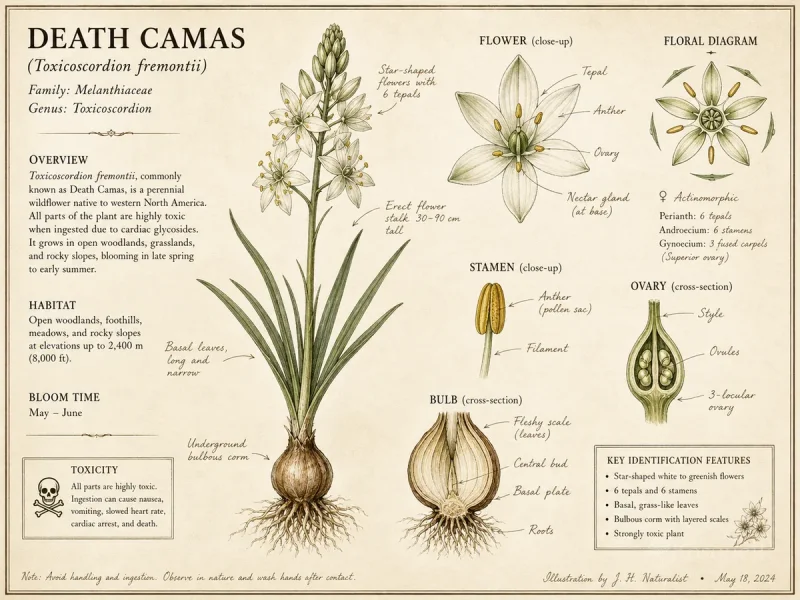
The common name is the usual mix-up. Edible camas is Camassia, often with blue or white meadow spikes, grown as a moist-spring bulb. Death camas is a different genus: cream-white stars with a green-yellow gland at the base of each tepal, and no onion smell if you bruise a leaf. [4] If you meant the food plant, read How to Grow Camassia instead. Wild onion is Allium — crush a leaf; onion smells like onion, and this plant does not — see How to Grow Alliums if that is the tag.
Soap plant is Chlorogalum. Its leaves are wavy and matte, and the flowers open in the evening later in spring. Death camas has shiny, straight-edged, keeled leaves and flowers in early spring — see How to Grow Soap Plant if the leaf is wavy. A search for star lily often turns up Stargazer garden lilies or lily of the valley, which are different plants — see How to Grow Lilies and How to Grow Lily of the Valley if that is the shop photo.
Is death camas the same as camas?
No. Edible camas is Camassia. Death camas is Toxicoscordion fremontii. Do not eat this bulb.
If the bulb rots, the bed stayed wet after the leaves yellowed. Next year plant it on a slope that dries in summer, and keep extra water off once the foliage browns.
FAQ
Is there more than one kind of death camas?
Toxicoscordion fremontii is the plant here, also sold as Fremont's star lily or under the old name Zigadenus fremontii. Meadow death camas is a related species with the same dry-summer rest; it is not a second shop card on this bed.
Can I grow it in a pot?
A nursery bulb can sit in a clay pot of gritty mix with a drain hole while you hold it, but it is happier in the ground. Keep the pot dry once the leaves yellow, and do not treat it as a houseplant.
Will it come back after winter?
Yes. Winter rain is the growing season. The top dies back in summer, then the bulb sits dry until fall. Mark the spot so you do not water it, or dig it, while it is dormant.
Is it safe around pets?
No. Every part is poisonous if eaten — leaves, flowers, and especially the bulb. Site it away from a chewing dog or a grazing paddock, and wash up after you handle it.
Related guides

Recommended plants
References
- [1] Las Pilitas Nursery -
https://www.laspilitas.com/nature-of-california/plants/707--zigadenus-fremontii - [2] Theodore Payne Foundation -
https://www.theodorepayne.org/nativeplantdatabase/index.php?title=Zigadenus_fremontii - [3] Theodore Payne Foundation -
https://theodorepayne.org/wp-content/uploads/2023/12/Bulb-Hort-One-PageLZS.pdf - [4] Friends of Edgewood -
https://friendsofedgewood.org/common-star-lily
This note is part of Toxicoscordion Guides.
More first-season notes by plant are gathered in How to Grow Guides.
Updated: Reviewed by Bosquelle Editors