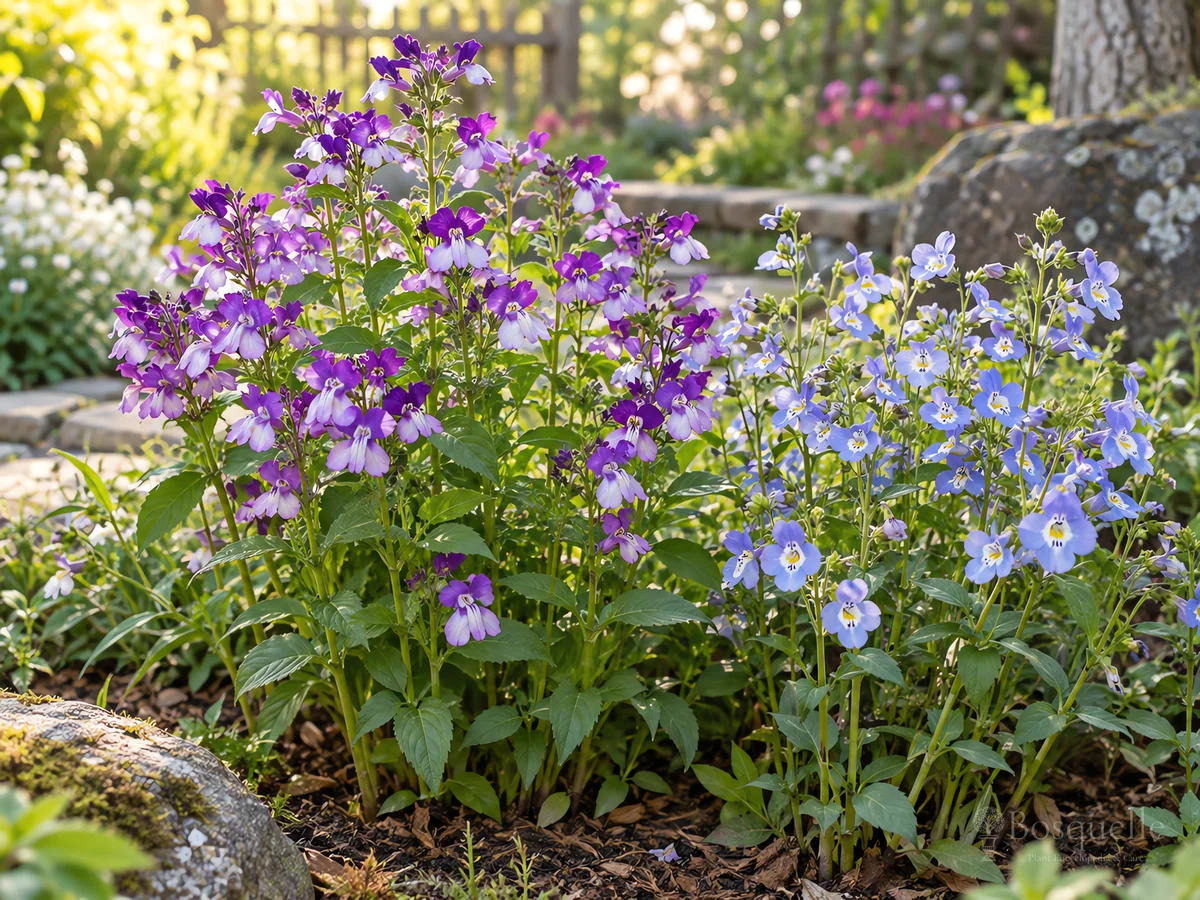
Grow collinsia as a cool-season annual in part shade and moist soil that still drains. Collinsia is also called Chinese houses.

Give it part shade and moist soil that still drains
| Factor | Recommended | Avoid |
|---|---|---|
| Light | Part shade, or bright shade under trees | Do not plant it in hot afternoon sun on dry soil |
| Water | Keep the soil moist while the plant is up | Do not let seedlings dry out, and do not treat it as a drought plant |
| Soil | Moist loam that still drains after rain | Do not plant it in a winter puddle or in bone-dry sand |
| Kind | Chinese houses for pagoda stacks of purple and white; Blue-eyed Mary for a woodland blue-and-white carpet | Do not buy navelwort when you want this annual |
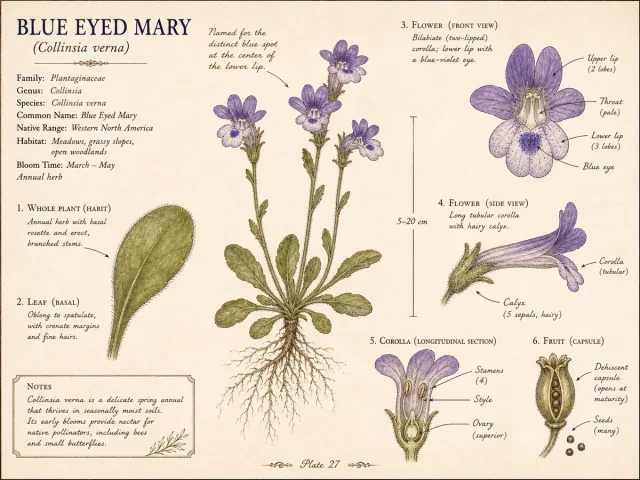
Collinsia is a winter annual. It wants part shade and soil that stays moist while it is growing, then it dies after the seed ripens. Keep the ground from drying while the plants are up. This is not a desert wildflower. [1] [2] Chinese houses takes a little more sun if the soil stays moist. Blue-eyed Mary wants a woodland floor, where the stems stay low and the flowers read as a blue carpet.
Does collinsia need full sun?
Give it part shade, or bright shade under trees. Hot afternoon sun on dry soil is the usual reason seedlings fail.
How often should I water collinsia?
Keep the soil moist while the plant is up, especially from sow until bloom. Do not treat it as a drought plant.
Which collinsia should I plant?
Buy Chinese houses for pagoda stacks of purple and white, or Blue-eyed Mary for an eastern woodland carpet. Both want part shade and moist soil that drains.
Sow in place in fall, and barely cover the seed
The usual start is seed sown where the plants will bloom. Scatter it in fall on bare soil, then press it down. Barely cover the seed, or leave it on the surface, because it needs light to sprout. Keep that surface moist until seedlings show, and leave the small winter plants in place. [3] [4]
- Rake a bare patch. Do not leave a thick mulch or a leaf pile on the seed, or the seedlings cannot push through.
- Sow in fall and press the seed onto the surface. Barely cover it, or leave it uncovered, so light can reach it.
- Water so the surface stays moist until seedlings show. Do not let the bed crust dry.
- Leave the small winter plants. Do not pull them as weeds. Blue-eyed Mary is often sown a little earlier, in summer, so it sprouts in fall.
When do I sow collinsia?
Sow in fall, on bare soil, where the plants will stay. In a cold garden that is after the first hard frost, or as soon as you can work the soil in early spring.
How deep do I cover the seed?
Barely cover it, or press it onto the surface and leave it uncovered. The seed needs light. Buried seed often fails to sprout.
Not navelwort — and not blue-eyed grass
Blue-eyed Mary on a tag may be Collinsia verna, or it may be navelwort, which is Omphalodes — see How to Grow Omphalodes. Navelwort is a perennial clump, not this winter annual. Blue-eyed grass is Sisyrinchium, an iris-family perennial — see How to Grow Sisyrinchium. Forget-me-not is Myosotis, a five-petaled flower, not this two-lipped annual — see How to Grow Forget-Me-Not. Chinese lantern is Physalis, with papery orange husks — see How to Grow Chinese Lantern. Indoor plants sold as Chinese house plants are not this wildflower. Confirm the Latin on the tag.
Is this the same as navelwort?
No. Collinsia is a cool-season annual. Navelwort is Omphalodes, a perennial. Both can be sold as blue-eyed Mary. Read the Latin.
Is this blue-eyed grass?
No. Blue-eyed grass is Sisyrinchium, a perennial in the iris family. Collinsia is a winter annual with two-lipped flowers.
Leave some flowers so the patch can return
The plants die after the seed ripens. A patch returns only if some flowers are left to set seed and that seed can hit bare soil. You can pick spent flowers if you want a longer bloom, then stop so later heads can drop seed.
- Pick spent flowers while you still want more bloom. Do not strip every stalk if you want seedlings next year.
- Leave later flowers to ripen. Seed needs to fall on bare soil, not on a thick mulch or a leaf pile.
- Leave the small plants that show in fall or winter. They are next spring's patch, not weeds.
Will it come back next year?
The plants die after seed. A patch returns if seed can hit bare soil. Thick mulch or a leaf pile blocks the seedlings.
Do I deadhead it?
You can pick spent flowers if you want a longer bloom. Leave some heads if you want the patch to return from seed.
If seedlings vanish after a hot dry week, keep the surface moist and give the bed afternoon shade.
FAQ
Can I grow collinsia in a pot?
A deep pot can hold a few plants for a season if the mix stays moist and drains. The usual start is seed in open ground, where it can self-sow.
Do you list giant blue-eyed Mary or violet collinsia?
No. This catalog holds Chinese houses and Blue-eyed Mary. Giant blue-eyed Mary and violet collinsia are other species. Treat pagoda stacks as Chinese houses.
Is this collomia?
No. Collomia is a different genus. Collinsia is the pagoda annual or the woodland Blue-eyed Mary in this catalog.
Can I start it indoors?
Sow where the plants will bloom. The slender taproot does not like a move, so trays and later transplanting often fail.
Recommended plants

References
- [1] Lady Bird Johnson Wildflower Center -
https://www.wildflower.org/plants/result.php?id_plant=COHE - [2] Lady Bird Johnson Wildflower Center -
https://www.wildflower.org/plants/result.php?id_plant=cove2 - [3] Eden Brothers -
https://grow.edenbrothers.com/planting-guides/chinese-houses-seeds/ - [4] Illinois Wildflowers -
https://www.illinoiswildflowers.info/woodland/plants/be_mary.htm
More first-season notes by plant are gathered in How to Grow Guides.
Updated: Reviewed by Bosquelle Editors