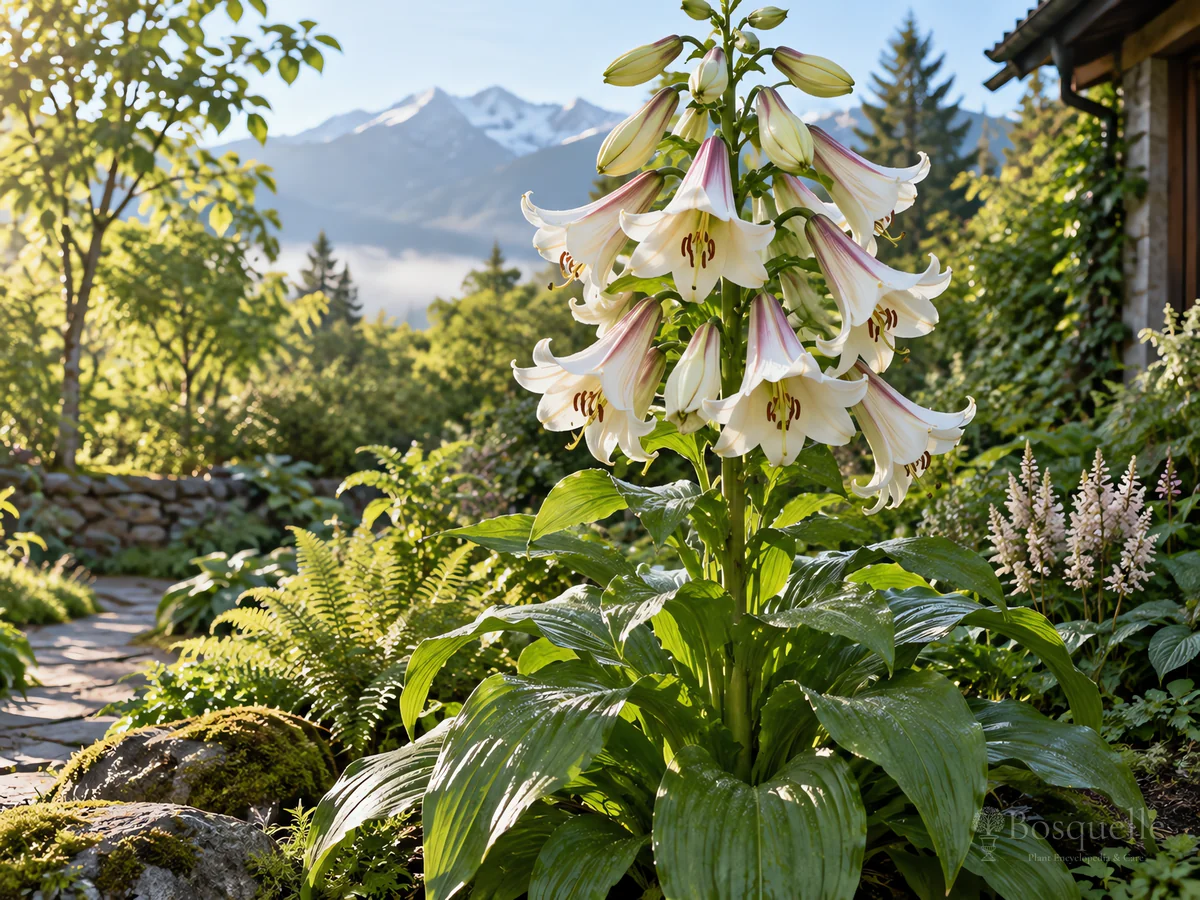
Grow Cardiocrinum in part shade and soil that stays moist but drains. Giant Himalayan lily is the shop name. It is not a true lily, and it is not a crinum or a daylily.
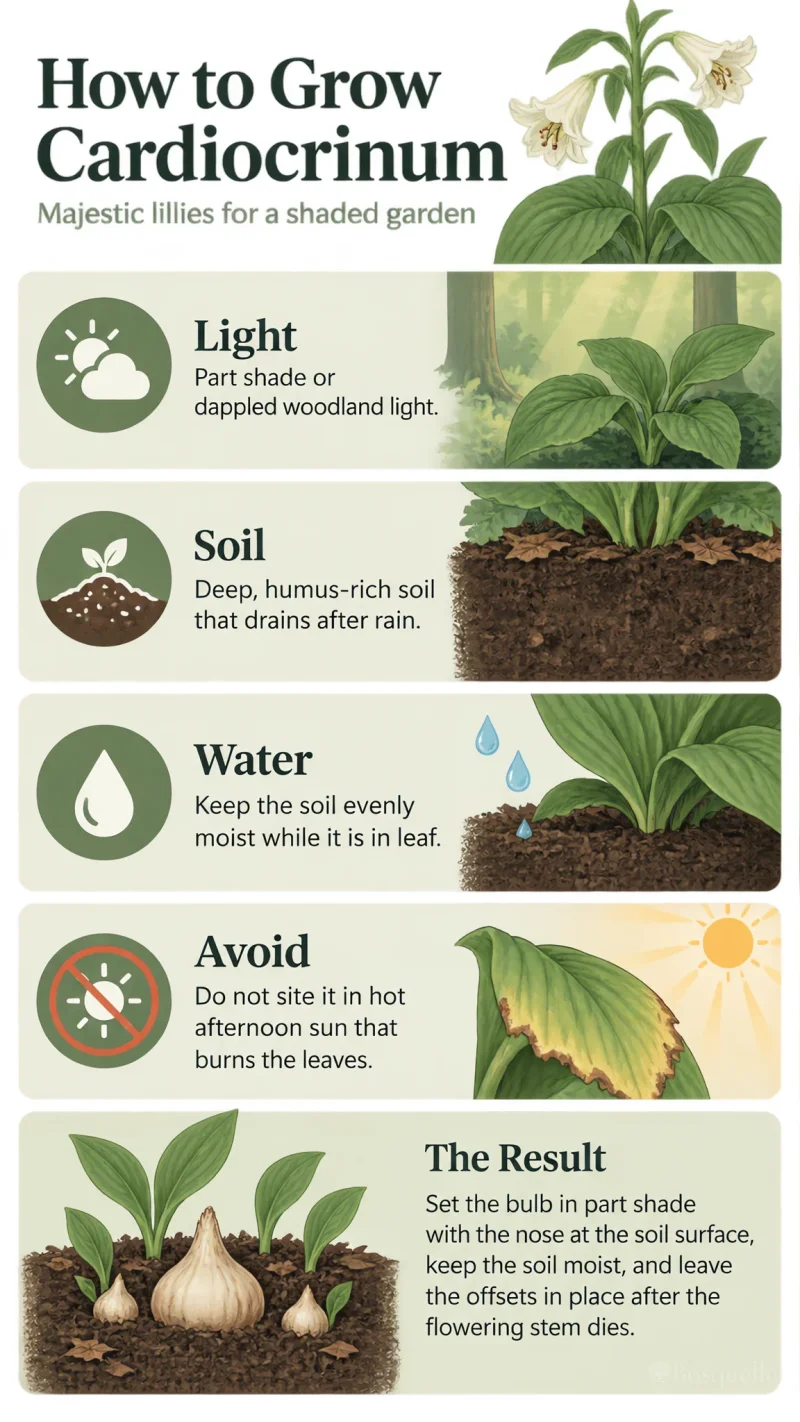
Give it part shade, moist woodland soil, and shelter from wind
| Factor | Recommended | Avoid |
|---|---|---|
| Light | Part shade or dappled woodland light | Do not site it in hot afternoon sun that burns the leaves |
| Water | Keep the soil evenly moist while it is in leaf | Do not let the bed dry out, and do not leave the bulb in a puddle |
| Soil | Deep, humus-rich soil that drains after rain | Do not plant it in thin dry ground or waterlogged clay |
| Winter | Mulch the crown with leaf mould before hard frost | Do not leave the shallow bulb bare in a hard freeze |
Cardiocrinum is a woodland bulb with huge heart-shaped leaves and a tall raceme of fragrant white trumpets. Give it part shade and soil that stays moist but drains, because hot sun burns the leaves and standing water rots the bulb. [1] It wants a sheltered spot, the way it grows in mountain woods, with a spring mulch of leaf mould or compost so the soil stays cool and damp. [2] Giant Himalayan lily is Cardiocrinum giganteum.
How much sun does Cardiocrinum need?
Give it part shade or dappled light under trees. Hot afternoon sun burns the large leaves.
How wet should the soil stay?
Keep it evenly moist while the plant is in leaf. Dry soil stalls growth, and a puddle around the bulb is the usual cause of rot.
Plant the bulb with the nose just showing
Buy a dormant nursery bulb and plant it as soon as you have it. Set the nose — the pointed tip — just at the soil surface, not deep the way you plant a true lily. Fall is a good window; spring works if the ground is workable and not frozen. [3]
- Choose part shade and deep soil you have enriched with leaf mould or compost.
- Plant in fall if you can, or in spring as soon as the ground is workable.
- Set the bulb so the nose sits just at the soil surface, and give it about 2 feet of room so offsets can form.
- Water in once, then keep the soil damp while it settles. Do not park the bulb in a holding pot if you can plant it in the ground that day.
- Label the spot. The leaves vanish after the stem dies, and a later dig can spear the offsets.
How deep do I plant the bulb?
Set the nose just at the soil surface. These bulbs sit shallow. Do not bury them the way you bury a true lily.
When do I plant Cardiocrinum?
Plant in fall if the bulb arrives then, or in spring as soon as the ground is workable. Plant it the day you get it.
After it flowers, the old bulb dies — keep the offsets
The flowering bulb dies after the trumpets fade. That is normal. Small offset bulbs form around the old one, and those keep the clump going. They usually take four or five years to bloom. Leave the leaves until they yellow so the offsets can store food. [4]
- Let the stem and leaves die back after bloom. Cut the seed pods off if you want the plant to put more energy into offsets.
- If the clump is crowded, lift it after the top growth has died, and separate the offsets by hand.
- Discard the spent flowering bulb. Replant the offsets at once, with each nose just at the soil surface, and water them in.
- Keep the soil moist the next growing season. Do not store the offsets dry.
Seed takes years — offsets flower sooner
Seed is the slow path. Fresh seed often needs a warm spell and then cold before it sprouts, and a plant from seed can take about seven years to bloom. Offsets from a flowered bulb reach size sooner.
- Sow ripe seed in late fall, or in spring, in a deep pot of seed mix.
- Cover the seed lightly. Keep the pot cool, shaded, and just damp. Germination may take a year or two.
- Grow the seedlings on without letting the mix dry. Plant a strong young bulb into the woodland bed while it is dormant.
What happens after it flowers?
The flowering bulb dies. Offsets around it keep the planting going. Leave the leaves until they yellow, then replant crowded offsets with the nose at the surface.
Can I grow it from seed?
Yes, but plan on years. Offsets from a flowered bulb bloom sooner than a plant raised from seed.
Not a true lily — and not crinum or daylily
Shop tags still say giant lily, and older lists still say Lilium giganteum. True lilies have narrower leaves that clasp the stem, and you plant those bulbs deep. Cardiocrinum has heart-shaped leaves on leaf stalks, and the bulb sits at the surface. See How to Grow Lilies. Crinum is a different bulb with strap leaves and a wetter, often warmer bed — see How to Grow Crinum. Daylilies are Hemerocallis, with grassy fans that bloom a day at a time — see How to Grow Daylilies. Confirm Cardiocrinum on the Latin. The leaves can look like a hosta in spring, but this is a lily-family bulb, not a hosta clump.
Is this a true lily?
No. It was once listed as Lilium giganteum. True lilies are Lilium. This plant has heart-shaped leaves and a shallow bulb.
Is this the same as crinum?
No. Crinum is a different genus with strap leaves. Cardiocrinum is the giant Himalayan woodland lily with heart-shaped leaves.
Set the bulb in part shade with the nose at the soil surface, keep the soil moist, and leave the offsets in place after the flowering stem dies.
FAQ
Can I grow it in a pot?
A flowering bulb is too large for a windowsill pot. A deep nursery pot can hold a young offset for a season, but a woodland bed is the lasting home. Plant the bulb in the ground the day you get it.
Is it safe around cats?
Cardiocrinum is not known as a toxic plant in the same way some true lilies are, but it is still a lily-family plant. Keep cats from chewing the leaves or flowers.
Are Japanese giant lily or Chinese giant lily in this catalog?
No. This catalog holds Cardiocrinum giganteum only. Cardiocrinum cordatum and Cardiocrinum cathayanum are related woodland species, not extra cards here.
Can I cut the stems or keep the seed heads?
You can cut a spent stem, or keep the dry capsules for a vase. Leave the leaves in the bed until they yellow so the offsets can store food. Cut the seed pods sooner if you want more offsets instead of seed.
Is this giant allium, Easter lily, or lily of the valley?
No. Giant allium is Allium giganteum — see How to Grow Alliums. Easter lily is Lilium longiflorum. Giant lily of the valley is Convallaria — see How to Grow Lily of the Valley. Confirm Cardiocrinum on the Latin.
Recommended plants

References
- [1] NC State Extension Gardener -
https://plants.ces.ncsu.edu/plants/cardiocrinum/ - [2] Royal Horticultural Society -
https://www.rhs.org.uk/plants/cardiocrinum/how-to-grow-cardiocrinum - [3] Missouri Botanical Garden -
https://www.missouribotanicalgarden.org/PlantFinder/PlantFinderDetails.aspx?taxonid=282198 - [4] Gardenia -
https://www.gardenia.net/plant/cardiocrinum-giganteum
More first-season notes by plant are gathered in How to Grow Guides.
Updated: Reviewed by Bosquelle Editors