
Grow black-eyed peas in full sun, in warm soil that drains, and water evenly once the plants bloom. Black-eyed peas are Vigna unguiculata, a warm-season cowpea — not a black-eyed Susan flower.
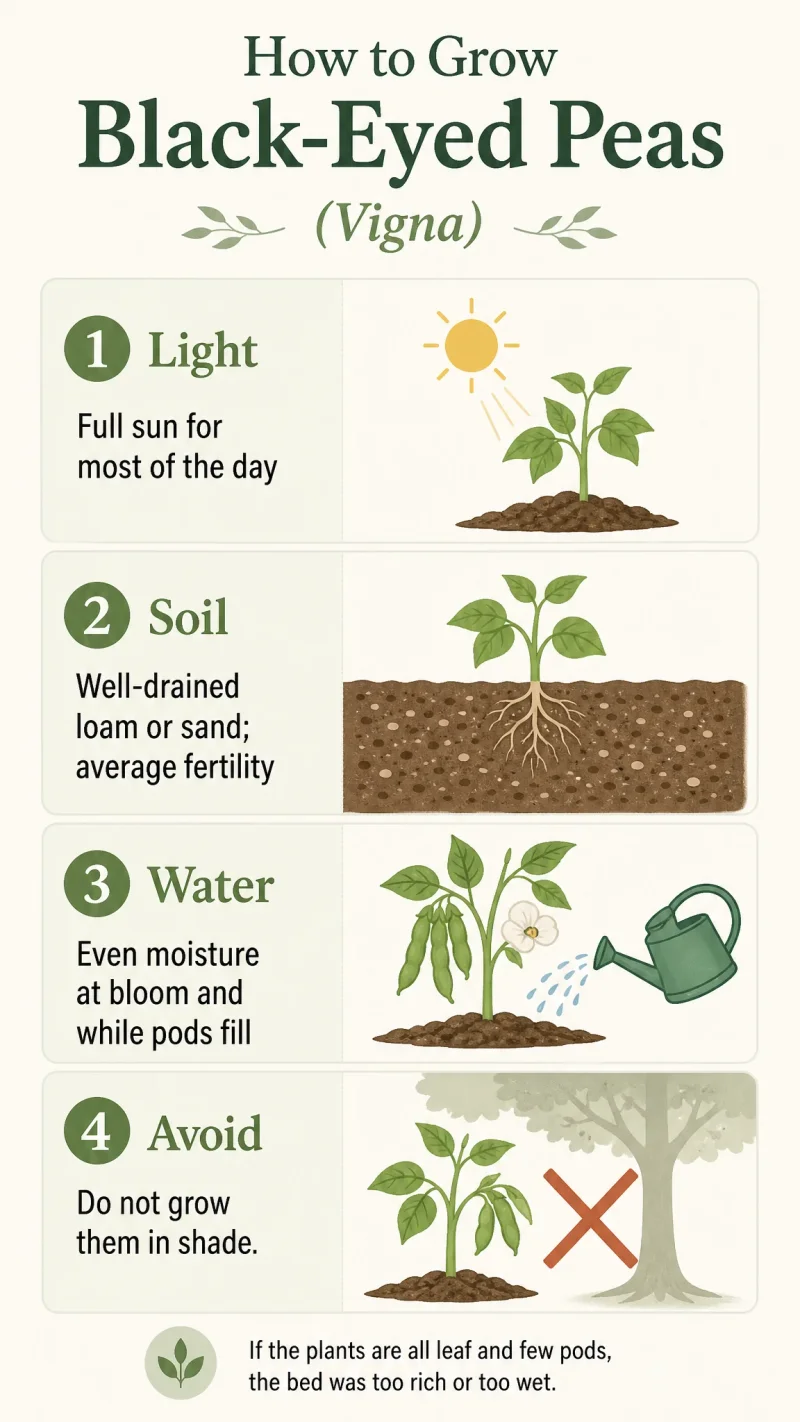
Give it full sun, warm soil that drains, and even water at bloom
| Factor | Recommended | Avoid |
|---|---|---|
| Light | Full sun for most of the day | Do not grow them in shade |
| Soil | Well-drained loam or sand; average fertility | Do not leave the roots in soggy ground |
| Water | Even moisture at bloom and while pods fill | Do not let the bed dry out while pods fill |
| Feed | Cowpea inoculant if this bed has not grown cowpeas | Do not add a high-nitrogen fertilizer, and do not use garden-pea inoculant |
| Support | Bush types stand on their own; set a fence for vining types the day you sow | Do not wait until a vining row sprawls to add a support |
black-eyed pea is a warm-season annual from Africa, grown here for the pods. Give it open sun and soil that drains, and keep moisture even once flowers open so the crop fills instead of dropping. [1] Average loam or sand is enough. Extra nitrogen grows a leafy vine and few pods, so skip a heavy feed once the plants are up. [2] Coat the seed with a cowpea, southern-pea, or Vigna inoculant if this bed is new to the crop. Garden-pea inoculant will not nodulate these roots. Water through bloom and pod fill; do not leave the row waterlogged. [3] Start it from seed after frost. Pair it with other heat-loving summer vegetables that will not shade the row.
How much sun do black-eyed peas need?
Full sun for most of the day. Shade gives a thin stand and a light crop.
Do I need inoculant?
Yes, if cowpeas have not grown in this bed. Use a powder labeled for cowpea, southern pea, or Vigna, not the one sold for garden peas.
Do they need a trellis?
Bush types stand on their own. Vining types need a fence or net set the day you sow, before the stems tangle.
Sow after frost once the soil is warm
Wait until frost has passed and the soil is at least 60 to 65°F. Sow about an inch deep, a few inches apart in the row, and keep the surface moist until seedlings show. Direct-sow in the bed; the plants do not transplant well.
- Wait until the soil is warm. Seed rots in cold, wet ground, even when the calendar says spring. [4]
- Dust the seed with cowpea inoculant just before you sow, if this bed has not grown cowpeas.
- Sow about an inch deep and a few inches apart. Give vining types more room in the row, and set their fence the same day.
- Keep the surface moist until seedlings show, then thin so each bush has space. Do not start them in pots and move them later.
When should I sow black-eyed peas?
After frost, once the soil is at least 60 to 65°F. Do not copy a cool-season garden-pea date.
Not a black-eyed Susan — and not a garden pea
The plant most people picture from black-eyed is the daisy, Rudbeckia, with a dark cone and yellow rays. If you have a flower bed labeled black-eyed Susan, read How to Grow Black-Eyed Susans instead. A vine sold as black-eyed Susan is often Thunbergia; see How to Grow Black-Eyed Susan Vine.
Garden peas are Pisum, a cool-season crop you sow as soon as the soil can be worked. Black-eyed peas want heat. If you have English peas, snow peas, or snap peas, read How to Grow Peas. Snap beans, lima beans, and runner beans are Phaseolus — see How to Grow Beans. Yard-long bean is a climbing Vigna, not this bush or short-vine crop. Sweet peas are Lathyrus; see How to Grow Sweet Peas. Edamame is a vegetable soybean; see How to Grow Edamame. Hyacinth bean is an ornamental screen; see How to Grow Hyacinth Bean.
Are black-eyed peas the same as garden peas?
No. Garden peas are Pisum, sown in cool soil. Black-eyed peas are Vigna, sown after the soil is warm.
If the plants are all leaf and few pods, the bed was too rich or too wet. Put the next sowing in full sun, in soil that drains, and water when they bloom.
FAQ
Is there more than one kind of black-eyed pea?
Vigna unguiculata is the plant here. Packets may say crowder, cream, purple hull, or pinkeye for seed and pod color; those are extra names, not a second species in this catalog. Yard-long bean is a climbing relative, not this bush crop.
Can I grow it in a pot?
Yes, a bush type in a large pot with drainage holes, in full sun outdoors. Water more often than in the ground, because the mix dries faster. Direct-sow into the pot.
Will it come back after winter?
No. Frost kills the top, so you sow again in spring. Save dry seed only from a healthy open-pollinated plant, or buy fresh seed.
Can I sow it as a summer cover crop?
Some packets sold as Iron Clay are the same species grown for forage. A food row still wants full sun, soil that drains, and a pick before frost. Do not copy a plow-down cover onto a kitchen row.
Related guides

Recommended plants
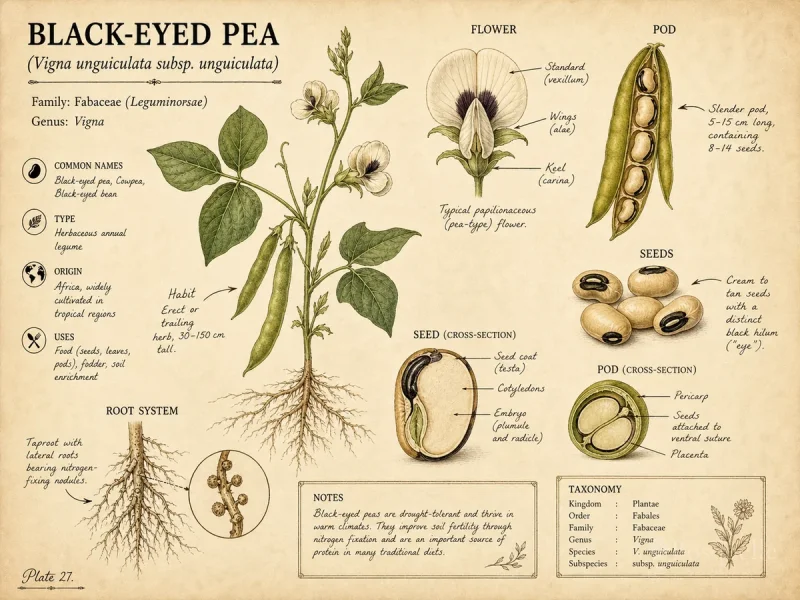
References
- [1] Clemson HGIC -
https://hgic.clemson.edu/factsheet/southern-peas/ - [2] University of Arkansas Division of Agriculture -
https://www.uaex.uada.edu/publications/pdf/FSA-6020.pdf - [3] Texas A&M AgriLife Extension -
https://lubbock.tamu.edu/programs/crops/vegetables/southern-pea/ - [4] Colorado State University Extension -
https://extension.colostate.edu/resource/black-eyed-pea-production-for-eastern-colorado/
This note is part of Vigna Guides.
More first-season notes by plant are gathered in How to Grow Guides.
Updated: Reviewed by Bosquelle Editors