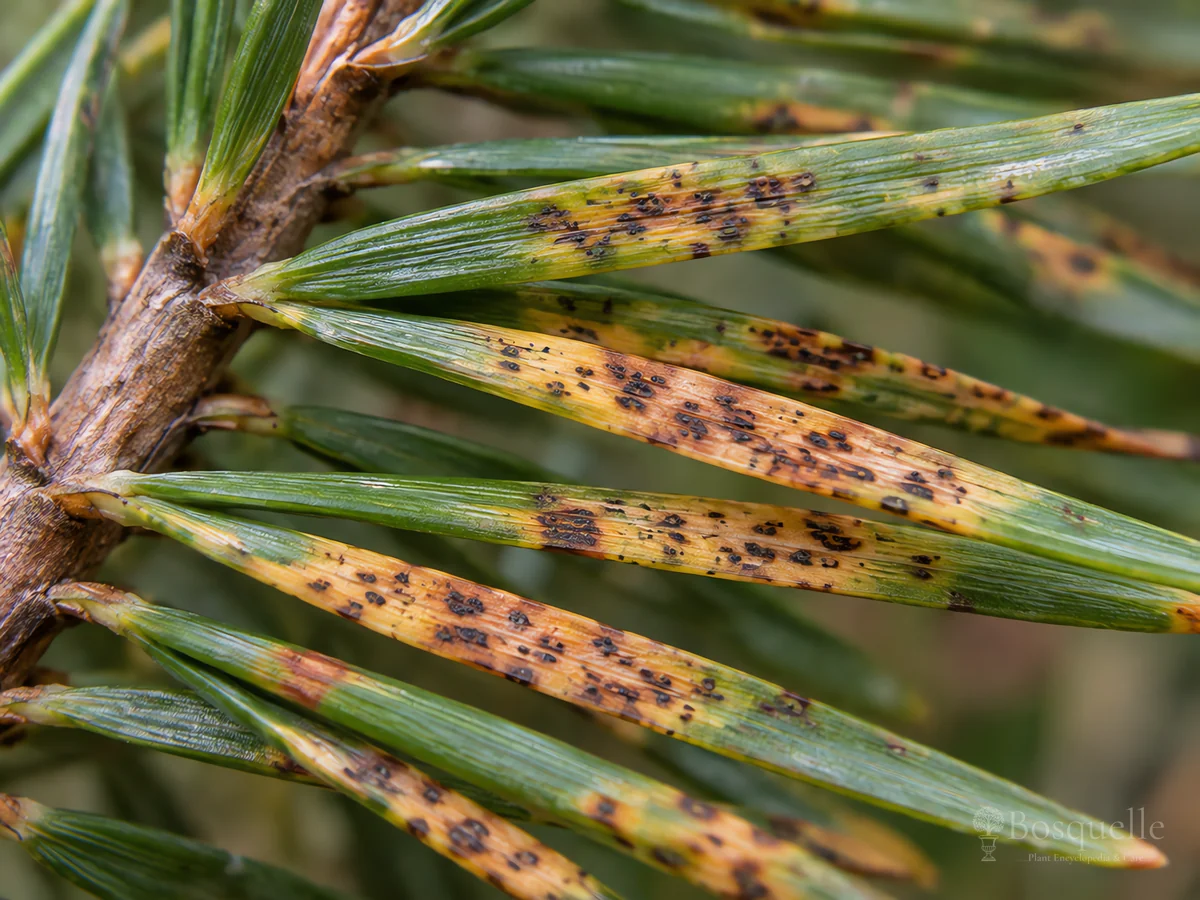
A spray will not green last year’s brown needles, because those needles were already infected while they still looked fine, so clip the dead inner wood tonight, keep the lawn sprinkler off the foliage, and if you still want that Colorado blue spruce, a labeled protectant has to wet the new needles when they are half out, then again a few weeks later. Needle cast is a group of fungi that infect conifer needles in wet weather and then drop them about a year later. On a landscape spruce the usual fungus is Rhizosphaera kalkhoffii.
People still say needlecast, then it is needle cast. The inner and lower needles go mottled yellow, then purple-brown on a blue spruce, and they fall, so the tree looks thin and see-through while the tips stay green. A healthy spruce keeps several years of needles on a twig. After a few seasons of this fungus, only the newest flush is left at the tip, and a branch that has been bare that long can die. Norway spruce is usually tougher in the same yard. Dish soap or horticultural oil can take the blue off a Colorado spruce and does not finish this fungus besides.
A spray will not green last year’s brown needles
Once a needle is purple-brown, that tissue is already dead, so a bottle now cannot rewind the color. The useful job this season is to cut next year’s spore load and to protect the new flush, because the fungus spends winter on living and recently killed needles, then splashes onto young needles whenever the surface stays wet. Clip dead inner branches in dry weather, rake the dropped needles, and destroy that debris, because a cold pile under the tree still sheds spores in every rain. Do not prune while the foliage is wet, and wipe the shears with a ten-percent bleach mix between trees so you are not walking the fungus across the yard.
Keep lawn sprinklers off the needles, because splash is how this disease moves up the tree and onto the spruce next door. Water the root zone in a dry stretch, then keep a couple of inches of wood-chip mulch over that soil, pulled back from the trunk, because drought stress makes a Colorado blue spruce easier to infect. Do not shear the tree into a dense hedge, because a tight face stays wet longer and the new needles never dry. If the tree is still worth keeping and a hand lens shows those black dots in rows, a product labeled for needle cast on spruce has to start when the new needles are about half their mature length, then again three to four weeks later, and you run that cover for at least two springs, because symptoms lag a year and last year’s brown flush will still drop while you are protecting this year’s. Chlorothalonil, copper, or mancozeb are the actives extension actually names. Some chlorothalonil mixes discolor spruce, so read the current label for spruce before you mix a tank. On a tree taller than about ten feet, a home pump sprayer will not wet the inner crown, so that cover belongs to an applicator who can reach it.
On Austrian pine or ponderosa pine the same dropping-needle job is usually Dothistroma, with reddish bands and brown tips while the needle base stays green. Copper labeled for pine when the buds open, then again when the new needles are full, because young pine needles resist until they mature. Do not plant another Austrian pine in that wet pocket.
- Confirm. Inner and lower needles purple-brown or dull brown, tips still green, twigs still green. A hand lens shows tiny black fruiting bodies in neat rows where the white stomata used to be. Bright orange blisters, silk and crawling specks, or white resin on the wood are different problems.
- Clip dead inner wood in dry weather. Rake the fallen needles and destroy them. Do not leave a wet pile under the tree, and do not compost whole infected needles in a cold heap.
- Keep water off the foliage. Point sprinklers at the lawn, not the spruce. Water the roots in drought and keep a thin mulch over the soil, pulled back from the bark.
- If you still want that spruce, a labeled protectant when new needles are half out, then again three to four weeks later, for at least two springs. Skip the bottle if the tree is already down to a few green tips with dead buds, and skip oil or kitchen soap on a blue spruce.
- On pine, look for red bands and brown tips, then use a copper product labeled for pine at bud break and again when needles are full. Do not copy the spruce calendar onto pine without reading that label.
How do I get rid of needle cast?
You cannot green needles that are already brown. Clip dead inner wood in dry weather, rake and destroy the fallen needles, and keep sprinklers off the foliage. If the tree is still worth keeping, a labeled protectant starts when new needles are half out, then again a few weeks later, for at least two springs.
When do I spray for needle cast?
When new spruce needles are about half their mature length, then again three to four weeks later. You need that pair of covers for at least two springs, because symptoms lag a year. A July spray on already-brown needles does not rewind them. On a tree taller than about ten feet, hire someone who can wet the inner crown.
Purple-brown inner needles with black dots in rows confirm needle cast
Look at last year’s inner needles first, because this year’s tips often stay green for months after the infection started. On Colorado blue spruce the older needles mottled yellow in late summer, then turn a distinctive purple-brown by late winter or spring, and they drop that summer, twelve to fifteen months after the spores landed. The twig under those needles stays green. That is the difference from a canker that girdles the wood. With a 10x hand lens, healthy stomata look like white dots in rows. Infected stomata push out tiny black fruiting bodies, like columns of pepper along the needle, and those black rows are the gardener check. You can sometimes see them on needles that are still partly green.
Damage starts on the lower, crowded branches and works up, or it opens a thin hole in the middle of the crown, because shade and wet air hold the fungus. A healthy spruce holds several years of needles. A tree with this fungus often keeps only the current flush at the tips, so the tree looks see-through. White spruce and Black Hills spruce are somewhat tougher. Norway spruce is usually the resistant choice in the same wet yard. Engelmann spruce is as soft a target as Colorado blue.
Stigmina looks the same in the yard. The fruiting bodies are hairier under a microscope, it hits every spruce including Norway, and there is no home product labeled for it, so send a sample to a clinic if you are about to spray for years. Sudden needle drop puts black pimples on the twigs, not on the needles, and a spray does not finish that either. On Douglas-fir in the Pacific Northwest, Swiss needle cast is a related underside-dot fungus, not a different backyard calendar. On pine, Lophodermium browns last year’s needles in spring, and Dothistroma makes the red-band pattern already named above.
| Where you see it | What it is | Try this |
|---|---|---|
| Inner, lower needles purple-brown; black dots in stomatal rows; tips still green | Needle cast (usually Rhizosphaera on spruce) | Clip dead wood; keep water off foliage; protect new needles when half out |
| Reddish bands, brown needle tips, green bases on Austrian or ponderosa pine | Dothistroma needle blight, same dropping-needle job | Copper labeled for pine at bud break and when needles are full |
| Needles dusty yellow to bronze; silk; specks that crawl on paper | Spruce spider mites | See spruce spider mite — hose, do not fungicide |
| Needles brown from the tip down on the windward or south side; bases often still green | Winter burn or drought | Water before freeze-up; no fungicide |
| Current-year needles yellow with orange or white blisters in July | Needle rust | See needle rust — not these black rows |
| Whole branch dead; white dried resin on the bark near the trunk | Cytospora-type canker | A needle spray will not save girdled wood |
What does needle cast look like?
Inner and lower needles turn yellow, then purple-brown on blue spruce, while the tips stay green and the twigs stay green. A hand lens shows tiny black fruiting bodies in neat rows on the needles. The tree looks thin and see-through after those older needles drop.
Is Stigmina the same as Rhizosphaera?
In the yard they look the same: inner needles purple, then drop. Stigmina fruiting bodies are hairier under a microscope, it can hit Norway spruce, and there is no home spray labeled for it. Send a sample to a clinic before you commit to years of chlorothalonil.
Winter burn, mites, orange rust, and resin on the wood are different problems
Tap a branch over white paper in spring or fall. Dark, slow specks that smear green are spruce spider mites, and fine silk between the inner needles is the same animal. Mite feeding bronzes inner needles too, but you will not find those black fruiting bodies in stomatal rows, and a chlorothalonil cover will not finish mites. See that pest. Hose the inside. Do not run this fungus calendar on silk.
Winter burn browns needles from the tip down, often on the south or southwest face and above the snow line, while the needle base can stay green and the inner needles near the trunk look better than the tips. There are no black rows. Water the root zone before the ground freezes and skip a fungicide. White cotton at the needle bases is adelgid wool, not a fruiting body. Smear the wool. Do not spray this fungus for that insect.
Pale orange or white blisters on this year’s needles in July, with a yellow or pink cast to the new flush, are needle rust. That rust hits current-year needles and often needs a bog plant such as Labrador tea. Black rows on last year’s inner needles are this cast. Do not run a rust calendar on pepper-grain fruiting bodies, and do not recap bog-host removal here. A whole lower limb that dies, with white dried resin on the bark near the trunk, is a canker in the wood, often called Cytospora on older Colorado blue spruce. The twig is girdled. Needles on that limb all fade together. A needle protectant will not unplug that canker, so do not spend two springs spraying a tree whose actual problem is dead wood. White flakes stuck to the needle are scale, not this fungus.
Is this winter burn or spruce spider mites?
Winter burn browns tips, often on the windward or south side, and there are no black fruiting bodies. Mites leave silk and specks that crawl on white paper. Needle cast shows purple-brown inner needles with black dots in stomatal rows. See spruce spider mite if the paper test crawls.
Is needle rust the same as needle cast?
No. Needle rust makes orange or white blisters on this year’s needles, often near bog plants. Needle cast puts black fruiting bodies in rows on last year’s inner needles and drops them the next year. See needle rust if the new flush is orange.
Needle cast rarely kills the tree in one season
Most landscape spruces live through a year of inner drop, because the fungus is ugly before it is lethal, and the top can stay green while the lower third looks bare. What kills a branch is three or four years of losing almost every needle on that limb, so the wood cannot feed itself. Small trees and trees planted in shade, wet air, or a tight row go faster. If live buds are still pushing a full new flush, and you can actually wet the new needles, two springs of a labeled cover plus dry foliage can thicken the tree again, but last year’s brown needles will still fall while you wait, because they were infected before you started.
Take the tree down if the crown is mostly bare, the remaining tips have dead buds, or you cannot reach the inner needles with a spray you are willing to repeat. Do not plant another Colorado blue spruce in that same crowded, wet hole, because this fungus loves that site and that species. Norway spruce, a well-adapted white spruce, or a different conifer that is not a blue spruce is the honest replacement. On pine, several years of Dothistroma can kill an Austrian pine, so do not replace it with another Austrian pine in the same low, damp spot.
Will needle cast kill my spruce?
Rarely in one season. Repeated drop for three or four years can kill a branch, and a small or crowded tree can go faster. If live buds are still pushing, you can try sanitation and a two-year cover. If the crown is mostly bare and the buds are dead, take it down.
Can I save a mostly bare blue spruce?
Only if live buds are still pushing a real new flush and you can actually wet those new needles for two springs. Spruce will not refill the inside of a bare branch. If the tree is a skeleton with dead tips, take it down and do not plant another Colorado blue spruce in that hole.
Related reading
- Spruce spider mite — inner needles dusty or bronze, with silk and crawling specks, not black fruiting bodies in rows.
- Needle rust — orange or white blisters on this year’s needles, not purple-brown inner needles with black stomatal dots.
- Adelgids — white wool at the needle bases, or a pineapple gall on new wood, not a needle-cast drop.
FAQ
Does neem oil or dish soap get rid of needle cast?
No. Oils and kitchen soaps can discolor Colorado blue spruce and they are not a labeled needle-cast program. Sanitation, dry foliage, and a product labeled for this fungus on spruce are the real job.
Can I compost the dropped needles?
Do not put whole infected needles in a cold home heap, because the fungus overwinters there and will splash again. Destroy them, bag them in household trash, or use a hot pile that actually heats through. Raking still helps even if a few needles stay stuck in the tree.
Will it spread to the spruce next door?
Yes, in rain and overhead water, because spores splash from needle to needle and from tree to tree. That is why you keep sprinklers off the foliage and why a wet, crowded row of Colorado blue spruce is a hard site to keep clean.
Is Dothistroma on Austrian pine this disease?
It is the same dropping-needle job on pine: red bands, brown tips, older needles falling. Copper labeled for pine at bud break and again when needles are full is the cover, not the spruce half-out calendar copied blind. Do not replace a dead Austrian pine with another Austrian pine in a damp pocket.
Related diseases



Related pests





Updated: Reviewed by Bosquelle Editors