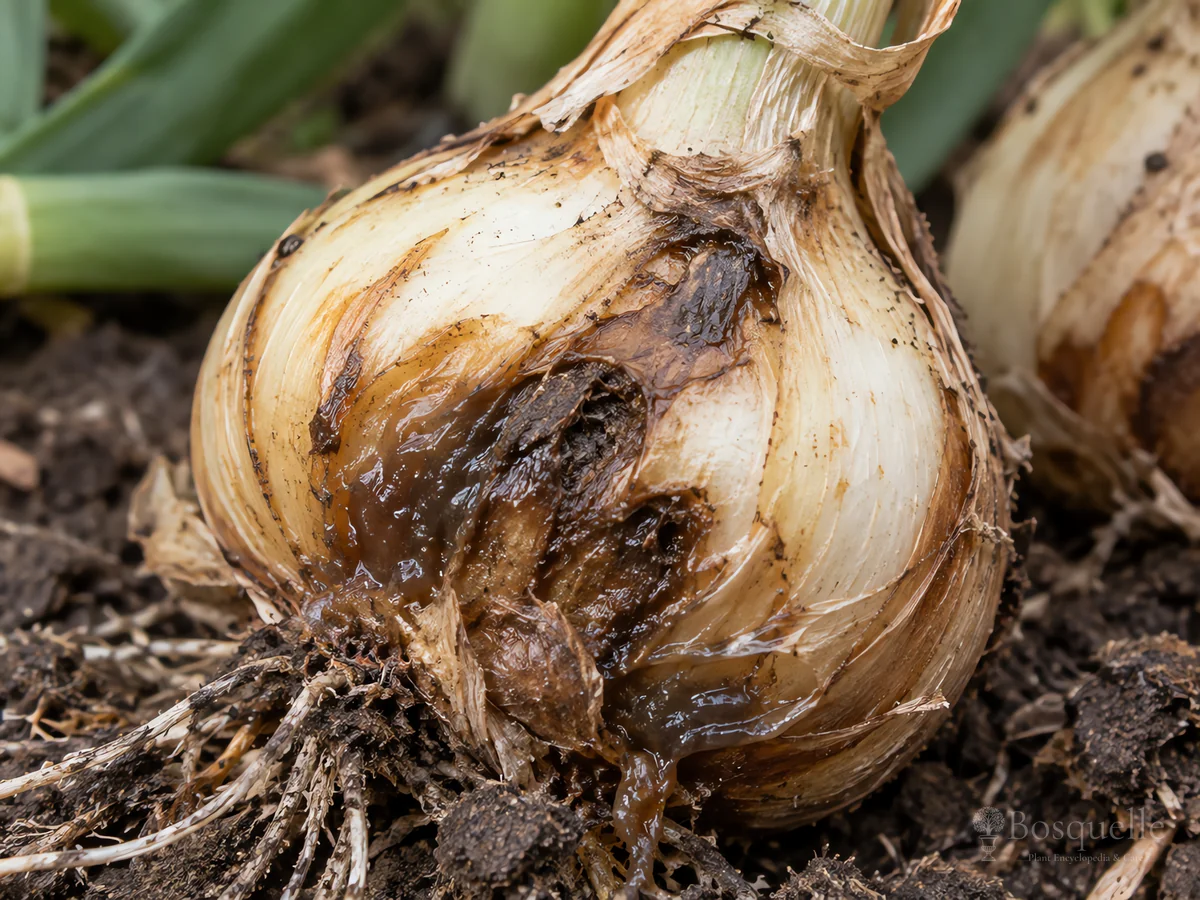
Squeeze the bulb, because a sound daffodil or tulip is firm and heavy, and a rotting one yields, smells sour, or lets the basal plate slide off the roots. Soft tissue at that root end will not grow a new root system, so bag it, put it in the household trash, and do not compost it. A spray on the leaves will not firm the scales back up.
People still call the same job basal rot when the decay starts at the basal plate and climbs the inner scales, often with a white or pink mold between them. That is still bulb rot, a Fusarium fungus on daffodils and tulips, and sometimes a blue-green Penicillium mold on a bruised stored bulb. It is a fungus, not a maggot and not the brown rot that mummifies a peach. You find it in the crate, in a wet pot, and in a bed that stays soggy after rain.
Throw out the rotting bulbs
Once the basal plate is soft, the bulb cannot grow a new set of roots, so a fungicide on the foliage will not firm the scales. Squeeze every bulb in the crate and every clump you lift, then bag the ones that yield, smell sour, or look chocolate-brown from the plate up. Put that bag in household trash, because Fusarium survives a home compost pile and will ride the next planting back into the bed.
- Squeeze every bulb, corm, and tuber in the crate or the pot. A firm, heavy bulb with a sound basal plate can stay in the pile you mean to plant. A soft, light, or sour one is done, even if a green nose is still showing.
- Look at the basal plate, the root end. White or pink mold between the scales, or chocolate-brown tissue spreading up from that plate, confirms this fungus. Cut a suspect bulb lengthwise if you are unsure.
- Bag the rotting bulbs and any foliage that came with them. Put the bag in household trash. Do not compost them, and do not leave the mush in the hole.
- If it is already in the bed, lift the clump and a spadeful of the soil around it, because the fungus lives on the rotting tissue and in that soil. Do not jam a new bulb into the same hole this season.
- Wash tools, trays, and boots before you work a clean bed. Plant only firm, undamaged stock next, in soil that drains, and do not pile fresh manure against the bulb.
How do I get rid of bulb rot?
Squeeze every bulb. Bag the ones that are soft, light, or sour, and put them in household trash. Do not compost them, and do not plant another bulb in that wet hole this season. A spray will not un-rot the scales.
Squeeze the bulb, then look at the basal plate
The first check is in your hand, not on the leaf. A sound tulip, daffodil, lily, hyacinth, or gladiolus corm is firm. An infected one yields, feels light, or smells sour because the fungus is eating the stored starch. The basal plate is the flat root end. Fusarium rot usually starts there and moves up the inner scales as chocolate-brown or purplish-brown tissue, with a weft of white or pink mold between the layers. It is often dryish rather than slimy. Shoots that come from those bulbs are short, crooked, or yellow, and they may never flower.
Blue-green mold on a bruise is Penicillium, often called blue mold. On a stored tulip it can sit on the outer husk and stay superficial, so peel that husk and squeeze again. If the flesh under it is still firm and does not smell sour, the bulb can go in the plant pile. If the plate is soft, or the cut shows brown climbing the scales, it is the same discard job as Fusarium. Neck rot after bloom is the same family of fungi entering at the neck instead of the plate, so the squeeze still decides it.
| Where you see it | What it is | Try this |
|---|---|---|
| Soft, light, or sour bulb; chocolate-brown from the basal plate; white or pink mold between scales | Bulb rot (Fusarium) | Bag it. Do not plant it. Do not compost it. |
| Blue-green mold on a bruise in damp storage; flesh under the husk still firm | Penicillium (blue mold) | Peel the husk. Plant only if the plate and flesh stay firm. |
| Cut across: brown rings or arcs, no maggot; pale swellings on the leaf | Narcissus eelworm | See narcissus eelworm — not this plate-up rot. |
| One plump maggot in a hollow center, with frass | Narcissus bulb fly | See narcissus bulb fly — not this fungus. |
| Watery, foul mush that collapses in the hand | Bacterial soft rot | See bacterial soft rot — still trash, different organism. |
| Peony or hosta wilt in a puddle; brown soft collar at the soil line | Crown rot | See crown rot — scrape the mulch, not a stored-bulb squeeze. |
What does bulb rot look like?
The bulb yields in your hand, often with a sour smell. Chocolate-brown or purplish-brown tissue spreads up from the basal plate, and white or pink mold sits between the scales. Blue-green mold on a bruise is Penicillium; peel the husk and squeeze again before you decide.
Is basal rot the same as bulb rot?
Basal rot is the usual name when Fusarium starts at the basal plate and climbs the inner scales, especially on daffodils. That is this disease. Uniform plate-up brown is not the brown rings of eelworm.
A maggot, brown rings, or mustard seed is a different problem
Cut a suspect daffodil across. Concentric brown rings or arcs in the scales, and no maggot, are narcissus eelworm, a nematode you can sometimes feel as pale swellings on the leaf before bloom. Where a whole patch fails to appear in the second year, that missing stand is more often this fungus than the worm. Do not run the eelworm three-foot calendar on a single soft tulip with pink mold on the plate. See that pest if you felt spickels or saw rings.
One creamy maggot in a hollow center, with a mass of frass, is narcissus bulb fly, not a fungus. Pearly mites with brown legs under the scales are bulb mites, and they often move into tissue this fungus already opened, so squeeze first and then peel. Watery, foul, collapsing mush is bacterial soft rot, and a spray will not un-rot that either, but the organism is a bacterium, not Fusarium. A peony or hosta that wilts in a bed that never dries, with a brown soft collar at the soil line and no mustard-seed specks, is crown rot. Mustard-seed specks on the collar are southern blight. Malformed tulip leaves with gray fuzz are tulip fire, a foliage job, not this squeeze. Brown rot that mummifies a peach or cherry is brown rot, a different disease on fruit.
Is a maggot in my daffodil bulb rot?
No. One plump maggot in a hollow center is narcissus bulb fly. Brown rings with no maggot are narcissus eelworm. Chocolate-brown from the plate, with white or pink mold and no maggot, is this fungus.
A spray will not un-rot a bulb
Home garden labels do not rewind tissue that has already gone chocolate-brown, so a bottle on the leaves, a neem oil, or a copper mix is not the job. There is no home chemical that cures daffodil basal rot once the plate is soft, and the grower soaks you see on farm sheets are for sound bulbs after every soft one has already been pulled. Sort first. If the basal plate is gone, the soak only spreads slime. Labeled products cannot fix bacterial mush or a virus streak either, so skip the aisle until the crate is clean and the next hole actually drains.
Will a fungicide cure bulb rot?
No. A spray on the leaves cannot rebuild scales that have already gone brown. Farm soaks are for sound bulbs after the soft ones are already gone, and they are not the home plan. Sort, discard, and plant the rest in a hole that drains.
Hot water is a commercial tank, not a kitchen pot
You can cut a tiny bruised spot off a firm bulb if the basal plate stays hard and the flesh under the knife is clean and odorless, then let that cut dry in air before it goes back in the crate. If the plate is soft, the bulb feels hollow, or the sour smell is still there after the cut, throw it out, because there is not enough sound tissue left to grow. Do not plant a prized named cultivar just because you paid for it.
Hot water at 44.5°C, about 112°F, for three hours is a grower tank with a thermostat, used on dormant stock. A stockpot on the stove cannot hold that temperature without cooking the bulb or leaving the fungus alive, and a too-hot dip also invites more rot. Leave the tank to people who have the equipment. Your job is still the squeeze, the bag, and a drier hole next time.
Can I save a rotting bulb?
Not once the basal plate is soft, because that end has to grow the next roots. You can cut a small surface bruise off a still-firm bulb, then dry the cut. If the smell stays, or the plate gives, throw it out.
Keep the rest dry, and keep bulbs out of that hole
Sound bulbs need cool, dry air, not a sealed plastic bag. Spread them in a thin layer in a paper bag, a mesh sack, or an open crate, somewhere around a cool basement or garage that does not freeze, and check them every few weeks so one sour bulb does not take the tray. Do not water a tulip that has gone dormant for summer. In the bed, work grit into a heavy hole, or use a raised bed or a pot with an open drain, because standing water around the plate is how the next round starts.
Keep host bulbs out of that hole for about three years, and pull volunteers, because the fungus can wait in the soil. Do not plant another daffodil, tulip, lily, or gladiolus in the same puddle this fall. Fresh manure and a heavy nitrogen feed against the bulb make the rot worse, so feed the foliage after bloom with a lighter hand, then let the leaves ripen and die back before you lift anything you mean to store.
Related reading
- Narcissus eelworm — brown rings in a cut bulb, not uniform plate-up rot.
- Narcissus bulb fly — one maggot in a hollow center.
- Bulb mites — pearls with brown legs, often after rot has started.
- Bacterial soft rot — foul watery mush, not chocolate-brown Fusarium.
- Crown rot — a wet collar on peony or hosta, not a stored bulb.
FAQ
Can I compost bulbs with bulb rot?
Do not put them on the home compost pile. The fungus survives there and comes back with the next load of compost. Bag the bulbs and put them in household trash.
Is brown rot on peaches the same disease?
No. Brown rot on peaches, plums, and cherries is a different fungus on fruit. The job here is a rotting bulb or corm in the crate or the bed. See brown rot if the fruit is mummifying on the tree.
Does this also hit onion and garlic?
Onion and garlic can get a Fusarium rot that starts at the basal plate too, and the gardener job is the same squeeze and discard. If the clove is mushy and foul, see bacterial soft rot.
Is tulip fire the same as bulb rot?
Tulip fire is a Botrytis on emerging leaves and flowers, often with gray fuzz and twisted foliage. This job is the squeeze on the bulb. Destroy a tulip with fire on the leaves, but do not treat gray fuzz on a petal as the same thing as a chocolate-brown basal plate.
Is blue mold on a bathroom wall this fungus?
No. Blue-green mold on a wall is a house-mold problem. Penicillium on a tulip sits on a bruised bulb in damp storage. Squeeze the bulb. The wall is a different job.
Is a rotting bulb dangerous to pets?
Throw it out so the fungus is not planted again. Daffodil and tulip bulbs are already a don't-eat for dogs and cats even when they are sound, so do not leave a rotting crate where a pet can chew it. The disease itself is a plant fungus, not a bite.
Related diseases




Related pests



Updated: Reviewed by Bosquelle Editors