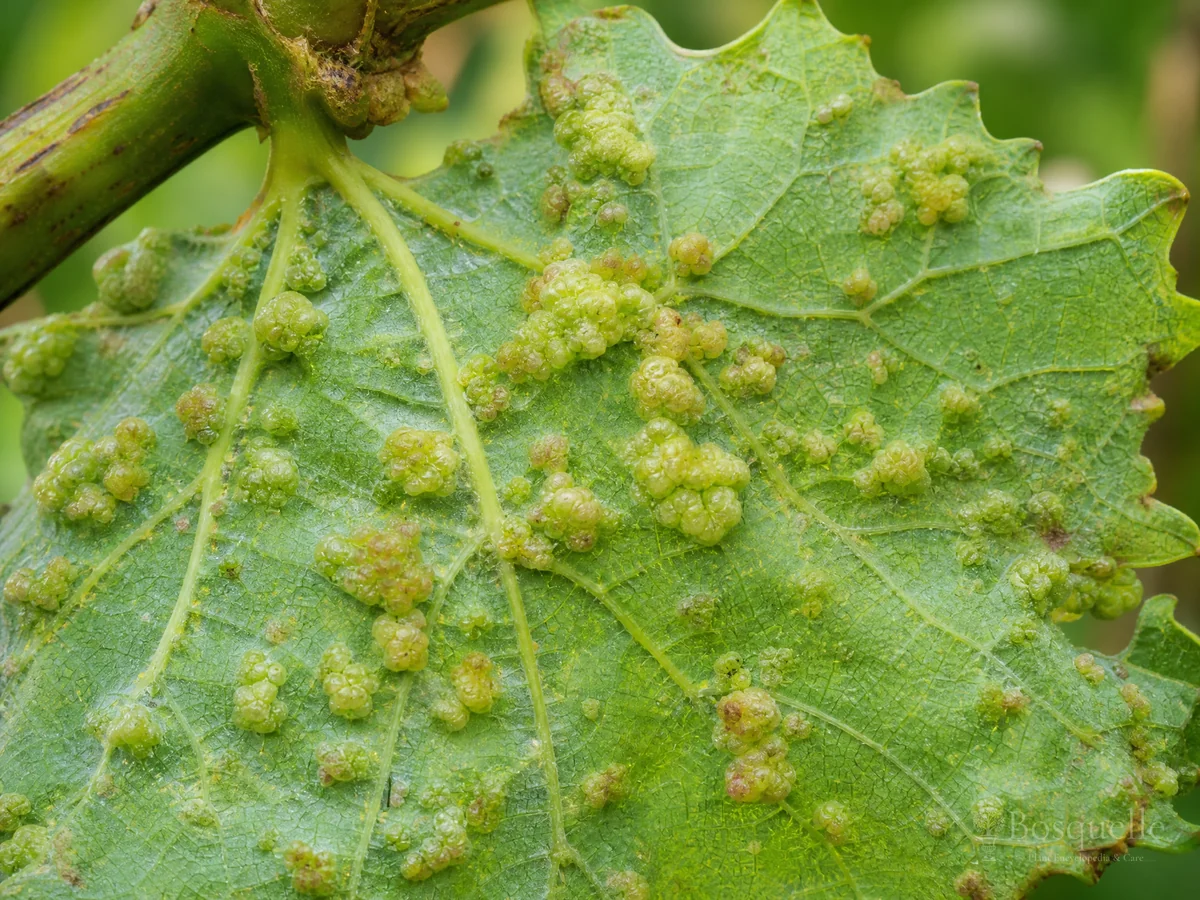
Cut a wart-like pouch on the underside of a grape leaf, and tiny yellow insects inside confirm grape phylloxera. People still say grape louse, then the real name: grape phylloxera, Daktulosphaira vitifoliae. It is an aphid-like insect without the two tail pipes aphids have, and the same species makes hollow galls on leaves in the East and feeds on roots wherever grapes grow. Pick the worst galled leaves if they are crowding the shoot, because a spray cannot reach insects already sealed in a gall, and it cannot reach the ones on the roots. American grapes such as Concord and Niagara usually live with both, so an own-rooted European wine grape that is shrinking and yellowing needs a vine grafted on American rootstock, not another bottle.
Pick the worst galled leaves; a spray will not reach the roots
Once the gall closes, the insect is inside a pocket of leaf, so a foliar spray stays on the outside, and root feeders stay in clay and cracks where a home bottle never arrives. This year's job on a backyard arbor is to confirm the gall, take off the worst leaves, and decide whether the vine is an American grape that can wait or an own-rooted vinifera that is already declining.
- Confirm. Flip a grape leaf with bumpy growth. The pouch sits on the underside, about a quarter inch across, and opens as a small pit on the upper surface. Slice one open. Yellow, pear-shaped insects and eggs inside are this species. A rash of tiny pits on expanding tips means crawlers are still walking onto new leaves.
- Pick leaves that are crowded with galls, curled, or already brown. Trash them. Do not home-compost a closed gall while insects are still inside, because crawlers walk out and climb the next shoot. You will not finish the insect by picking, but you take off the mothers that would fill the next flush of tips.
- Wait on Concord, Niagara, and most American or hybrid table grapes when the first galls show after the shoot already has a dozen leaves. Those late galls make the tips ugly and do not take the crop. Frontenac, Marquette, Aurore, and Foch gall the leaf harder. Treat those only if new leaves keep coming in covered, because a heavy summer of curled foliage can slow ripening and leave the vine thinner for winter.
- Spray only while crawlers are walking. Contact sprays and kaolin clay work before the gall closes, usually when shoots have about five to ten leaves and you can see yellow crawlers at the pits. Kaolin has to keep the new leaves white and needs a fresh pass after rain. A late-season spray on sealed galls wastes the bottle. Carbaryl does not finish this insect. The systemic that can move into a closed gall is a grower material, not a home first move. There is no home insecticide registered that reaches root populations.
- Replant an own-rooted European wine grape that is stunted, pale, and declining, after you have dug and seen hooked, swollen young roots with yellow insects on them. Buy a vine grafted on American rootstock with no vinifera in the roots. Insecticide will not reverse that decline. Sandy soil is a harder place for this pest to build; heavy, wet clay is where roots fail first.
Do not move soil, boots, or cuttings from a declining vine onto a clean planting. Crawlers ride those. Keep water and fertility steady on a vine you are keeping, because drought on damaged roots is what finishes Concord as well as vinifera.
How do I get rid of phylloxera on grapes?
Pick the worst galled leaves and trash them. Spray only while yellow crawlers are still walking onto new leaves. A spray will not reach insects already sealed in a gall or feeding on the roots. Own-rooted European wine grapes that are declining need a vine grafted on American rootstock.
Does insecticidal soap or neem kill phylloxera?
Not once the gall has closed. Soap and oil can hit crawlers that are still walking on new leaves if you wet those surfaces, and they do nothing to root feeders. Kaolin clay as a white barrier on young leaves is the usual home deterrent while crawlers are moving.
Will Sevin or a soil drench save the roots?
Carbaryl does not finish the leaf form. Home soil drenches do not reach every infested root. If an own-rooted vinifera is declining, replant on resistant rootstock. Skip the brand aisle as the plan.
Should I compost galled grape leaves?
Not in a home pile while the galls are still closed and yellow insects are inside. Trash those leaves. Hot municipal compost is a different job.
Cut a wart-like pouch: yellow insects sit inside
Grape phylloxera is easiest to name from the gall, not from the insect in your hand. Adults are about a twenty-fifth of an inch, oval to pear-shaped, bright yellow on a healthy young root or leaf, then brown or olive on a weak one. They have no cornicles, and winged adults that show up in late summer in the East are easy to miss. In the East, a fertilized egg winters under bark; the first female crawls to a young leaf, the leaf folds a pouch around her, and she fills it with eggs. Crawlers leave through the pit on the upper surface and walk to the next expanding tip. Several generations follow on new leaves. Some crawlers walk down into soil cracks and start on the roots, where they can cycle year after year even if you never see a leaf gall.
Root feeding bends young feeder roots into yellowish hooks and swellings. Older woody roots can swell too, then rot where fungi enter the wound. Dig near the trunk after a watering, once the topsoil is no longer mud, and use a hand lens in spring or late summer. A heavily infested root can look yellow from the insects themselves. Dead roots go black.
| Where you see it | What they are | Try this |
|---|---|---|
| Wart-like pouch on the leaf underside; pit on top; yellow insects inside | Leaf form of grape phylloxera | Pick crowded leaves; spray only while crawlers walk |
| Hooked, swollen young grape roots; yellow insects; vine pale and short | Root form of the same insect | American grapes often wait; own-rooted vinifera needs a grafted replant |
| Raised blister on the top of the leaf; felted white-to-brown hair underneath; no hollow pocket of insects | Grape erineum mite | Not this insect — sulfur for mildew often keeps mites down |
| Tiny yellow-to-brown spots on oak leaves, no grape galls | Oak leaf phylloxera, a different species | Oaks usually live; do not import a grape spray |
| Hard galls on pecan leaves, stems, or nuts | Pecan phylloxera, a different species | That is a pecan job, not this vine |
What does grape phylloxera look like?
The insect is tiny, yellow, and pear-shaped, about a twenty-fifth of an inch, with no tail pipes. You name it from the wart-like pouch on the leaf underside or from hooked, swollen young roots with yellow insects on them.
A felted blister is erineum mite, not this insect
Grape erineum mite, also called grape blister mite, raises a wart on the upper leaf surface and fills the dip underneath with a felt of enlarged hairs, first white, then yellow or brown. There is no hollow pouch and no yellow insect you can slice out with a knife. Sulfur used for powdery mildew usually keeps that mite down. Do not run a phylloxera crawler spray for felt.
Aphids cluster on soft tips and have two small tubes on the rear, and phylloxera does not. If the cotton sits in a houseplant joint, that is not this vine insect — see aphids. Skeletonized grape leaves are Japanese beetle, not a gall. A reddish sting and a worm inside the berry are grape berry moth. Do not pick fruit for a leaf gall, and do not treat leaf galls as a berry worm.
A woody tumor on the trunk is crown gall, not a leaf pouch. Knots on many garden roots with no yellow phylloxera are a nematode job — see root-knot nematode. In California, a vine that yellows and collapses without hooked yellow roots may be Pierce's disease instead. Dig before you assume the bottle missed.
Are the bumps on my grape leaves erineum mite?
Cut one. A hollow pouch with yellow insects is phylloxera. A blister with a felt of white-to-brown hairs underneath, and no insects you can slice out, is grape erineum mite. That mite is not this insect.
Is oak or pecan phylloxera the same insect?
No. Those are different species on oak or pecan. Grape phylloxera lives on grapes. Spots on oak leaves, or galls on pecan stems, are not a reason to spray the grape arbor.
Concord usually lives; own-rooted vinifera does not
Grape phylloxera is native in the East, and American grapes grew up with it. Concord and Niagara on their own roots take nodosities on small roots and usually keep cropping if water and fertility stay steady, because drought on those weakened roots is what cuts growth. Leaf galls on Concord are uncommon, while many French-American hybrids gall the leaf hard and still keep tolerable roots.
European wine grapes, Vitis vinifera, did not grow up with this insect. Root feeding on own-rooted vinifera can stunt the vine in a few years and kill it, faster in dry climates and in heavy soil that stays wet then cracks. A spray will not reverse that. The honest finish is a certified vine grafted onto American species roots such as Vitis riparia or Vitis rupestris crosses, with no vinifera parentage in the stock. In soil that already held a heavily infested vine, even a resistant stock can carry a few insects and start slow. Do not catalog rootstock numbers here; ask a nursery which resistant stock they sell for your soil.
Leaf galls that arrive late, after the canopy is already built, are looks. You do not pull a healthy Concord for bumpy tips. You do not wait on a shrinking own-rooted Cabernet or Chardonnay once hooked yellow roots are confirmed. California leaf galls are rare; the West Coast job is almost always the root.
Will phylloxera kill my grapevine?
Concord, Niagara, and most American table grapes usually live. Own-rooted European wine grapes can decline and die from root feeding, faster in heavy soil and drought. Leaf galls alone rarely kill a vine.
Related reading
- Grape berry moth — a worm in the berry, not a pouch on the leaf.
- Japanese beetle — lace-like grape leaves, no gall.
- Aphids — cornicles on soft tips, not a hollow leaf gall.
- Pierce's disease — a yellowing, collapsing vine without hooked yellow roots.
- Black rot — leaf spots and mummies, no yellow insects in a pouch.
- How to grow grapes — vine choice and grafting sit on the grow guide, not on this insect.
FAQ
Do phylloxera bite people or pets?
No. They feed on grape leaves and roots. They are not a biting fly and they do not live in houseplant mix.
Can I eat grapes from a vine with leaf galls?
Yes. The gall is on the leaf, not a poison in the fruit. Pick sound fruit. Skip clusters that are rotten for other reasons.
Related pests



Related diseases




Updated: Reviewed by Bosquelle Editors