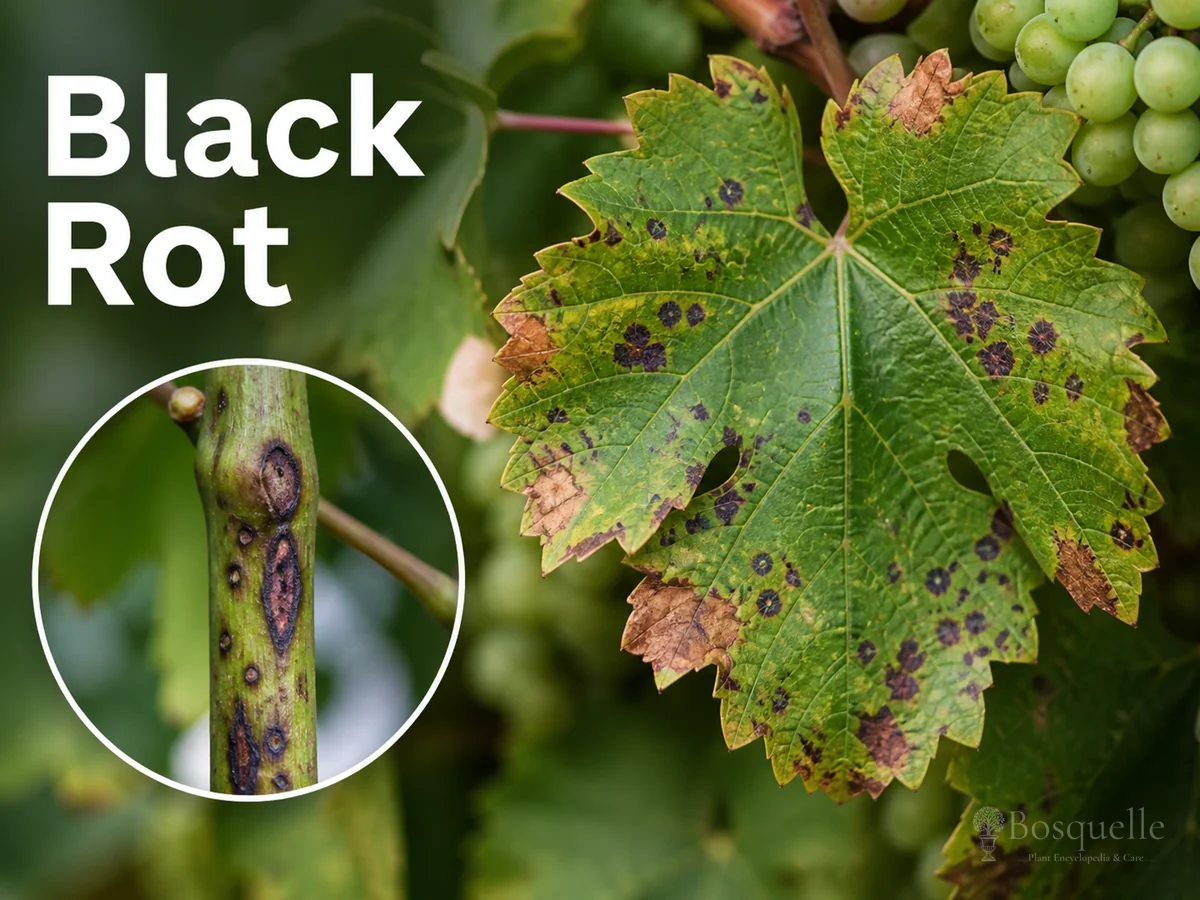
Grape black rot turns Himrod berries into hard black mummies that stay on the cluster. It is not tomato leftover and not the gray fuzz of Botrytis bunch rot. A spray will not rewind a mummy.
Do this first: pull every mummy off the trellis, then water the soil, not the leaves.
Hard mummies on the cluster, or tomato leftover
| What you see | Likely | Do this first |
|---|---|---|
| Hard black raisins still hanging on the cluster | Grape black rot | Pull mummies off the trellis |
| Gray fuzz and slip-skin on a tight bunch | Botrytis bunch rot | See Botrytis bunch rot |
| Soft brown berries near harvest; cracked basal canes | Phomopsis | See Phomopsis cane and leaf spot |
| Leathery black patch on a tomato blossom end | Blossom-end rot leftover | See blossom-end rot |
| Matchstick petioles and green islands | Pierce’s disease | See Pierce’s disease |
Gardenia’s all-crops dump is leftover. Walk the Himrod cluster.
Is this the same as tomato black rot?
No. Tomato leftover is a different job — often mixed with blossom-end rot. Hard grape mummies on the cluster are this job. See blossom-end rot if the tomato is leathery at the blossom end.
Tan leaf spots with black pimples in a ring
Young leaves take round tan spots with a darker rim. Black pimples sit in a ring inside the tan. Clusters can look fine until midsummer, then berries brown, blacken, and wrinkle into hard raisins. Walk the shaded, wet side of the vine after rain. Fail if you wait for a perfect photograph of a mummy before you stop overhead water. Two or three tan spots in June are the warning. Pull those leaves. Scout twice a week while nights stay humid. After a rain, flip the leaf and look for the ring of black pimples before you blame sun scald. Sun scald is bleached and dry; this spot holds moisture and specks. Two minutes with a hand lens beats a week of guessing. If Himrod is against a fence that never dries, thin one cane so morning sun hits the fruit. Fail if you wait until every berry is a raisin before you walk the leaves. A wet June on a shaded trellis will mummy a cluster that still looks green from the path.
How do I identify grape black rot?
Tan leaf spots with black pimples in a ring, then berries that shrivel into hard black raisins still hanging on the cluster. Soft gray fuzz is bunch rot.
Pull the mummies off the trellis
Mummies in the wires keep shooting spores all season. Floor mummies mostly finish by bloom. Tonight’s job is the raisins still clipped to last year’s stems. Bag them. Do not compost. Fail if you rake the ground and leave a necklace of raisins in the trellis. A winter walk under Himrod still shows last summer’s fruit — pull that before spring rain. In a small planting you can pick infected berries as they brown, before they harden. Bag those too. Fail if you drop mummies on the mulch and call it done — they still shoot. Two winters of raisins in the wires will keep bringing June spots even if you copper the leaves. A clean dormant prune that keeps fruiting wood without last year’s stems is the job. Walk the top wire; that is where home vines hide a necklace of raisins.
What are grape mummies?
Hard, wrinkled, blue-black berries that stay on the stem. They hold next year’s spores. Pull them off the trellis tonight.
Should I remove grape mummies?
Yes, especially those still in the wires. Floor mummies mostly finish by bloom. Canopy mummies keep shooting spores all summer.
A spray will not rewind a mummy
A hard raisin does not unkink. Wait while the vine is still full and only a few clusters are gone. Act on the wire tonight. Fail if you copper a collapsing cluster or leave it as next year’s source. Protect bloom next year. Skip the brand aisle.
Will a spray save infected berries?
No. A hard mummy does not unkink. Protect next year’s bloom. Fail if the bottle is the plan and last year’s raisins are still on the wire.
Should I pull the vine?
Wait. One bad cluster is not a funeral. Pull mummies. Pull the vine only if the plant is already weak and every cluster is a raisin two years running.
Bloom through four weeks — then the berry hardens
Fruit is open from bloom until about four to six weeks after. After that window the berry hardens to this fungus. Two to three wet weeks around bloom do more damage than an August bottle. Fail if you start a spray program in August when the raisins are already hard. Start next year at bloom, after the wire is clean. If last year was a mummy year, do not skip the bloom window even if May looks dry. One long wet spell at bloom is enough. Fail if you spray at veraison and leave June’s raisins. Two to three passes from first bloom through pea-size fruit beat a late panic. Keep the label honest: protectants need coverage before the rain, not after the berry is already brown.
When does fruit become resistant?
About four to six weeks after bloom. Protect from bloom through that window. After the berry hardens, this job moves to sanitation.
Shade and wet leaves feed it
A vine under trees stays wet. Open the canopy. Water the soil in the morning. Fail if a sprinkler hits the clusters every afternoon. A dry leaf at bedtime is worth more than a bottle. Thin a crowded planting so morning sun hits the fruit. Two wet nights in a row on a shaded fence will do more than a dry August. Fail if you mulch up the trunk and splash soil onto the lowest clusters. Keep fruit off wet ground. A morning walk after dew tells you whether the vine ever dries.
Himrod in a humid year
Himrod is the live vine here. A humid June will mummy a cluster that looked perfect in May. Keep the fruit off wet ground. Fail if you wait for a Concord row that is not in this bed. Two to three years of mummies in the wires will keep bringing the job back. Train the vine so clusters sit in moving air, not in a wet pocket against the house. Fail if you let a second crop of late laterals tangle through the fruit. A humid year on Himrod is this job even when the vine still looks vigorous. Water at the roots. Keep the fruit dry at night.
Not a harvest-soft Phomopsis berry
Phomopsis cracks basal canes in a wet spring. If it rots fruit, it is near harvest and soft. Hard mummies before the berries color are this job. Fail if you treat a June mummy as a September soft rot. Walk both jobs on the same vine: tan leaf spots now, then the cluster. Two diseases can sit on one Himrod in a wet year. Pull the raisins anyway. Cut bleached basal wood in winter for the other job.
Is this Phomopsis?
Phomopsis cracks basal canes in a wet spring. Its fruit rot, if it shows, is near harvest and soft. Hard mummies before the berries color are this job.
Pull the mummies — a bottle will not rewind a mummy
- Confirm hard black raisins on the cluster, not gray fuzz.
- Pull every mummy off the trellis. Bag them.
- Water the soil in the morning. Stay off the canopy.
- Open shade so clusters dry.
- Protect bloom next year. Skip the brand aisle. Fail if the bottle replaces a clean wire.
Does copper rewind a mummy?
No. Skip the brand aisle. Culture first: sun, air, pull the wire.
Related reading
- Botrytis bunch rot — gray fuzz and slip-skin, not a hard mummy.
- Phomopsis cane and leaf spot — cracked basal canes in a wet spring.
- Blossom-end rot — leathery tomato leftover, not a grape mummy.
- Pierce’s disease — matchstick petioles, not a cluster raisin from this fungus.
FAQ
Can I compost mummies?
No. Bag them. Do not compost. Fail if last year’s raisins feed this year’s clusters.
Do I need Concord to use this?
No. Himrod is the live vine here. Do not wait for a Concord planting that is not in this bed.
Will more water fix it?
Not on the leaves. Overhead water feeds the spots. Water the soil. Fail if a sprinkler hits the canopy every afternoon.
Host plants
A few garden examples linked on this site — open a plant for care context.

Related diseases




Related pests



Updated: Reviewed by Bosquelle Editors