
Choose Hebe by class first: a compact hardy mound, a landscape small-leaf shrub, or a tender variegated kind.
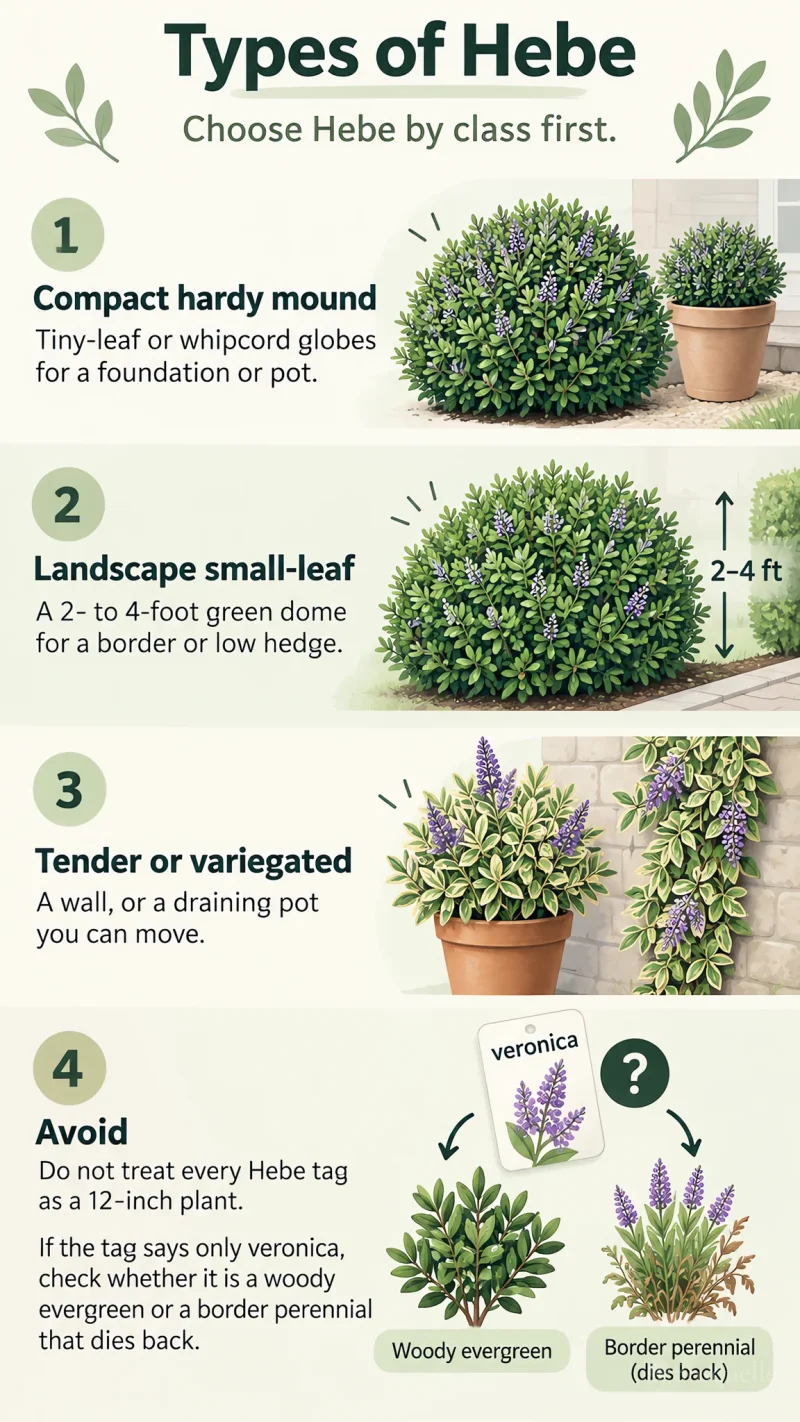
Choose a compact hardy mound, a landscape small-leaf shrub, or a tender variegated kind
| Factor | Recommended | Avoid |
|---|---|---|
| Compact hardy mound | Tiny-leaf or whipcord globes for a foundation or pot | Do not treat every Hebe tag as a 12-inch plant |
| Landscape small-leaf | A 2- to 4-foot green dome for a border or low hedge | Do not pick a cream-edged large leaf if you need a hard winter |
| Tender or variegated | A wall, or a draining pot you can move | Do not put speciosa or elliptica in an open, wet, windy bed |
| Leaf as a clue | Smaller leaf is usually hardier — not a guarantee | Do not buy Patty's Purple as a hardy boxleaf |
Know your USDA hardiness zone before you pick a type of hebe that will take your winter. Type your ZIP below.
2023 USDA ZIP listings (PRISM / USDA-ARS). Find Your USDA Hardiness Zone · Official USDA map.
Read leaf size and the mature width before you buy. Small-leaf mounds take a typical West Coast winter. Large-leaf and cream-edged kinds need shelter. [1] [2] Once you know the kind, site it on How to Grow Hebe. [3] [4] Herbaceous speedwell is a different plant — see How to Grow Speedwell.
What is the difference between small-leaf and large-leaf Hebe?
Smaller leaves are usually hardier. Large or heavily variegated leaves burn in a freeze. Patty's Purple is the exception — small leaves, still tender.
Which Hebe should I plant?
Pick a compact hardy mound, a landscape small-leaf shrub, or a tender variegated kind from the groups below. Do not treat every tag as a 12-inch plant.
Browse by kind
Compact hardy mounds
Emerald Gem is a tight 12-inch globe of tiny glossy leaves. Boughton Dome is a gray whipcord mound; Sutherlandii is the silver pinguifolia cushion. These are the hardy small-leaf class.
Landscape small-leaf shrubs
Rakaiensis is the usual 3-foot green dome — shrubby veronica. Topiaria and Vernicosa are the same small-leaf border habit, denser or glossier.
Tender and variegated kinds
Speciosa Variegata and Silver Queen are large or cream-edged leaves that burn in a hard freeze. Patty's Purple has small leaves and still burns in a sudden cold snap. Purple Shamrock, Heartbreaker, and Frozen Flame are foliage kinds for a wall or a pot you can move.
Pick by leaf class and the width on the tag, not by a shop list of extra names. Set the plant on Planting Hebe, and shape it after bloom on Pruning Hebe.
If the tag says only veronica, check whether it is a woody evergreen or a border perennial that dies back.
FAQ
Is Andersonii, Coed, or Western Hills in this list?
No. Those names are not cards here. They still follow the same leaf-and-hardiness split if the tag says Hebe.
Does Purple Shamrock flower much?
Often not. It is grown for cream and purple foliage, not a heavy flower spike.
Is Hebe the same as speedwell?
No. Speedwell dies back each winter. Hebe is a woody evergreen shrub from New Zealand.
Related guides


References
- [1] Oregon State University Horticulture -
https://horticulture.oregonstate.edu/hebe-landscape-evaluation - [2] Oregon State University Landscape Plants -
https://landscapeplants.oregonstate.edu/plants/hebe-emerald-gem - [3] Portland Nursery -
https://portlandnursery.com/plant-library/shrubs/hebe/ - [4] The Hebe Society -
https://www.hebesociety.org/faqs
This note is part of Hebe Guides.
More type comparisons by plant are gathered in Types of Plants Guides.
Updated: Reviewed by Bosquelle Editors