
Grow Hebe in full sun and soil that drains in winter. It is a New Zealand evergreen shrub — shrubby veronica — not the herbaceous speedwell sold as Veronica.

Give it full sun and soil that drains in winter
| Factor | Recommended | Avoid |
|---|---|---|
| Sun | Full sun; light afternoon shade in hot interiors | Do not site it in deep shade that makes it leggy and flowerless |
| Soil | Fast drain; a raised bed on heavy clay | Do not leave it in a low clay cup that stays wet all winter |
| Water | Even moisture the first season; then soak in dry spells | Do not leave a new ball bone-dry, or a winter crown in standing water |
| Feed | Skip extra fertilizer until roots have taken | Do not heap rich feed on wet ground |
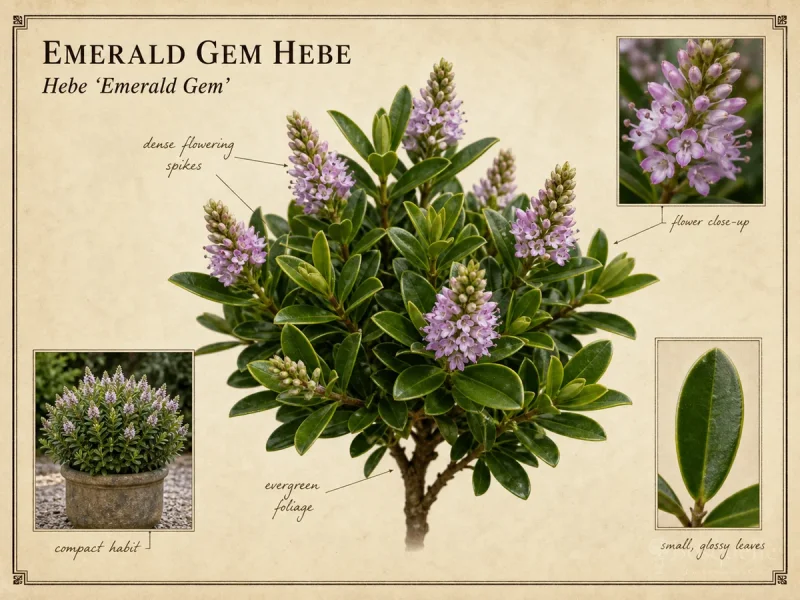
Hebe dies in shade and in waterlogged clay. Give it sun and a raised or gritty bed so winter rain can leave the roots. [1] [2] A small-leaf mound such as Emerald Gem or Rakaiensis wants that same drain. Match kind on Types of Hebe. [3]
Does Hebe need full sun?
Full sun. Light afternoon shade helps in hot interiors. Deep shade makes it leggy and cuts the flower show.
Water the first season, then soak in dry spells
A new plant needs water so roots leave the nursery ball. An established shrub takes missed rain better than a soggy winter crown — it is not a drought-proof shrub.
- Water thoroughly after planting. Keep the root ball moist — not soggy — through the first growing season.
- Check a few inches down. Water again when that soil is drying, not on a calendar splash.
- Once roots have taken, soak during dry spells, and in a dry freeze while the ground is still open.
- Do not leave the crown in standing water, especially from fall through spring.
How often do I water Hebe?
Keep a new plant moist for the first season. After that, soak during dry spells. Soggy soil around the roots in winter is the main reason the plant rots.
Set a new plant on Planting Hebe so the crown sits at the old soil line.
Shelter tender kinds from winter wind, or grow them in a pot you can move
Small-leaf kinds take a typical West Coast winter. Large-leaf and cream-edged kinds burn in an early freeze or a wet wind. Plant those against a wall, or keep a draining pot you can move.
- Read the leaf: tiny or whipcord leaves are the hardier class; large or heavily variegated leaves need shelter.
- Use a pot with a drainage hole and a potting mix that drains. Terra cotta helps extra water evaporate. [4]
- Water the pot in summer when the top inch is dry. Keep the mix drier in winter, and raise the pot so the hole stays open.
- Move tender kinds under cover in a hard freeze. Mulch two inches over in-ground roots, kept off the stems. Shape after bloom on Pruning Hebe.
Can I grow Hebe in a pot?
A compact kind can sit in a draining pot if you water it in summer and keep the mix drier in winter. Move tender kinds under cover in a hard freeze. Open ground that drains is the usual home.
Take summer cuttings if you want more plants
Stem cuttings can root, but buying a plant is the usual path. Take a 3- to 4-inch piece of this year's growth in summer, below a leaf joint.
- Cut a non-flowering shoot. Strip the lower pairs of leaves.
- Push the stem into gritty, moist mix — not soggy. A humidity cover helps if the air is dry.
- Keep it frost-free through winter. Pot it on in spring, and pinch the tip so it branches.
Can I start it from a cutting?
Yes, from a 3- to 4-inch summer cutting below a leaf joint. Keep the mix moist, not soggy. Buying a plant is still the usual path.
Not herbaceous speedwell
Speedwell is herbaceous Veronica — it dies back in winter and grows in a damper border. See How to Grow Speedwell. Hebe is a woody evergreen from New Zealand. Botanists now fold it into Veronica, but the shop still labels the shrub Hebe.
Is Hebe the same as speedwell?
No. Speedwell is herbaceous Veronica that dies back. Hebe is a woody evergreen shrub. The Latin now sits in Veronica, but the tag still says Hebe.
If tips brown after a freeze, cut back to live buds in spring — do not waterlog the crown to compensate.
FAQ
Can I use it as a low hedge?
A small-leaf landscape kind can make an informal low hedge. Shape after bloom. Read the mature width — a dwarf globe is not a screen.
Why is it called Hebe?
The name is the Greek goddess of youth. The garden plant is an evergreen New Zealand shrub, not that myth.
Why is my Hebe going brown in winter?
Winter-wet clay and an early freeze are the usual causes. Improve drain; shelter large-leaf and variegated kinds.
Can I cut the flowers?
You can snip a spike for a vase when the flowers are just opening. This is not a food crop.
Related guides


Recommended plants

References
- [1] Oregon State University Extension -
https://extension.oregonstate.edu/news/hebes-offer-long-lasting-color-pacific-northwest-gardens - [2] Portland Nursery -
https://portlandnursery.com/plant-library/shrubs/hebe/ - [3] Epic Gardening -
https://www.epicgardening.com/hebe/ - [4] Douglas County Master Gardeners -
https://www.douglascountymg.org/ask-a-master-gardener-hebes/
This note is part of Hebe Guides.
More first-season notes by plant are gathered in How to Grow Guides.
Updated: Reviewed by Bosquelle Editors