
Choose citrus by the fruit: lemon, sweet orange, lime, a mandarin, grapefruit, or a kumquat. Meyer is a lemon class, not a second plant.
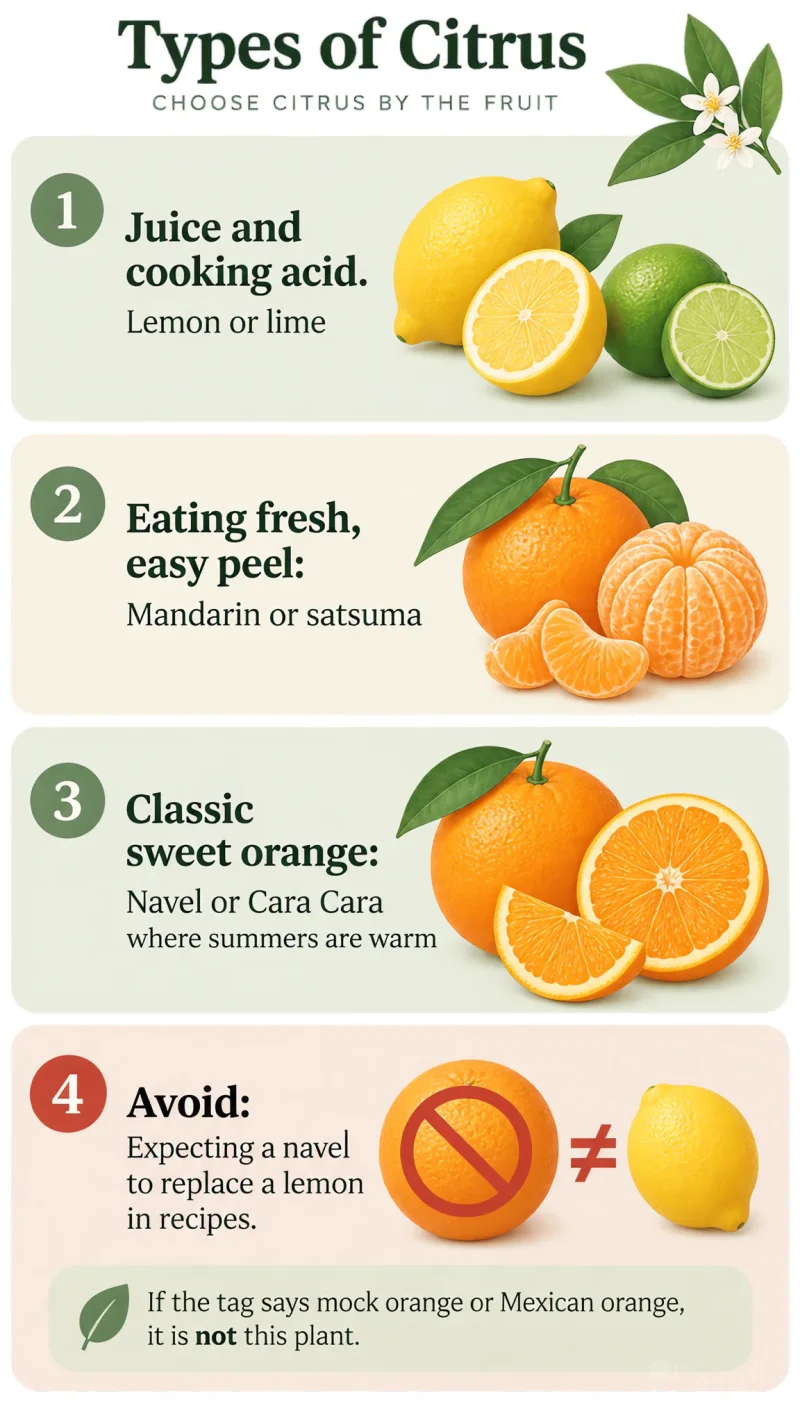
Choose lemon, orange, lime, or a mandarin
| Factor | Recommended | Avoid |
|---|---|---|
| Juice and cooking acid | Lemon or lime | Expecting a navel to replace a lemon in recipes |
| Eating fresh, easy peel | Mandarin or satsuma | A grapefruit tree in a tiny yard |
| Classic sweet orange | Navel or Cara Cara where summers are warm | A sweet orange in a cool, short summer with no extra heat |
| Small tree, edible peel | Kumquat or calamansi | Treating kumquat as a second genus |
Know your USDA hardiness zone before you pick a type of citrus that will take your winter. Type your ZIP below.
2023 USDA ZIP listings (PRISM / USDA-ARS). Find Your USDA Hardiness Zone · Official USDA map.
Read the fruit class on the tag, not only the cultivar name. [1] Lemons and limes are the acid group. Sweet oranges and grapefruit are the everyday eating group. Mandarins peel easy. Kumquat is eaten whole. [2] Oranges and grapefruit need more heat to sweeten than lemons and limes. [3] One tree sets fruit. A second cultivar nearby can improve set on some mandarins. [4]
What is the difference between Meyer and Eureka lemon?
Meyer is sweeter, thinner-skinned, and bushier. Eureka is the classic tart lemon and more frost-tender. Both are lemons, not oranges.
Do I need two citrus trees to get fruit?
Most citrus sets fruit alone. Some mandarins and tangelos crop better with a compatible neighbor.
Browse by kind
Lemons
Meyer lemon is sweeter and bushier than Eureka or Lisbon. True lemons are more frost-tender. Sun and drain stay on How to Grow Citrus.
Sweet oranges
navel orange is the usual eating orange. Cara Cara is a pink-fleshed navel. Blood orange needs cool nights for color. These need more heat than a lemon to sweeten.
Limes
Key lime is small, seedy, and very cold-tender. Persian lime is the seedless grocery lime. Thai lime is grown for leaves as well as fruit.
Mandarins and satsumas
satsuma peels easily and takes more cold than a lime. Clementine and Sumo sit here. Tangelo is a tangerine–grapefruit cross.
Grapefruit and pummelo
pomelo is the large parent. Forbidden Fruit is the grapefruit class we hold. One tree is usually enough.
Kumquat, calamansi, and specialty
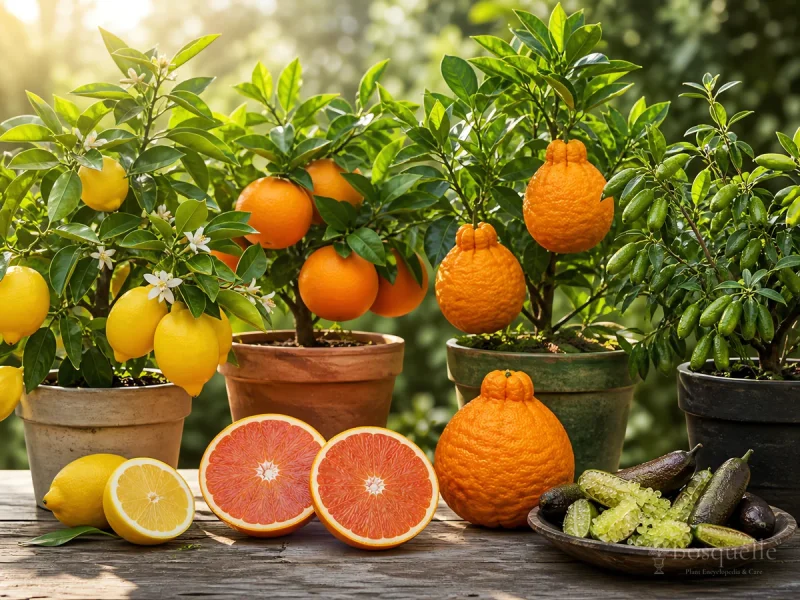
kumquat is eaten peel and all. Calamansi, yuzu, citron, Buddha’s Hand, and finger lime are the same keep-alive, different fruit. Limequat sits with this group.
Pick the group, then the cultivar. Extra shop names are not extra kinds. Hamlin, Valencia, Owari, and Nagami show up in other lists but are not cards here; treat a named sweet orange as the orange group, and a named satsuma as the mandarin group, if you grow one.
Is a kumquat a citrus?
Yes. It is this genus (once sold as Fortunella). Eat the peel. Same sun and drain as other citrus.
Not mock orange, not Mexican orange
Mock orange is Philadelphus. Mexican orange is Choisya. Orange jasmine is Murraya. None of those are a lemon or orange tree. See How to Grow Citrus for the lookalike list.
If the tag says mock orange or Mexican orange, it is not this plant.
FAQ
Is Meyer a true lemon?
Meyer is a lemon–mandarin hybrid sold as a lemon. Grow it with the lemon group. It is not a navel orange.
Is Dekopon a navel?
Sumo / Dekopon is a mandarin (reticulata), not a sweet orange. Browse it with mandarins.
Is finger lime grown like a lemon?
Same sun, drain, and frost split. The fruit is different. It is not a second keep-alive.
Related guides




References
- [1] University of Florida IFAS -
https://ask.ifas.ufl.edu/publication/HS132 - [2] University of Florida IFAS -
https://gardeningsolutions.ifas.ufl.edu/plants/edibles/fruits/citrus/ - [3] UC Master Gardeners of Santa Clara County -
https://ucanr.edu/site/uc-master-gardeners-santa-clara-county/growing-great-citrus - [4] Mississippi State University Extension -
https://extension.msstate.edu/publications/fruit-and-nut-review-citrus
This note is part of Citrus Guides.
More type comparisons by plant are gathered in Types of Plants Guides.
Updated: Reviewed by Bosquelle Editors