
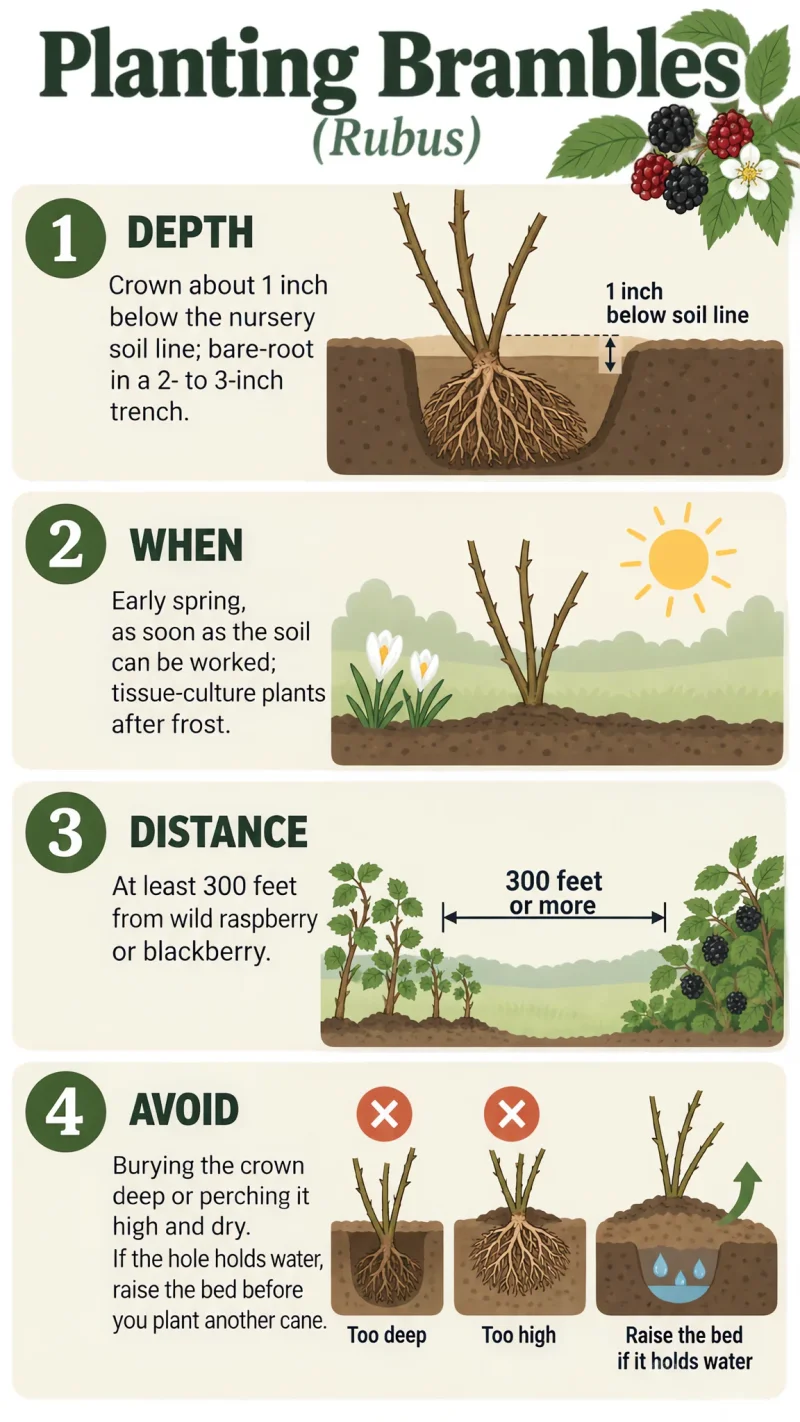
Plant brambles in early spring, at least 300 feet from wild canes, with the crown about an inch under the soil.
Plant in early spring, well away from wild brambles
| Factor | Recommended | Avoid |
|---|---|---|
| When | Early spring, as soon as the soil can be worked; tissue-culture plants after frost | Leaving bare roots to dry in sun and air |
| Distance | At least 300 feet from wild raspberry or blackberry | A row beside a fencerow of wild canes |
| Depth | Crown about 1 inch below the nursery soil line; bare-root in a 2- to 3-inch trench | Burying the crown deep or perching it high and dry |
| Space | Red raspberry about 2 feet; black raspberry about 3 feet; blackberry 3 to 4 feet; 8 feet between rows | A tight hedge you cannot pick or prune |
Wild canes carry viruses and rust. Certified nursery stock still catches them if you plant next to a fencerow thicket. [1] [2] Keep roots moist until they go in the ground. Site sun and drain stay on How to Grow Brambles. [3] [4]
How far from wild brambles should I plant?
At least 300 feet. Wild canes are a source of virus and rust.
How to plant brambles
Potted plants go in at the same depth they grew in the pot. Bare-root plants go in a shallow trench. Tissue-culture plants wait until after the last frost, because they may not yet take a freeze.
- Dig a hole or a shallow trench wide enough to spread the roots. Do not wad them.
- Set the crown about 1 inch below the old nursery soil line. For bare-root plants, lay roots in a 2- to 3-inch trench and cover.
- Cut off any old dead cane attached as a handle after new shoots start, unless the nursery already removed it.
- Firm the soil, water well, and mulch. Set the trellis posts now so you are not driving them through new roots later.
- Pick off flowers the first year so the crown can bulk up.
Tip-layer a black raspberry if you want another clump
In late summer, bend a first-year cane and bury the tip about two to four inches in loose soil. Leave it attached until spring, then cut it free and move the new plant. Do not take a sucker from a neighbor patch — that is how virus moves. Seed is slow and may not come true; start a home row from certified plants.
What fails at planting
A J-rooted cane in a wet hole rots. A row tight to wild brambles stays sick. Skipping the first-year flower pinch gives a tiny crop and a weak plant. Red raspberry will fill a hedge from root suckers; black raspberry will not, so give each clump its own space at plant-out.
How far apart do I plant raspberries?
About 2 feet for red raspberry, 3 feet for black raspberry, and 3 to 4 feet for blackberry, with about 8 feet between rows.
If the hole holds water, raise the bed before you plant another cane.
FAQ
Can I start blackberry from seed?
Home rows start from certified plants. Seed is slow and may not come true.
Can I move a sucker from a neighbor?
Do not. Neighbor patches often carry virus. Buy certified stock.
Should I fertilize at planting?
Water in well. Heavy feed at plant-out pushes weak, soft canes. Follow a soil test if the bed is poor.
Related guides



Recommended plants



References
- [1] University of Maryland Extension -
https://extension.umd.edu/resource/growing-raspberries-and-blackberries-home-garden - [2] NC State Extension -
https://content.ces.ncsu.edu/raspberries-in-the-home-garden - [3] Penn State Extension -
https://extension.psu.edu/brambles-in-the-home-fruit-planting - [4] University of Minnesota Extension -
https://extension.umn.edu/garden-and-home/yard-and-garden/gardening-in-minnesota/growing-raspberries-in-the-home-garden
This note is part of Rubus Guides.
More planting notes by plant are gathered in Planting Guides.
Updated: Reviewed by Bosquelle Editors