
Grow water pennywort in wet mud or shallow water, in full sun or part shade. Water pennywort is Hydrocotyle, also sold as dollarweed.
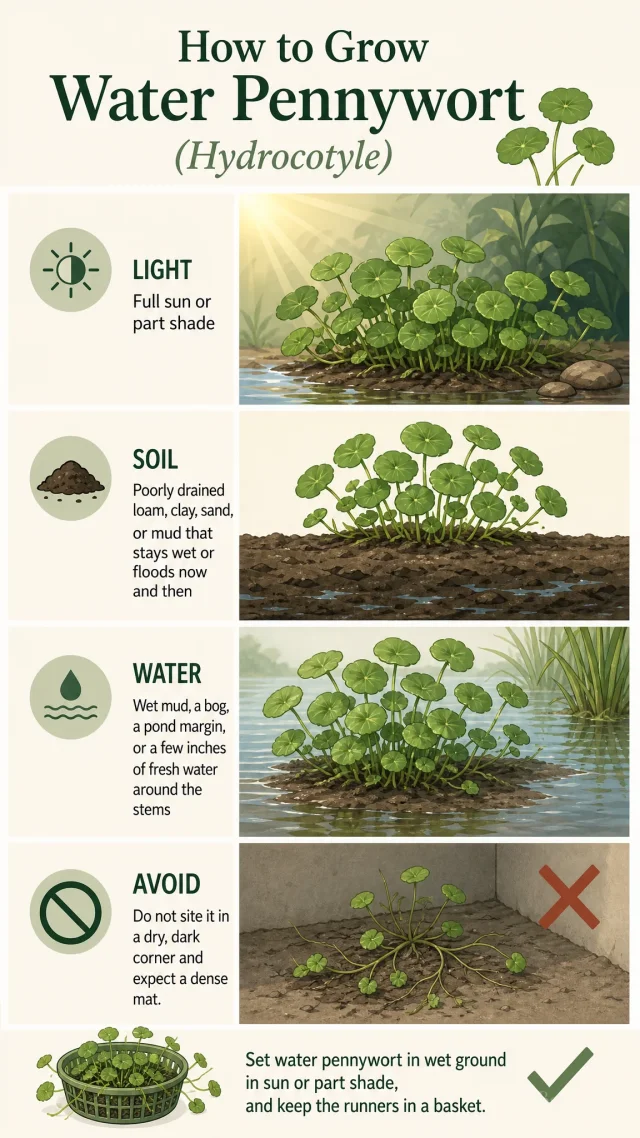
Keep the ground wet, in full sun or part shade
| Factor | Recommended | Avoid |
|---|---|---|
| Light | Full sun or part shade | Do not site it in a dry, dark corner and expect a dense mat |
| Water | Wet mud, a bog, a pond margin, or a few inches of fresh water around the stems | Do not let the ground dry, even once |
| Soil | Poorly drained loam, clay, sand, or mud that stays wet or floods now and then | Do not plant it in a mix that dries in a day |
| Spread | Keep runners in a pond basket so the colony stays on your shelf | Do not plant those runners loose in a small pond, and do not toss extras into a lake |
| Feed | Little fertilizer once the stems sit in wet mud | Do not dump nitrogen into a small pond and thicken algae |
Water pennywort wants wet ground in sun or part shade. Heat is fine; a dry week is not. Give it loam, clay, or sand that stays moist to wet along a pond, ditch, or bog, and the round leaves hold instead of going crisp. [1] manyflower marsh-pennywort uses that same wet site as a low mat, about three to ten inches tall, that can run several feet and even float. whorled marsh pennywort uses the same wet mud as a slightly taller colony, with flowers in stacked whorls instead of one umbel. Both plants share the same water. Neither one is a dry lawn or a windowsill succulent.
How much sun does water pennywort need?
Give it full sun or part shade. A dry, dark corner will not hold a dense mat.
How wet does it need to stay?
Keep the ground wet. Wet mud, a bog, or a few inches of fresh water around the stems is the home. A dry week crisps the leaves.
Plant at the waterline, no deeper than about four inches
Set the crown at the same depth it grew in the pot. A pond basket of heavy loam keeps the runners on the shelf; light potting mix floats and then dries. You can also plant into wet mud at the pond edge. Water over the roots should stay shallow — about four inches is plenty. [2] Deeper water can lift a mat free so it drifts. Keep extras out of a lake or storm drain.
- Plant into wet mud, a bog, or a pond shelf once the water will stay up.
- Set the crown at the same depth it grew in the pot. Use a mesh pond basket and heavy loam or clay, not a light mix that floats.
- Set the basket at the waterline, or under no more than about four inches of water.
- Give manyflower room to run, or keep it in the basket. Do not dump extras in a lake.
How deep do I plant it?
Set the crown at the same depth it grew in the pot, at the waterline or under about four inches of water. A dry hanging-basket mix is not the home.
Thin the mats, and never dump extras in a lake
The runners root wherever they touch wet mud, and floating mats can cover a small pond. Dense cover can cut the oxygen in the water, so lift what leaves the basket before it fills the shelf. [3] In a hard freeze the top may brown; new leaves come from the runners in spring if the mud stayed wet. Compost extras on dry ground. Never toss them into a lake, ditch, or storm drain, because a scrap will root.
- Lift runners that leave the basket or the wet bed as soon as they wander.
- Cut dense floating mats so they do not cover the whole pond.
- Compost extras on dry ground. Do not dump them in a lake or storm drain.
Will it take over a small pond?
Yes, if you plant it loose. Keep the runners in a pond basket, thin mats that cover the water, and never dump extras in a lake.
Split a rooted runner in spring
Most gardeners start a new patch from a rooted runner, not from seed. Lift a piece in spring while the soil is wet, and reset it at the waterline.
- Lift a rooted runner in spring while the mud is wet and workable.
- Cut a piece that has roots and at least one leaf.
- Replant at the waterline in wet mud or a fresh basket of heavy loam, and keep the new piece wet while it takes.
Not dichondra — and not a Chinese money plant or gotu kola
A round green leaf in wet turf is often this plant, but dichondra is a different mat. Dichondra has a kidney-shaped leaf with the stem at the notch, not in the center — see How to Grow Dichondra. [4]
A shop tag that says money plant is often the Chinese money plant, Pilea, a dry indoor plant — see How to Grow Chinese Money Plant. Navelwort on a woodland tag is Omphalodes — see How to Grow Omphalodes. Creeping jenny is Lysimachia — see How to Grow Lysimachia. Gotu kola is Centella, the plant people eat and brew; water pennywort leaves can cause nausea, so do not treat this as a salad green.
Is this the same as dichondra?
No. Dichondra has a kidney-shaped leaf with the stem at the notch. Water pennywort has a round leaf with the stem in the center.
Is this a Chinese money plant?
No. The Chinese money plant is Pilea, a dry indoor plant. Water pennywort is Hydrocotyle for wet mud and shallow water.
Set water pennywort in wet ground in sun or part shade, and keep the runners in a basket.
FAQ
Is whorled marsh pennywort a different plant?
Whorled marsh pennywort is Hydrocotyle verticillata, the kind with flowers in stacked whorls. Use the same wet soil. Manyflower marsh-pennywort is Hydrocotyle umbellata, the wider-running mat.
Can I grow water pennywort in a pot?
Yes, if the mix stays wet. Stand the pot in a tray of water, or set a pond basket on a shelf. A mix that dries in a day crisps the leaves.
Is this Brazilian pennywort for an aquarium?
Aquarium shops often sell Brazilian pennywort, Hydrocotyle leucocephala, which is not manyflower or whorled marsh pennywort. Pond and bog culture outdoors is the usual garden job for those two.
Can I grow it from seed?
Seed is possible, but most gardeners plant a rooted runner. Keep the new piece wet at the waterline.
Does water pennywort come back after winter?
In a frost-free winter the leaves can stay green. After a hard freeze the top browns, and new leaves come from the runners in spring if the mud stayed wet.
If it is in the lawn, what do I do?
It is telling you the turf stays too wet. Cut back on watering and fix the low spot so the lawn can dry between soakings. Do not spray a pond patch you meant to keep.
Can I eat the leaves?
Do not eat them. The leaves can cause nausea. Gotu kola is Centella, a different plant. Do not treat a ditch scrap as a salad green.
Is navelwort the same plant?
Navelwort on a woodland tag is usually Omphalodes. Water pennywort is Hydrocotyle for wet mud. Read the Latin on the tag.
Recommended plants


References
- [1] NC State Extension Gardener -
https://plants.ces.ncsu.edu/plants/hydrocotyle-umbellata/ - [2] Lady Bird Johnson Wildflower Center -
https://www.wildflower.org/plants/result.php?id_plant=HYUM - [3] Texas A&M AgriLife AquaPlant -
https://aquaplant.tamu.edu/plant-identification/alphabetical-index/water-pennywort/ - [4] Clemson Home & Garden Information Center -
https://hgic.clemson.edu/factsheet/dollarweed/
More first-season notes by plant are gathered in How to Grow Guides.
Updated: Reviewed by Bosquelle Editors