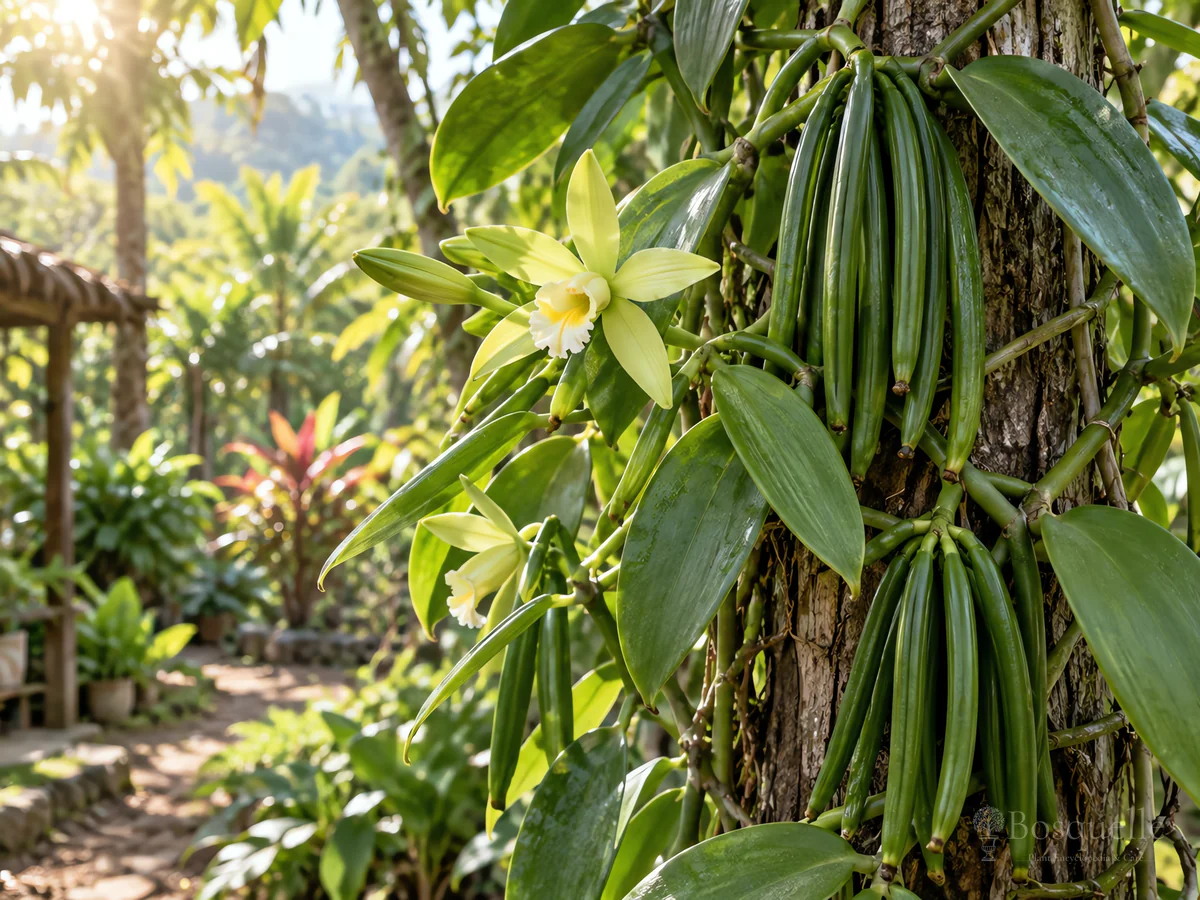
Grow vanilla warm and humid, in bright shade, on a support. Vanilla is Vanilla planifolia, also sold as vanilla orchid. It is not a grocery moth orchid.
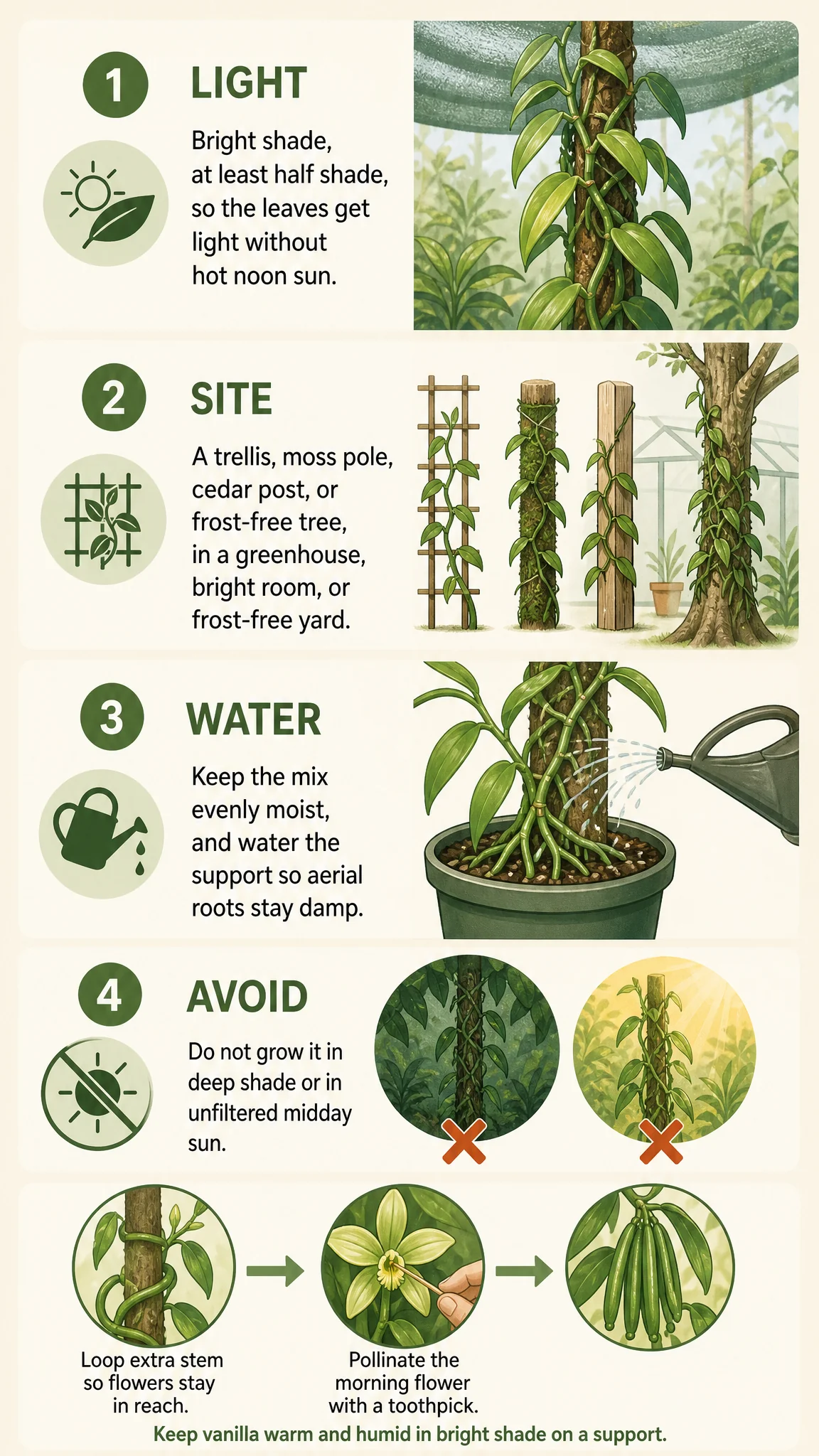
Keep it warm, humid, and in bright shade on a support
| Factor | Recommended | Avoid |
|---|---|---|
| Light | Bright shade, at least half shade, so the leaves get light without hot noon sun | Do not grow it in deep shade or in unfiltered midday sun |
| Temperature | Days in the 70s to 90s F, and keep the vine above about 64 F | Do not leave it out in a freeze |
| Water | Keep the mix evenly moist, and water the support so aerial roots stay damp | Do not sit the roots in a soggy pot |
| Site | A trellis, moss pole, cedar post, or frost-free tree, in a greenhouse, bright room, or frost-free yard | Do not grow it as a compact windowsill moth orchid without a climb |
vanilla is a climbing orchid vine. Day temperatures in the 70s to 90s F keep new growth coming, and high humidity helps the aerial roots cling. [1] Cold below about 64 F can burn the tips or kill the plant, so a greenhouse, a frost-free porch, or a bright indoor room is the usual home outside a tropical yard. [2] Give it at least half shade. Bright light is fine; hot noon sun scorches the thick leaves, and deep shade stalls the vine. Water the mix and the support, then let the mix dry a little before the next watering so the roots do not rot. [3] A drier stretch in winter can help it set flower later, but the vine itself should not freeze. Bring it in before a cold night.
How to grow vanilla?
Keep it warm and humid in bright shade on a support. Water the mix and the support, and do not let the roots sit wet.
Does vanilla need full sun?
No. Give it bright shade, at least half shade. Hot noon sun burns the leaves, and deep shade slows the vine.
Can vanilla stay outside in winter?
Only where nights stay above about 64 F. If a freeze is coming, move the pot into a warm, bright room.
Set one node in a draining mix, and loop the vine as it grows
Shop plants arrive as a rooted vine in a pot. Use orchid bark, sphagnum, coco chips, or a similar mix that drains, in a pot with a hole, or a mulch bed in frost-free ground. Keep one node in contact with the mix. Tie the rest of the stem to a support so aerial roots can cling. As the vine lengthens, loop extra stem back toward the mix so later flowers stay in reach and more ground roots can form. [4] Do not bury the whole stem.
- Choose a pot with a drainage hole, or a mulch bed that never stands in water.
- Fill with orchid bark, sphagnum, coco chips, or a similar draining mix. Do not pack it like garden soil.
- Set one node against the mix. Leave the rest of the vine in the air on a support.
- Tie the stem loosely to a trellis, moss pole, cedar post, or tree as it climbs.
- Loop extra length back down toward the mix so flowers stay in reach. Water the mix and the support after you set it.
How do I plant a vanilla vine?
Set one node in a draining mix, and tie the rest to a support. Loop extra stem so later flowers stay in reach.
Hand-pollinate the morning flower with a toothpick
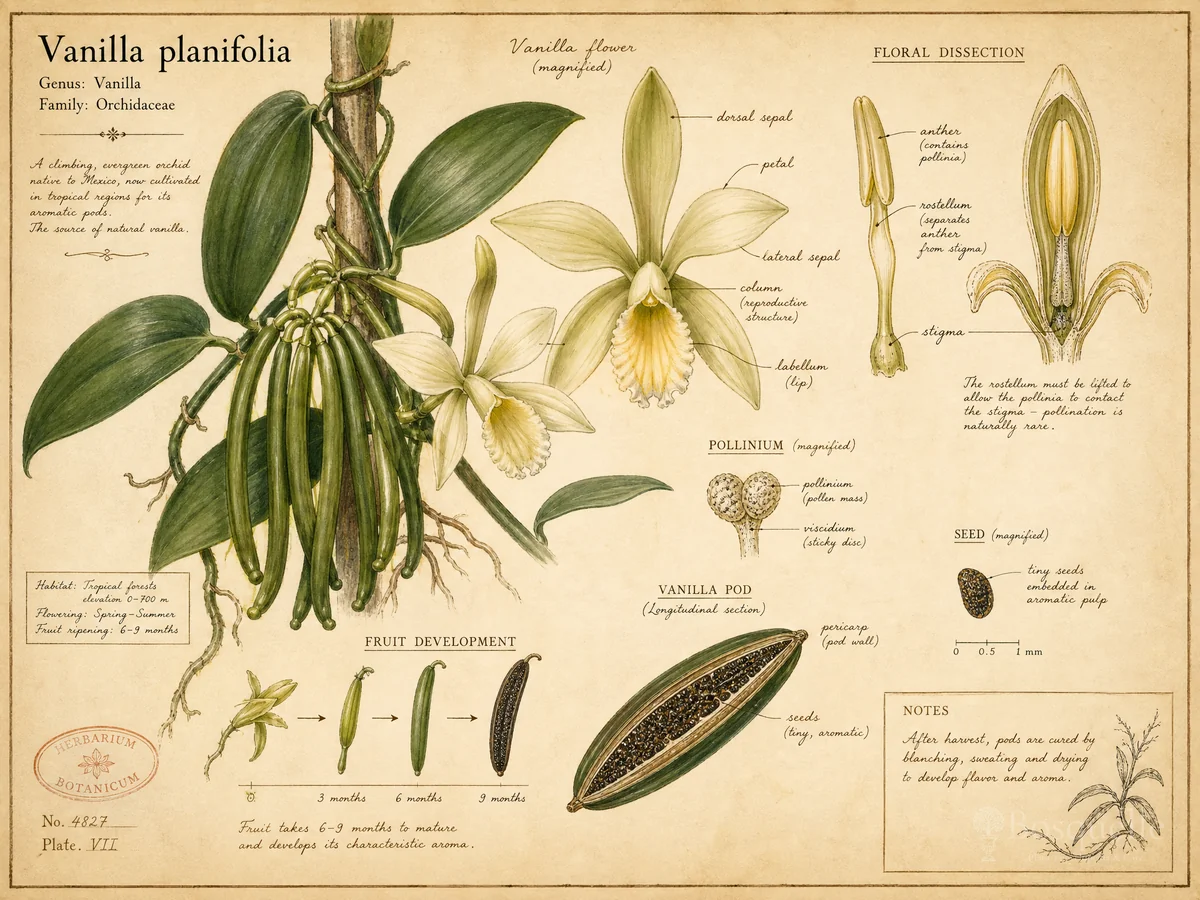
The vine usually flowers after two to four years, once it has some length on a support. Each flower opens in the morning and lasts one day. Native bees rarely do the job in a U.S. garden, so you pollinate by hand. In the morning, open the lip, lift the flap called the rostellum with a toothpick, and press the pollen onto the stigma. If it took, the flower stays and the ovary swells. If it missed, the flower drops in two or three days. Set only about nine or ten beans on a cluster so the vine is not overloaded. Beans take months to ripen; picking and curing live on Harvesting Vanilla.
- Check the vine each morning in bloom season. One flower, sometimes two or three, opens at a time.
- Fold or tear the lip so you can see the column, the pollen, and the flap between them.
- Lift that flap, the rostellum, with a toothpick.
- Press the pollen onto the stigma, then let the flap fall back.
- Watch for two or three days. A flower that holds and swells at the base has set a bean. A flower that drops did not take.
- Stop at about nine or ten beans on one cluster so the vine can finish them.
How do I pollinate vanilla?
In the morning, lift the rostellum with a toothpick and press the pollen onto the stigma. The flower lasts one day.
Not a moth orchid — and not Vanilla Strawberry hydrangea
A grocery moth orchid is How to Grow Phalaenopsis. It is a compact plant with a flower spike, not a climbing vine that makes beans. Vanilla Strawberry is a panicle hydrangea on How to Grow Hydrangeas. Vanilla cactus is a night-blooming Selenicereus on How to Grow Dragon Fruit. Ice cream banana, sometimes sold as vanilla banana, is How to Grow Banana. Coconut orchid is a different genus on How to Grow Coconut Orchid.
Is vanilla a moth orchid?
No. Vanilla is a climbing orchid vine. A grocery moth orchid is Phalaenopsis, a compact plant grown for sprays of bloom.
Keep vanilla warm and humid in bright shade on a support, loop extra stem so flowers stay in reach, and pollinate the morning flower with a toothpick.
FAQ
Can I grow vanilla from grocery beans or seed?
No. Grocery beans are cured fruit, and the dust-like seed needs lab conditions. Start with a vine or a stem cutting.
Is variegated vanilla a different plant?
No. The cream-striped vine is still Vanilla planifolia, grown for the leaves. It uses the same warmth, shade, and support.
Will it flower in a house?
It can, once the vine has some length on a support, often after two to four years. Warmth, bright shade, and a drier winter stretch help it set buds.
Related guides

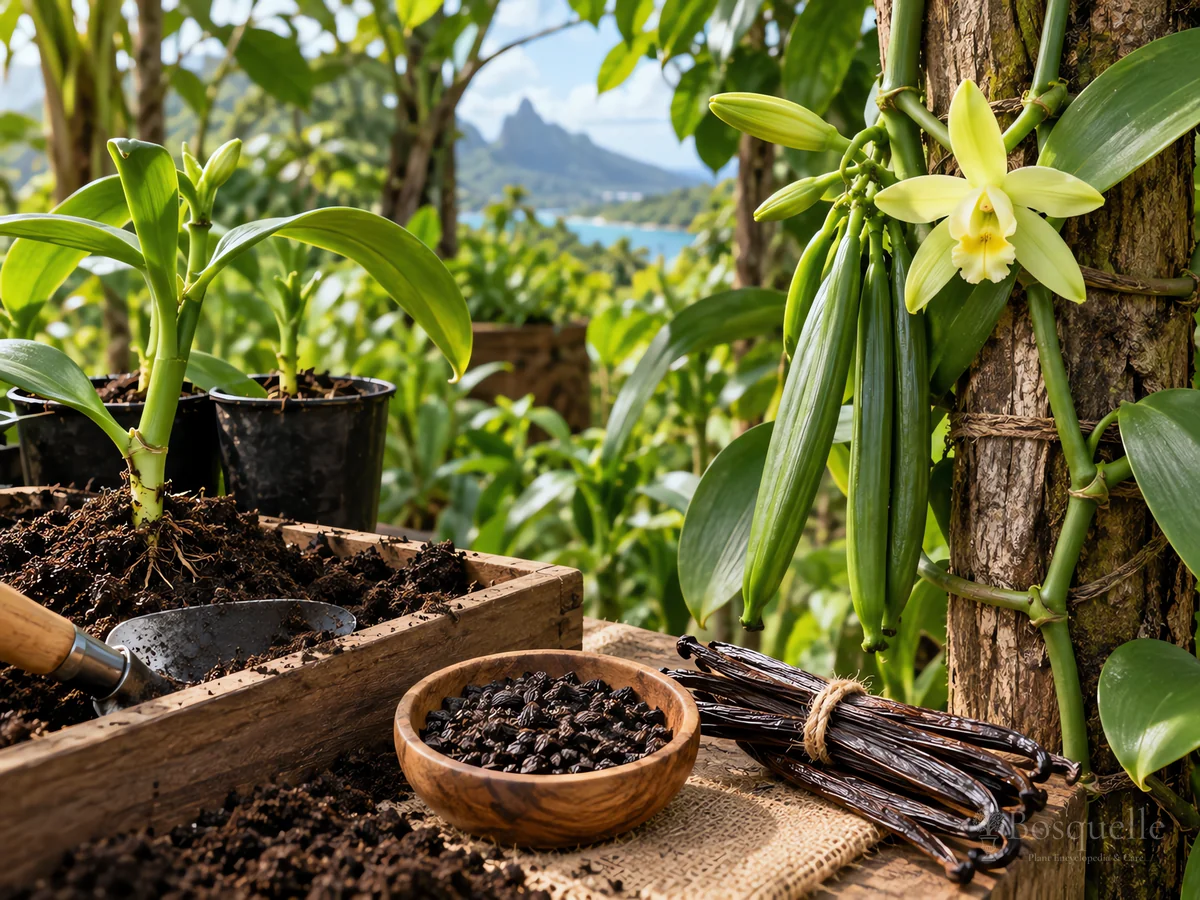
Recommended plants
References
- [1] UF/IFAS Extension Hillsborough County -
https://blogs.ifas.ufl.edu/hillsboroughco/2026/09/03/growing-vanilla-in-the-home-garden/ - [2] UF/IFAS Extension Miami-Dade County -
https://blogs.ifas.ufl.edu/miamidadeco/2025/07/01/fundamentals-in-growing-vanilla-as-a-cash-crop-part-i-what-and-where-to-grow/ - [3] Logee's Plants -
https://www.logees.com/grow_vanilla - [4] UF/IFAS EDIS -
https://ask.ifas.ufl.edu/publication/HS1348
This note is part of Vanilla Guides.
More first-season notes by plant are gathered in How to Grow Guides.
Updated: Reviewed by Bosquelle Editors