
Grow Texas sacahuista in full sun on soil that drains. Texas sacahuista is Nolina texana, also sold as Texas beargrass — a grass-like evergreen clump, not a yucca and not a ponytail palm.
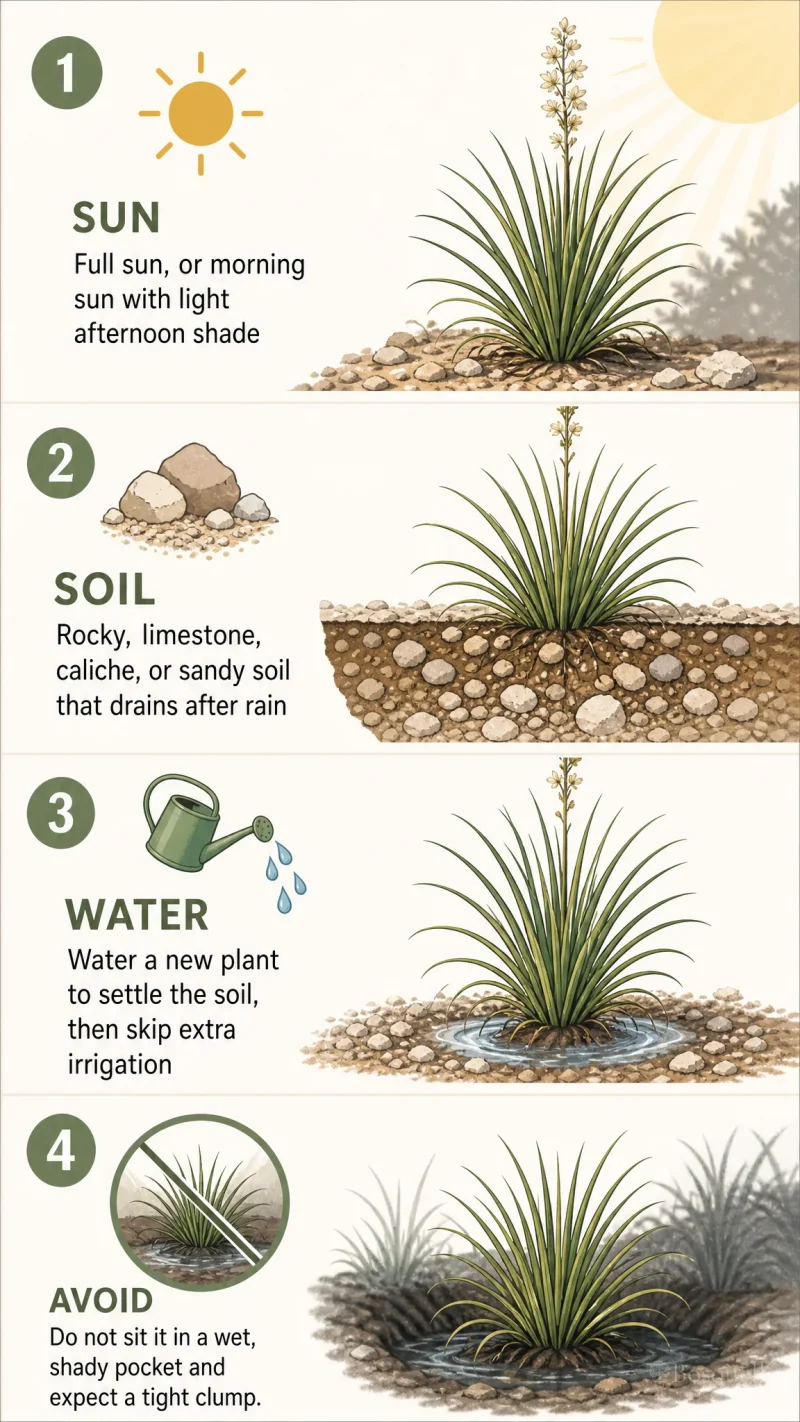
Give it full sun and soil that drains
| Factor | Recommended | Avoid |
|---|---|---|
| Sun | Full sun, or morning sun with light afternoon shade | Do not sit it in a wet, shady pocket and expect a tight clump |
| Soil | Rocky, limestone, caliche, or sandy soil that drains after rain | Do not plant it in a low hole that stays wet |
| Water | Water a new plant to settle the soil, then skip extra irrigation | Do not keep the crown wet on a timer |
| Deer | Deer usually leave the clump | Do not plant it as forage for livestock |
| Winter | Leave it in the bed; it stays evergreen | Do not lift it like a tender houseplant |
Texas sacahuista is an evergreen mound of long, wiry leaves on a woody base that sits mostly underground. It is not a true grass. Grow it in sun on soil that drains, and skip extra water once the roots take. [1] Rock, decomposed granite, clay, or caliche is fine when water runs through. Give a little extra water only in a long, baked summer. [2]
- Set it in full sun. Light afternoon shade is fine; a wet, shady pocket makes a loose clump.
- Use soil that drains after rain. A gravel bed or a limestone slope is the usual site.
- Water once to settle a new plant, then skip the irrigation clock. Established clumps live on rainfall in a dry garden.
How much sun does Texas sacahuista need?
Full sun, or morning sun with light afternoon shade. A wet, shady pocket makes a loose clump.
How often should I water it?
Water a new plant to settle the soil, then skip extra irrigation. Add a deep soak only in a long, baked summer.
Plant it high, on a slope or in gravel
Set the clump where water runs off, not where it pools. A slope, a gravel bed, or the face of a retaining wall is the usual site, and it helps hold soil on a bank. [3] The woody stems sit mostly underground, so match the nursery depth and do not bury the crown in a wet hole. [4]
- Choose a slope, a gravel bed, or a wall that drains. Keep the clump a few feet off a walk, because the leaf edges can cut.
- Knock it from the nursery pot and set the crown at the same depth. Do not bury the woody base.
- Backfill with the native soil if it drains. Mix in gravel if the hole holds water after rain.
- Water once to settle. Then skip extra irrigation unless the plant is a fresh offshoot you just moved.
- Leave about three feet for the clump to spread. Leaves may reach four feet even when the mound stays about two feet tall.
Can I grow it in a pot?
Yes, in a pot with a hole and a gritty mix, set in full sun. Empty the saucer. It is a dry-garden plant, not a dim indoor plant.
Cut the spent flower stalk inside the clump
Cream flowers sit down in the leaves in spring and early summer, so the stalk is easy to miss until it is in bloom. After the flowers fade, reach into the clump and cut that stalk as close to the base as you can. Leave it if you want seed or insects.
- After bloom, follow the stalk into the leaves and cut it at the base.
- Leave the stalk if you want capsules for seed, or if you want insects on the old flowers.
- Do not mow or skin the green leaves. Snip only a leaf that hangs into a walk.
- To thin a crowded clump, take a rooted section in winter — see How to Propagate Texas Sacahuista.
Do I cut the flower stalk?
Cut it at the base after bloom if you want a tidy clump. Leave it if you want seed or insects. Do not mow the green leaves.
Not a yucca — and not a ponytail palm
Yucca is a stiffer plant, often with a trunk, and the flower stalk stands well above the leaves. See How to Grow Yucca if that is the tag you bought.
Desert spoon, or sotol, is Dasylirion. The leaves are broader, with sharp teeth, and the bloom spike rises high. See How to Grow Desert Spoon if the leaf margins feel like a saw.
Ponytail palm is Beaucarnea recurvata, still sold as Nolina recurvata. It has a swollen base and a tuft of strap leaves, and it is a houseplant in most of the country. See How to Grow Ponytail Palm if the pot has a fat caudex. Pacific Northwest beargrass is Xerophyllum, a mountain plant with a tall white plume — not this Texas clump.
Is this a yucca?
No. Yucca holds a stiffer rosette, and the flower stalk stands above the leaves. Texas sacahuista blooms down in the clump.
Is this a ponytail palm?
No. Ponytail palm is Beaucarnea, with a swollen base. Texas sacahuista is a stemless clump for a dry bed.
Is Texas beargrass a different plant?
No. Texas beargrass is Texas sacahuista. It is not the Pacific Northwest beargrass sold as Xerophyllum.
Set the next clump in sun on soil that drains, water once to settle, and cut the spent stalk inside the leaves after bloom.
FAQ
Is blue nolina or devil's shoestring the same plant?
No. Blue nolina is a trunked Mexican plant. Devil's shoestring holds a taller flower spike above the leaves. The shop card here is the stemless Texas clump.
Is basket grass a different plant?
No. Basket grass is another shop name for Texas sacahuista. The leaves have been used for baskets; that is history, not a harvest job.
Will deer eat it?
Deer usually leave the clump. Do not count on it as forage. Flowers and seeds poison cattle, sheep, and goats, so keep livestock off the bloom.
Do I need to feed it?
No. Skip extra fertilizer. Rich, wet soil is why the crown rots.
What else likes this sun and drain?
Other dry-garden plants that want sun and gravel. Do not pair it with a lawn sprinkler bed.
Related guides

Recommended plants

References
- [1] Lady Bird Johnson Wildflower Center -
https://www.wildflower.org/plants/result.php?id_plant=NOTE - [2] Central Texas Gardener -
https://www.centraltexasgardener.org/resource/nolina/ - [3] City of Austin Grow Green -
https://www.austintexas.gov/department/grow-green/plant-guide/basket-grass - [4] Texas A&M AgriLife Extension -
https://rangeplants.tamu.edu/plant/sacahuista/
This note is part of Nolina Guides.
More first-season notes by plant are gathered in How to Grow Guides.
Updated: Reviewed by Bosquelle Editors